
Table Of Contents
- Part 1: Top Policy-Backed Megatrends (2026 Budget Winners)
- 1. Electronics Manufacturing
- 2. Renewables & Solar Panels
- 3. Agro-Processing: Tapping Into Smart Export Opportunities
- 4. Digital Services And SaaS: 2047 Tax Holiday
- 5. Biopharma & Healthcare: The SHAKTI Scheme
- 6. Logistics Infrastructure: Cutting Down India’s Logistical Costs
- The 4-Part Structure For Traditional And Digital Winners
- 1. IT & Enterprise SaaS
- 2. Online Coaching & Education
- 3. Content Creation Hubs
- 4. Real Estate Consulting
- 5. Cloud Kitchens
- 6. Pharma & Medicine Distribution
- The 2026 Entrepreneur Launch Checklist
- 1. Business Legal Structure & Setup
- 2. Mandatory Government Registrations
- 3. Industry-Specific Licenses
- 4. Digital Foundations
- Stop Planning, Start Executing
The Blueprint Of Profit: Which Business Is Most Profitable In India To Start In 2026
If you are an aspiring entrepreneur or an investor currently searching for a business opportunity in India, the first thing to know is that you are in the right place at the right time.
However, there is a catch that you must know about before you spend a single rupee on your business idea.
The business plans and strategies that worked for people three or four years ago are now obsolete.
Moreover, if you try to implement them in 2026, you will see little or no profit due to high customer acquisition costs, tough competition, and poor cash flow management.
So, which business is most profitable in India? What is the way forward? How can you design a business plan that has a high possibility of reaping rich profits?
Well, if you want to make India your profit centre, you must follow the money trail.
A business that fits into the government’s agenda has a higher chance of securing budget allocation, tax holidays, and easy credit lines from the government.
You no longer have to navigate through the murky waters of the business world alone.
Instead, you can leverage the massive opportunities that come with government tenders and contracts.
In this guide, we will look at the most profitable business opportunities in India.
We will also highlight the lucrative trends forecasted from the latest Union Budget and examine a 12-sector profitability matrix to help you get your share of the cake.
Part 1: Top Policy-Backed Megatrends (2026 Budget Winners)
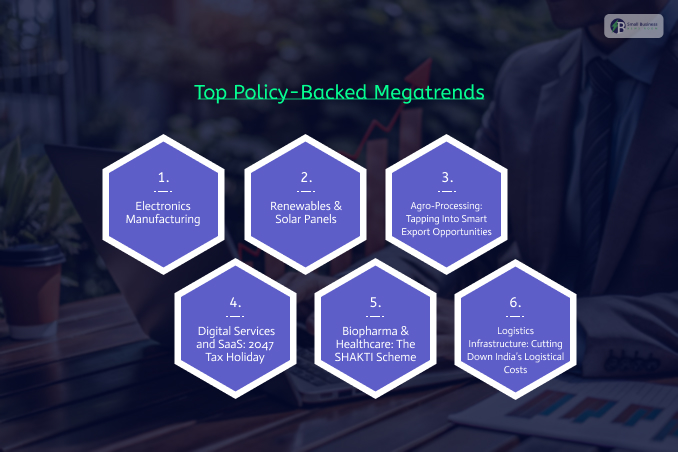
The latest government budget disclosures allow one to quickly identify the safest areas for investment growth. Backed by policy, these directions offer the best protection for investors.
1. Electronics Manufacturing
Description: Creation of mini-industrial parks for the production of high-tech electronics and optical components: PCBs, cameras, displays, etc.
The CAGR Driver: The Electronics Component Manufacturing Scheme (ECMS) budget was increased almost twice to 40,000 crore.
This helped to finance the transition from purely assembling ready-made components to local manufacturing of critical elements for the electronics industry.
Where To Apply: B2B supplier to electronics manufacturers of consumer devices, EVs, and medical equipment.
Specific Advantage: The government provides collateral-free loans to MSMEs under the CGTMSE scheme up to 5 crore rupees.
2. Renewables & Solar Panels
Description: Creation of local solar panel trading agencies, commercial solar farms, and localised electricity generation projects.
The CAGR Driver: The Ministry of New and Renewable Energy (MNRE) received an allocation of 32,915 crore to finance the achievement of the 500 GW clean energy target.
Where to Apply: Installation of solar panels on residential and commercial buildings under the 22,000 crore PM Surya Ghar program.
Specific Advantage: Import duties on machinery for the production of solar glass and lithium-ion batteries are fully exempt.
3. Agro-Processing: Tapping Into Smart Export Opportunities
The government has allocated 1,63,000 crore for the development of the agricultural sector and rural enterprise.
In particular, 50 lakh new jobs are to be created through the specialisation of agricultural processing parks and rural small business clusters.
The CAGR Driver: Previously unpredictable supply due to natural conditions is now regulated by the launch of the multilingual AI platform, Bharat-VISTAAR, which connects farmers with big data.
Where To Apply: Processing of high-yield strategic crops for export: spices, grains, packaged food products, milk, and sea products.
Specific Advantage: a company can purchase high-quality raw materials at low prices directly from government-subsidised rural producer cooperatives.
They just need to organise an export supply chain. Therefore, it is necessary to secure high profit margins that are unavailable to local suppliers.
4. Digital Services And SaaS: 2047 Tax Holiday
India’s digital infrastructure received a significant boost in the new budget, as the newly introduced provisions of the Income Tax Act provide a tax holiday for enterprises.
This provides universal digital services via India-hosted data centres until 2047.
The CAGR Driver: Over 1.3 lakh crore (about $160 billion) has been allocated for the creation of data centres. At the same time, MSMEs face a 20-25 lakh crore credit gap.
Where to Apply: Development of simple and accessible SaaS software for the needs of small businesses: online accounting systems, local inventory management systems, software solutions for digitising lending and trade.
Specific Advantage: The marginal cost of the software is close to zero due to its high degree of automation.
The government’s security and tax benefits ensure stable profit margins for many years.
Also Check: What You Need To Know About Implementing Stripe Tax For Your E-Commerce Store?
5. Biopharma & Healthcare: The SHAKTI Scheme
Under the 10,000-crore SHAKTI scheme, India has begun building a domestic high-tech medical industry.
The Institutional Infrastructure: The government has allocated resources to upgrade 7 research institutes, establish 1,000 clinical trial sites, and create 5 regional medical value tourism clusters.
Where To Apply: Provision of high-complexity medical technologies, equipment, and automated solutions to medical institutions and clinics. Development of standardised digital protocols for medical treatment.
Specific Advantage: The government is creating the necessary infrastructure for medical tourism, thereby ensuring a steady supply of patients for private clinics.
This allows for fairly safe profit margins of 15-25%.
6. Logistics Infrastructure: Cutting Down India’s Logistical Costs
India aims to reduce the logistics weight in the GDP from double digits to below 9% by 2030.
The government is investing in dedicated freight corridors, 20 new waterways, and a 10,000-crore Container Manufacturing Scheme.
The CAGR Driver: Enhanced freight transportation infrastructure creates new routes and shortens transfer times between logistics hubs.
Where To Apply: 3PL logistics management companies, micro-warehouses near major transportation hubs, logistics software for tracking freight.
Specific Advantage: Digitised single-window clearance systems at customs checkpoints shorten the time spent at borders, helping to save on fuel and driver salaries.
You May Also Love To Read: Why Scaling Businesses Need A Treasury Management System (TMS)?
The 4-Part Structure For Traditional And Digital Winners
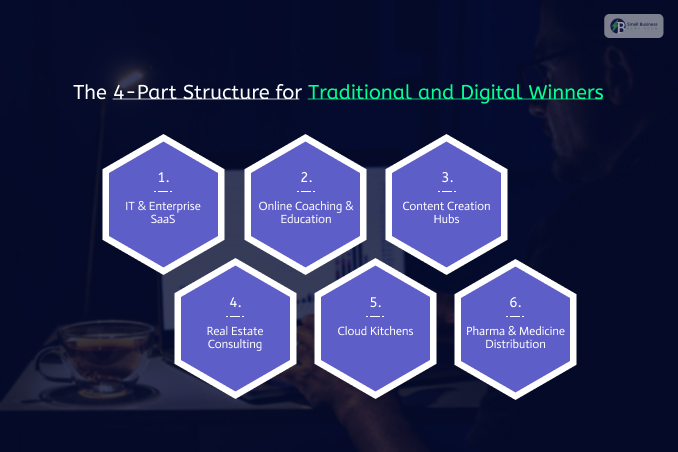
To match your clean format from previous, below is the list of traditional and digital businesses that have experienced rapid growth.
1. IT & Enterprise SaaS
Description: Developing digital software solutions, cloud-based applications, or automation systems for enterprises.
The Major Shift: Indian software developers are not only catering to international clients.
It is also creating solutions adopted by local small businesses (MSMEs) undergoing digitisation.
Profit Channels: Subscription-based revenue (monthly or annual fees) from accounting, inventory management software and ONDC-linked online stores.
Edge: A huge 55%-80% markup is generated because, once software is developed, online selling is essentially free.
2. Online Coaching & Education
Description: Establishing web-based learning platforms to offer video courses, digital study kits, or live group coaching.
The Big Change: A huge population explosion occurred when high-speed internet became available in the very heart of small towns and rural areas (Tier-2 and Tier-3).
Profit Channels: Sale of niche regional, finance, or coding video packages at a lower price and mastermind groups at a premium.
Cheap to Start with, Huge Margin: A super low startup cost as low as ₹30K to ₹2L with margin percentages ranging from 50-75%, which is amazing!
3. Content Creation Hubs
Branding and launching premium media outlets, magazines, video studios, and digital creative agencies specialised in niche areas.
The Big Change: Advertising clients no longer rely on a single source of standard commercials. Instead, they have shifted budgets for major commercial campaigns toward paying micro-influencers or city-level specialists.
Where the Profit Is: Securing regular sponsorships from corporations, marketing products of affiliate marketers, and earning money via digital membership programs and the launch of private digital tools.
The Advantages: A huge potential for your margins at up to 85% from your initial investment, as your creative effort and internet equipment are the only real continuing expenses.
Related Article For You: 11 Small Business Advertising Ideas To Grow Your Business.
4. Real Estate Consulting
Finding buyers for suitable commercial property, a new house, or a place for rent for the tech-savvy property advisor.
The Big Change: Property construction has boomed in Tier-2 smart cities, opening up new real estate opportunities.
It has, however, also created a need for trusted real estate professionals who can verify the documents.
Where the Profit Is: Getting a sole advising contract from a major residential or commercial real estate development.
The Advantage: A margin of 50% 65% as you only require limited startup capital (₹1L to ₹3 Lakh) because your network and your local knowledge constitute your major asset.
5. Cloud Kitchens
Setting up and managing a virtual restaurant that delivers only through mobile food-ordering apps.
The Big Change: Commercial rental costs on main streets are so high now that they force traditional restaurants out of the market.
Where the Profit Is: Managing virtual food businesses for sale through a single delivery platform out of the basement.
The Advantage: A profit margin of 20% to 35% is possible without running a full-service restaurant or maintaining luxury interiors.
6. Pharma & Medicine Distribution
Description: Setting up a licensed bulk trading supply network to deliver medicines, healthcare stock, and pharmacy items.
The Big Change: The expansion of digital healthcare and tier-2 generic pharmacy stores requires highly efficient regional supply networks.
Where the Profit Is: Securing high-volume distribution contracts for fast-moving chronic illness medications or wellness supplements.
The Advantage: Highly resilient, recession-proof revenue streams that yield very stable 15% to 30% profit margins.
The 2026 Entrepreneur Launch Checklist
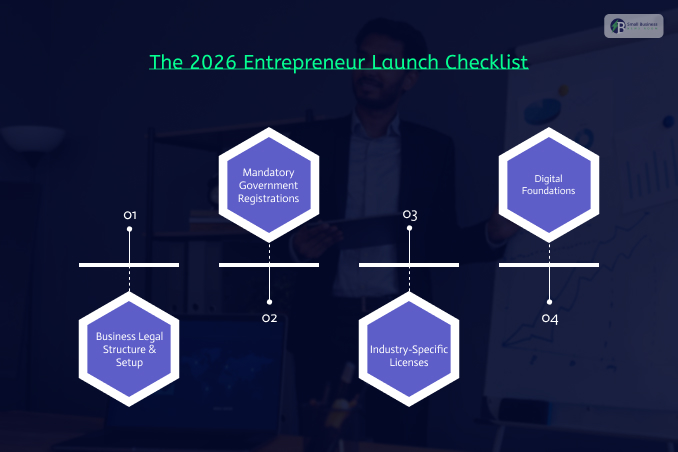
Launching your business in India has become extremely quick in 2026. There are a handful of steps that you cannot skip if you wish to enjoy your government benefits.
Here’s a rapid list for you to follow:
1. Business Legal Structure & Setup
Choose your business structure before spending a single rupee on your venture. If you are planning to go all out and raise substantial investment, go with the Private Limited (Pvt Ltd) structure to secure funding from Angel Investors.
A Limited Liability Partnership (LLP) is ideal for any partnership model with less investment.
- Choose between OPC, Pvt Ltd or LLP based on your investment plans.
- Apply for Tax IDs
- Apply for your business PAN and TAN instantly through the tax portal.
- Secure your business name by checking on the MCA portal.
2. Mandatory Government Registrations
Mandatory Government Registrations are the next on your Entrepreneur Launch Checklist. Moreover, you must complete them before your entity gets approved by the government.
Your Udyam certificate is one such mandatory registration that offers you collateral-free bank loans.
- Apply for your Udyam certificate to enjoy all the state benefits.
- Apply for GST registration if your sales are inter-state or you have crossed the turnover threshold.
- Open a Current Account to showcase your business’s credibility by separating your professional and personal finances.
3. Industry-Specific Licenses
You may need specific licenses to operate your venture, based on the product or service your business deals in.
The government has been taking strict measures concerning food and drugs, so it’s better to be safe than sorry.
Secure FSSAI certification to run any kind of Cloud kitchens or Wellness D2C. Moreover, you need to obtain a drug license to operate any regional pharma distributorship.
Apply for the AYUSH license if your business is into Ayurvedic medicines or products.
4. Digital Foundations
Lastly, make sure your brand has a solid digital foundation. It’s extremely important to secure your digital domain before anyone else can steal it.
Buy your domain name, preferably a .in or .com extension, as soon as possible.
Buy business email IDs to create a professional outlook for your business communications. Also, you can buy your team collaboration tool account to avoid using generic email IDs.
Stop Planning, Start Executing
The year 2026 has been an incredible time to build a business in India. However, the window of opportunity moves really fast.
Furthermore, the biggest takeaway from this guide is pretty simple. The high profit margins occur when your business aligns with what the country is actively building.
Whether you choose a low-cost digital service like SaaS or a government-backed powerhouse like EV infrastructure, the secret is to start lean, protect your cash flow, and secure your legal licenses on day one.
As you take your next steps, keep these final three rules in mind:
- Firstly, you must stay focused on cash flow, not vanity.
A business is only truly profitable when the cash hits your bank account, not when you generate high views or gross sales numbers.
- Secondly, you have to use the policy safety nets. Do not hesitate to use free government tools, such as the Udyam portal.
This helps protect your company and enables you to apply for cheaper credit.
- Secondly, test your market early. Before spending your entire budget, launch a basic version of your software, food item, or service to verify that real customers are ready to pay.
The data is clear, the budget lines are drawn, and the market is waiting. Choose your sector, follow the checklist, and build your profitable venture today!