Table Of Contents
- What Is Growth Navigate Funding All About?
- Growth Navigate As A Service
- Growth Navigate As A General Strategy
- Available Funding Structures
- Who Can Use This?
- What Are The Five Pillars Of Growth Navigate Funding?
- 1. Smart Capital Order
- 2. True Money Planning
- 3. Simple Digital Tools
- 4. Real, Actionable Advice
- 5. Growing Your Wealth
- Where Exactly Do The Founders Go Wrong?
- What Are The Tools That Can Make The Framework Work?
- 1. Smart Money Systems
- 2. Funding Readiness Tools
- 3. Clear Operational Playbooks
- What Does The Failure Numbers Talk About?
- It Is A Systems Problem
- How To Put Growth Navigate Funding Into Practice?
- 1. Test Before You Build
- 2. Prepare Your Systems
- 3. Set Real Goals
- 4. Stay Pointed At The Same Target
- The Difference Between Growth Navigate Funding And Hyper-Growth
- The Power of Customer Retention
- What Does It Take To Qualify? The Real Rules Of Funding
- 1. Basic Business Setup
- 2. The Cash Flow Test
- 3. Credit Profiles
- 4. Rules For Startups
- 5. Industry & Location Filters
- What Paperwork Will You Need? The Growth Navigate Funding Checklist
- 1. Proving Your Identity (Business ID)
- 2. Showing The Money (Financials)
- 3. Sharing Your Vision (Planning Docs)
- 4. Gaining Support from Equity Investors (Investor Packages)
- 5. Keeping Things Safe (Your Digital Data Room)
- Master Document Checklist
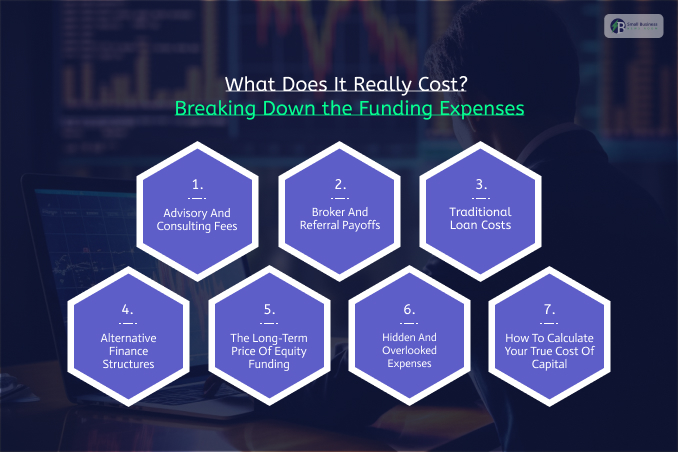
- What Does It Really Cost? Breaking Down The Funding Expenses
- 1. Advisory And Consulting Fees
- 2. Broker And Referral Payoffs
- 3. Traditional Loan Costs
- 4. Alternative Finance Structures
- 5. The Long-Term Price Of Equity Funding
- 6. Hidden And Overlooked Expenses
- 7. How To Calculate Your True Cost Of Capital
- Quick Cost Comparison
- Is Growth Navigate Funding Legitimate? How To Stay Safe
- Critical Security Questions to Ask
- Inside The Growth Navigate Funding Application Process: Step-By-Step
- Step 1: Check Your Funding Readiness
- Step 2: Schedule The Initial Consultation
- Step 3: Clean Up And Submit Your Documents
- Step 4: Navigate Underwriting Or Investor Review
- Step 5: Receive And Compare Your Offers
- Step 6: Negotiate The Fine Print
- Step 7: Get An Independent Expert Review
- Step 8: Sign The Deal And Get Funded
How To Master Growth Navigate Funding And Insider Secrets To Stop Guessing!
Finding the right funding path for your business comes down to balancing growth speed against company control.
Your options range from bootstrapping with your own revenue to chasing grants, loans, or venture capital.
Each choice requires a different sacrifice, whether it is your future profit margins or your decision-making power.
Securing that capital requires looking at your business through a funder’s eyes.
Traditional lenders look backward, checking your tax returns and cash flow to ensure your income easily covers new debt payments.
Investors look forward, analyzing your pitch deck and financial models to ensure you have enough runway to scale rapidly.
Matching your current financial metrics to the right funder’s expectations is the secret to getting funded quickly.
What Is Growth Navigate Funding All About?
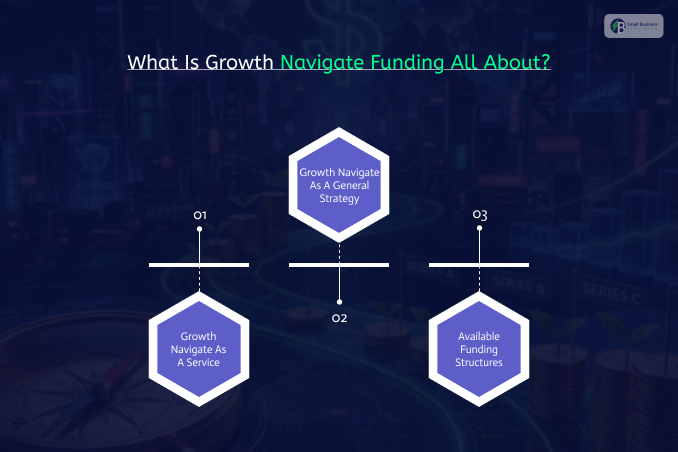
Growth Navigate Funding refers to two distinct concepts: a specific business advisory service or a general strategy for managing business expansion capital.
It is not a standardized financial product, loan, or government grant.
Growth Navigate As A Service
Operating primarily as a consulting and advisory brand, Growth Navigate helps founders prepare to raise capital.
It does not typically fund businesses from its own balance sheet. Instead, its services include:
- Preparation: Developing pitch decks and financial models.
- Matching: Connecting businesses with angel investors, venture capital, or third-party lenders.
- Advisory: Restructuring deals and supporting financial negotiations.
Growth Navigate As A General Strategy
Broader “growth funding navigation” involves matching a company’s specific timeline and milestones to the optimal type of capital.
It forces founders to strategically evaluate debt affordability, equity dilution risks, and exact funding requirements.
Available Funding Structures
Depending on business readiness, the navigated routes generally encompass:
- Debt Financing: Business loans, equipment financing, or lines of credit.
- Equity Investments: Angel networks or venture capital.
- Alternative Models: Revenue-based financing, crowdfunding, or specialized grants.
Who Can Use This?
Finding the right financial path depends entirely on where your company stands today. To help you visually map out your options, here is a quick, simple breakdown of how different business stages match up with the best funding choices:
| Business Stage | Best Funding Route | What Lenders Look For | Main Priorities |
| Startup | Equity, Grants, Crowdfunding, Accelerators | A solid pitch deck, market size, and early customer interest. | Turning a great concept into an investor-ready opportunity. |
| Small Business | SBA 7(a) Loans, SBA 504 Loans, Business Credit Lines | Clear revenue streams and the ability to repay the loan. | Buying inventory, hiring employees, or opening new locations. |
| Growth Stage | A mix of Equity and Debt (like credit lines) | Steady customer demand and a clear strategy to scale fast. | Entering new markets and scaling up sales capacity quickly. |
| Established | Traditional Commercial Loans and Property Financing | Years of financial statements, stable cash flow, and strong assets. | Modernizing operations or buying out other companies. |
| Not Ready Yet | None (Fix internal business fundamentals first) | Clean accounting books, healthy profit margins, and tax compliance. | Fixing structural issues before |
What Are The Five Pillars Of Growth Navigate Funding?

Every framework needs a solid foundation to work. When it comes to growth, navigating funding relies on five simple ideas.
In fact, these principles help startups avoid the hidden traps that usually pull them apart.
1. Smart Capital Order
First, getting money isn’t just about having a cool idea. Investors actually look for real proof.
Therefore, you need clean money records before any big meeting.
Plus, it is smart to choose the right type of funding for your specific needs rather than just following trends.
2. True Money Planning
This is why smart founders use simple dashboards to watch their spending daily. This helps them spot cash problems early while they can still fix them.
Next, cash flow is everything. A business can survive slow growth, but it cannot survive running out of cash.
3. Simple Digital Tools
Meanwhile, good software should save you time, not make things harder.
Growth Navigate startup tools like invoicing keep your business running smoothly. Ultimately, the goal is to reduce manual steps so you can focus on growth.
4. Real, Actionable Advice
Furthermore, generic advice doesn’t help anyone. You need specific tips you can use this week, like finding hidden costs.
A great coach will also teach you how to delegate tasks so you can step up as a true leader.
5. Growing Your Wealth
Finally, don’t let your profits just sit there. Instead, use that extra money to build new income lines or create a cash safety net.
Consequently, this keeps your business strong and ready for the future.
Also Check: The TimeWarp TaskUs Advantage: Delivering Exceptional Support Every Time!
Where Exactly Do The Founders Go Wrong?
The five pillars we just talked about show you what a healthy startup looks like. However, many founders fall into a classic trap.
They only focus on one pillar—usually the funding part—because it gets the most attention.
But here is the truth. If you get a huge chunk of growth, navigate funding, but have zero visibility into money, you are not actually safe.
Instead, you are just moving faster toward a major crash. Therefore, these pillars are not a menu to pick and choose from.
Ultimately, they must all work together to keep your business standing tall.
What Are The Tools That Can Make The Framework Work?
Great ideas are useless unless your team lives them every single day. Therefore, you need simple, real-world tools to turn your strategy into action.
1. Smart Money Systems
First, skip the guesswork. You need cash flow templates that track your money daily, not just at the end of the month.
Build your revenue forecasts on real sales data rather than wishful thinking. This highlights budget trends before they turn into major cash problems.
2. Funding Readiness Tools
Next, when you are seeking growth and funding, your pitch deck must present the unvarnished financial reality.
Do not just send mass emails to random funds. Instead, create a targeted list of investors who genuinely care about your industry.
3. Clear Operational Playbooks
Finally, create simple step-by-step guides for your daily work. Write down clear sales scripts and customer onboarding checklists.
Consequently, new hires can become useful in days rather than months.
What Does The Failure Numbers Talk About?
Startup failure stats are everywhere, but it is worth looking at them closely. In fact, these numbers show exactly what growth navigate funding helps you avoid.
| Failure Metric | 2026 Statistic | Primary Cause |
| First-Year Failure | 21.5% | Lack of market need |
| Five-Year Failure | 50.0% | Cash flow exhaustion |
| Overall Failure | 90.0% | Premature scaling |
It Is A Systems Problem
Interestingly, notice what is missing from this list. Having a “bad idea” is rarely the main issue after year one.
Instead, running out of money and growing too fast are the real culprits.
Consequently, this means businesses collapse when they scale faster than their internal tools can handle.
This is simply a systems problem, not a lack of talent. Fortunately, a broken system is easy to fix with the right plan.
How To Put Growth Navigate Funding Into Practice?
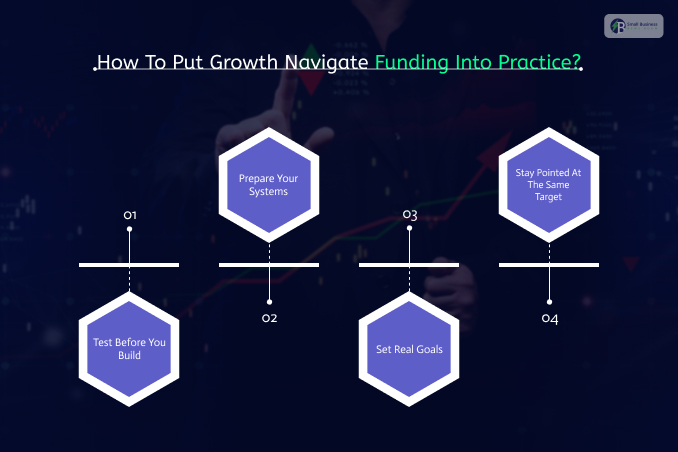
A great framework only works when you apply it in the correct order. Therefore, taking things step by step keeps your business safe and organized.
1. Test Before You Build
First, clarify your market value right away. Always test your product idea with real customers before spending more money.
In fact, catching mistakes early is incredibly cheap, whereas discovering them after scaling can ruin a business.
2. Prepare Your Systems
Next, build scalable tools before the big growth hits. You should document your workflows well before your team doubles in size.
Otherwise, vital company information gets trapped as tribal knowledge inside just one person’s head.
3. Set Real Goals
Furthermore, focus on clear, measurable goals rather than wishful corporate language.
Track your business metrics relentlessly so your team never has to guess how the quarter is going.
4. Stay Pointed At The Same Target
Finally, ensure everyone agrees on the exact destination. Encourage honest communication so people can call out problems early.
This careful alignment is exactly how growth navigate funding helps teams spot bottlenecks before they turn into expensive crises.
The Difference Between Growth Navigate Funding And Hyper-Growth
Not all business growth is healthy. In fact, growth-focused funding promotes sustainable expansion rather than expansion at any cost.
When user or customer acquisition outpaces a company’s infrastructure, the business quickly collapses.
For instance, the app Clubhouse experienced massive user spikes but failed because it lacked the underlying systems to retain those users in the long term.
| Growth Type | Core Focus | Long-Term Risk |
| Hyper-Growth | Rapid acquisition | High cash burn, system collapse |
| Sustainable Growth | Profitability & retention | Slower initial market capture |
The Power of Customer Retention
Ultimately, retention is the ultimate growth engine. Keeping an existing customer is always cheaper than buying a new one every quarter.
Consequently, scaling profitably requires a slow, intentional approach. External growth partners help this process by providing strict accountability.
Their job is not to cheerlead, but to ask the hard questions that internal teams are often too close to see.
What Does It Take To Qualify? The Real Rules Of Funding
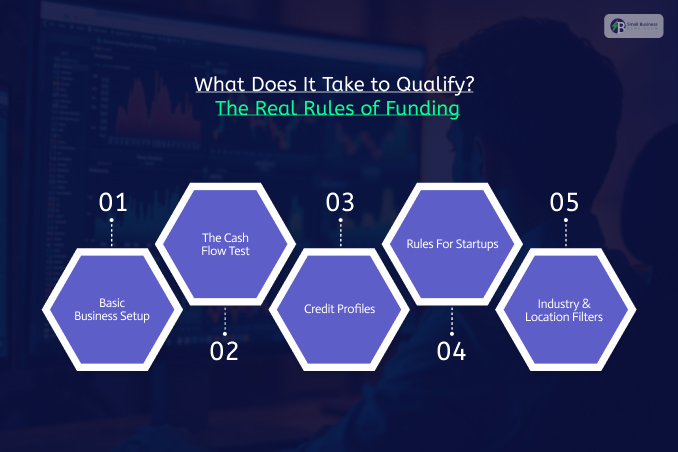
You need to navigate funding does not require a magic checklist since every lender sets its own rules.
However, most providers look at a few core building blocks before handing over any cash.
Here is a short, punchy breakdown of what it takes to qualify.
1. Basic Business Setup
You must prove your business is a legitimate, legal operation. You will need a registered business name, a dedicated business bank account, clear proof of ownership, and clean financial records.
2. The Cash Flow Test
Lenders look closely at your Debt-Service Coverage Ratio (DSCR) to see if your profits can comfortably pay back a loan.
- For example, if you have $150,000 in yearly free cash flow and $100,000 in yearly loan payments, your score is 1.50 ($150,000 ÷ $100,000).
- Any score above 1.0 proves you have extra cash to cover your debts, making you a safe bet.
3. Credit Profiles
Your payment history, credit card use, and any past tax liens matter. If your business is brand new, lenders will check your personal credit score.
- Pro-Tip: Ask for a “soft inquiry” during the review stage so the credit check doesn’t lower your score.
4. Rules For Startups
If you don’t have revenue yet, you must show value through a strong founding team, a working prototype, and realistic financial projections.
Never tell investors you have no competition; it is a major red flag that shows a lack of market research.
5. Industry & Location Filters
Many programs exclude high-risk or highly regulated fields like gambling, speculative ventures, or industries with high credit card chargeback rates.
Location rules also apply, as many U.S. programs require you to operate entirely within the country.
What Paperwork Will You Need? The Growth Navigate Funding Checklist
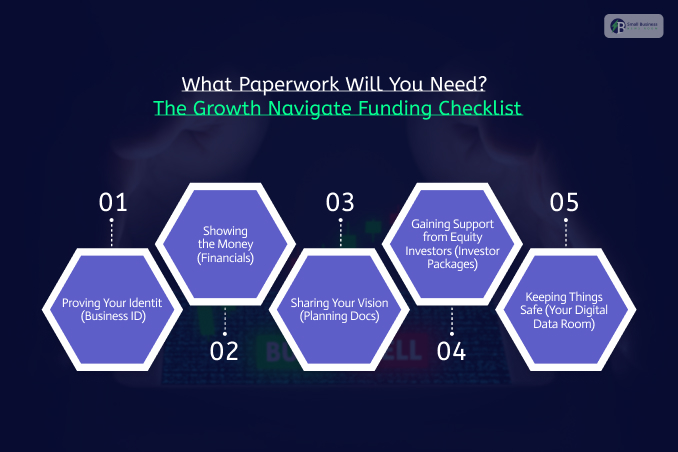
Gathering your paperwork might feel like a chore, but it is the fastest way to look like a pro in the eyes of lenders and investors.
There is no single master checklist for Growth Navigate Funding.
A quick online line of credit requires very little paperwork, while a major commercial bank loan or a venture capital round requires a lot of paperwork.
At the end of the day, your files must answer four simple questions:
- Who owns the company?
- How is it performing?
- What will you do with the cash?
- Does this deal actually make financial sense?
Here is a quick, straightforward breakdown of the exact documents you need to gather.
1. Proving Your Identity (Business ID)
Your name and ownership percentage should be identical among these documents:
- Formation Papers: Your Articles of Incorporation or Operating Agreement
- Tax Identification Number (EIN): Make sure the Federal Employer Identification Number (EIN) on your business license and other documents (such as bank and accounting records) matches.
- Ownership Records: A document that indicates who the owner is and what percentage of the brand they own.
- Licenses: Make sure your local or state license is active.
- Address Proof: A utility bill or lease agreement under the business name.
2. Showing The Money (Financials)
Lenders really want a detailed financial breakdown for any loan to your business.
It is pretty normal for your internal accounting records and your bank reports to differ somewhat due to transaction timing, one-time charges, etc.
But you have to be able to clearly explain the discrepancies. You will probably be asked for the following:
- Bank statements: This is for the 3 to 6 months prior to the loan application date.
- Tax Returns: Last 2 to 3 years of corporate and personal tax returns
- Core Accounting Sheets: Profit and Loss statement, Balance Sheet, and Cash Flow sheet
- Aging Reports: Outstanding customer balances (Accounts Receivable) and Outstanding vendor balances (Accounts Payable).
- Debt Schedules: You know, it is all the current loans you’ve got on your business and the payments associated with them.
- Operations Reports: A few recent payrolls and a basic sales report showing how sales have trended over the past couple of months.
3. Sharing Your Vision (Planning Docs)
Sharing what you aim to do through planning documents strengthens your funding requirements.
For instance, a lender will easily say yes to a “$200, 000 request backed by a specific equipment quote.”
However, it might be a $100, 000 request labeled as “general expansion” that gets turned down.
Take these to win the lenders over:
- Master Plan: A well-prepared business plan and transparent growth roadmap.
- Use-of-Funds: A very precise list highlighting every dollar’s destination.
- Future Projections: Realistic financial forecasts and a break-even analysis.
- Risk & Reward: An easily understandable repayment plan and a timeline of upcoming milestones.
4. Gaining Support from Equity Investors (Investor Packages)
You just need to be prepared to share more information with them if you are seeking support from venture capitalists or angel investors rather than just securing a loan from a financial institution.
They get a stake in your company rather than merely expecting loan repayment. Therefore, they’ll want to witness:
- The Pitch Deck: Your core presentation that you will be sharing in front of the investors.
- The Cap Table: A visual display that shows each shareholder’s percentage ownership.
- The Math: An interactive financial model in its simplest form.
- Proof of Concept: Signed client contracts that are still active, product demos you’ve made, and patent or IP records.
- Company Background: Team bios, market survey results, and previous financing disclosures.
5. Keeping Things Safe (Your Digital Data Room)
If there’s a need to transmit confidential financial documents, it is unsafe to use a typical email platform.
You must set up a secure digital data room to store and manage your documents.
Tip: It is best to control folder access so that a person does not see files he was not supposed to see.
Before uploading the files, double-check the privacy policies of the funders so as to ensure that they don’t sell, resell, or disclose the data to third parties for marketing purposes.
Master Document Checklist
Here is a complete summary of everything you need to gather based on your funding path:
| Document Category | Specific Items to Gather | Who Needs to See It? | Why It Matters |
| Business ID | Articles of Incorporation, EIN, Licenses, Owner IDs, Address Proof | Every Lender & Investor | Verifies legal registration and true ownership. |
| Financials | Bank Statements, Tax Returns, P&L Sheets, Balance Sheets, Debt Schedules | Banks & Alternative Lenders | Evaluates real cash flow and debt repayment ability. |
| Planning Files | Use-of-Funds, Financial Forecasts, Business Plan, Break-Even Analysis | Banks & Traditional Lenders | Connects the loan amount to a clear, less risky plan. |
| Investor Pack | Pitch Deck, Cap Table, Financial Model, IP Records, Customer Contracts | Venture Capitalists & Angels | Assesses long-term corporate value and equity stakes. |
| Data Room | Corporate Docs, Tax Records, Legal Agreements, Revenue Folders | All Approving Parties | Protects sensitive data and keeps the deal organised. |
Related Article For You: Startup Accounting Secrets: The VC Blueprint 90% Of Founders Fail To Use.
What Does It Really Cost? Breaking Down The Funding Expenses
Growth Navigate’s public terms make it clear that all fees depend entirely on your individual client agreement.
Plus, these service fees are non-refundable unless your contract explicitly says otherwise.
You must always demand a complete written fee schedule before you sign any documents or hand over any money, because there are no universal rates.
Here is a transparent look at where your money actually goes during the funding process. This can help you to budget.
1. Advisory And Consulting Fees
They might charge you through a fixed project fee, an hourly rate, a monthly retainer, or a success fee once your capital is secured if you work with a funding adviser.
Never settle for a vague contract that just promises “funding support.” Make sure your agreement clearly spells out exactly what you are paying for, such as:
- Detailed financial reviews or application prep
- Live lender matching or warm investor introductions
- Pitch-deck development or financial modeling
- Hands-on negotiation assistance and legal document coordination
2. Broker And Referral Payoffs
Some finders and online marketplaces get paid directly by the lender, while others will pass that charge onto you.
Always ask your adviser whether they are earning a lender referral commission, a percentage of your funded amount, or a fee for selling your data as a qualified lead.
Moreover, a commission doesn’t mean they are giving you bad advice but knowing how they get paid helps you spot any hidden bias.
3. Traditional Loan Costs
A loan costs far more than just its basic interest rate. You need to keep an eye out for origination fees, closing costs, application fees, servicing fees, and even prepayment penalties if you pay the loan off early.
- The Reality Check: Let’s say you take out a $100,000 loan with a 3% origination fee ($3,000).
- The lender deducts that fee upfront, so only $97,000 hits your bank account.
- However, your total scheduled repayment over the life of the loan is $118,000. Always look at what you actually take home versus what you have to pay back.
4. Alternative Finance Structures
If you use alternative options like merchant cash advances or invoice factoring, you won’t see traditional interest rates.
Instead, they use factor rates, fixed fees, or revenue-sharing percentages taken through daily or weekly withdrawals.
Moreover, never mistake a small daily payment for a “cheap” loan. Fast approvals usually equal much higher total dollar costs and aggressive repayment schedules.
5. The Long-Term Price Of Equity Funding
Selling a piece of your company doesn’t cost you monthly interest, but it is far from free.
- Firstly, imagine your business is worth $1.5 million today. An investor gives you $500,000, pushing your company’s new total valuation to $2 million.
- Secondly, in exchange for that cash, the investor now owns 25% of your business ($500,000 ÷ $2,000,000), dropping your personal share to 75%.
- Lastly, if your company grows and becomes worth $20 million down the road, that investor’s 25% share is now worth $5 million.
Equity is fantastic for scaling. Moreover, its long-term cost can massively outweigh the initial cash you received.
6. Hidden And Overlooked Expenses
Don’t forget to budget for the extra operational costs that pop up during a deal. You will likely have to pay for the following:
- External legal reviews,
- CPA services,
- Professional business valuations,
- Asset appraisals,
- Filing fees,
- Specialised insurance.
7. How To Calculate Your True Cost Of Capital
To accurately compare two different funding offers, always lay out these core numbers side-by-side:
- Net cash received: The actual money deposited into your account.
- Upfront deductions: All fees taken out before you get the money.
- Total repayment amount: The absolute final dollar amount you will pay back.
- Frequency & Length: How often you pay (daily, weekly, monthly) and for how long.
- Risk & Control: The collateral at risk, personal guarantees required, and any company control rights you are giving up.
Pro-Tip: Take your top funding offers and ask your accountant to plug them directly into your business’s monthly cash-flow forecast.
A deal that looks amazing on paper can easily break your business if a heavy monthly payment hits during your slowest seasonal sales month.
Quick Cost Comparison
Use this quick guide to understand what type of financial pressure each funding route places on your cash flow before making a final choice:
| Funding Type | Primary Cost Structure | Upfront Fees to Watch For | Impact on Cash Flow | Long-Term Trade-off |
| Advisory Services | Fixed, Hourly, or Success Fees | Retainers, Pitch-deck design fees | Immediate out-of-pocket cost | Pays off if they secure better loan terms. |
| Traditional Loans | Interest Rate + Origination Fees | Application, Closing, & Broker fees | Predictable monthly payments | Requires steady cash flow to avoid default. |
| Alternative Finance | Factor Rates & Revenue Splits | Processing & Documentation fees | Heavy daily or weekly withdrawals | Drains daily cash quickly for fast funding. |
| Equity Funding | Percentage of Company Ownership | Legal diligence, Valuation fees | No monthly payment pressure | Permanent loss of profits and company control. |
Is Growth Navigate Funding Legitimate? How To Stay Safe
Growth Navigate Funding operates as an advisory and consulting service, not a direct lender.
Their terms clearly state that funding is not guaranteed and fees depend entirely on your individual contract.
You always need to do a little homework before sharing your sensitive documents because they are consultants, not a bank.
You need to focus on these four quick checks to protect your business:
- · Find The Cash Source
Firstly, ask exactly where the money comes from. Is it a bank, a private fund, or a venture capital firm? You have a right to know who is actually funding you.
- · Watch For FTC Red Flags
According to the Federal Trade Commission (FTC), you should run the other way if a provider “guarantees” approval before looking at your books, pressures you to sign instantly, or demands strange upfront fees.
- · Check The Paperwork
Lastly, double-check that the exact company name listed on your contract matches the party you are actually paying.
Critical Security Questions to Ask
Before you upload bank statements, tax records, or corporate data, protect your identity by asking the provider these quick questions:
- Which specific entity is receiving my information, and will it be sold or shared?
- Is my data encrypted, and can I request total deletion if this deal falls through?
- Will this application trigger a hard or soft credit inquiry?
Note: Never under any circumstances share your online banking login credentials or passwords with a funding consultant.
Inside The Growth Navigate Funding Application Process: Step-By-Step
Getting your business funded is a journey, not a one-click button.
The exact steps depend on whether you are pursuing a bank loan or pitching to a venture capitalist.
Growth Navigate Funding generally follows a very structured, predictable sequence.
Here is a breakdown of how the process actually works from start to finish, to help you ace your application without the stress.
Step 1: Check Your Funding Readiness
You need to sit down and evaluate your own numbers. Look at your business stage, monthly revenue, credit score, and how much debt you already owe.
Be completely honest about how much cash you actually need and whether your monthly cash flow can handle the payback.
Moreover, this stops you from wasting time on funding routes you can’t support.
Step 2: Schedule The Initial Consultation
Treat your first meeting like a two-way street. Yes, you are selling your business vision, but you are also interviewing the provider.
Ask tough questions about their exact funding sources, fee schedules, expected timelines, and data-sharing policies.
Always request written confirmation of any big promises they make over the phone.
Step 3: Clean Up And Submit Your Documents
Missing or messy paperwork is the number one reason applications get delayed or rejected.
Before uploading anything to a secure server, there are a few things that you need to do. You need to:
- Firstly, reconcile your bank statements with your accounting books,
- Secondly, update your Profit & Loss sheets,
- Thirdly, double-check that your company name and dates match exactly across every form.
Step 4: Navigate Underwriting Or Investor Review
Once your files are in, expect follow-up questions. If you are dealing with a bank lender, they will want to know about past revenue dips, tax liabilities, or customer concentration risks.
They will grill you on your competition and customer acquisition costs if you are talking to an equity investor.
So, just answer with hard evidence, not just blind optimism.
Step 5: Receive And Compare Your Offers
When the offers start rolling in, do not just jump at the fastest cash. Put them side by side on a comparison sheet.
Moreover, look closely at upfront deductions, total payback amounts, payment frequency, and the collateral or personal guarantees you must pledge.
Step 6: Negotiate The Fine Print
If you have a healthy business and multiple offers on the table, you have leverage.
Do not be afraid to negotiate the loan amount, interest rates, repayment terms, or the percentage of equity you are giving up.
Step 7: Get An Independent Expert Review
Your funding adviser might be great, but it is always smart to get a second opinion from someone who does not get paid only if the deal closes.
So, it is advisable to have a commercial finance attorney review the contract risks.
Moreover, they can also let your accountant test whether the monthly payments are genuinely affordable.
Step 8: Sign The Deal And Get Funded
Confirm the final take-home cash amount, fee deductions, the exact disbursement date, and the due date for your very first payment before you sign on the dotted line. Once signed, save copies of everything and keep your payment records safe.
Additional Resources: