Table Of Contents
- Accounting Basics That Every Startup Must Know About!
- Is It Necessary For Startups To Have Accountants?
- How To Start Accounting For Startups?
- Step 1: Pick Your Accounting Method
- Cash Method
- Accrual Method
- Step 2: Split Your Bank Accounts
- Step 3: Pick The Right Software
- Step 4: Plan For Tax Season Early
- Top Accounting Software For Startups
- 1. For Worldwide Expansion & Comprehensive Management: QuickBooks Online
- 2. For Trendy Staff & Gorgeous Co-Operation: Xero
- 3. For Bootstrapped Startups & Tight Budgets: Zoho Books
- 4. For Freelancers & Service Providers: FreshBooks
- 5. For True Beginners With Simple Cash Flow: Wave
- How To Choose The Right Tool For You
- Accounting Costs For The Startups
- Path 1: The Diy Approach (Best For Tight Budgets)
- Path 2: The Outsourced Route (Best For Growing Teams)
- Path 3: The In-House Hire (Best For Well-Funded Startups)
- Clever Additional Costs To Remember
- Factors To Consider While Looking For An Accounting Service
- 1. Startup Experience
- 2. Tech-Savvy Tools
- 3. Room to Scale
- 4. Strategic Mindset
- 5. Clear Communication
- 6. Industry Knowledge
- The Key Financial Metrics Investors Expect You To Track
Startup Accounting Secrets: The VC Blueprint 90% Of Founders Fail To Use
Last Updated on: August 31st, 2026
Starting a new business is an exciting experience! When you are deeply engaged in making amazing products and finding customers, it is surprisingly easy to neglect bookkeeping.
Nevertheless, the first step to survival and success is nothing more than getting your cash flow right from the beginning.
Independent of whether you are self-funding or backed by a big investor, reliable accounting for startups enables you to monitor your success, win over lenders, obtain credit, and handle your taxes without any problems.
Key Takeaways
- Bring in partners: Great financials will aid you in getting loans, capturing the interest of investors, and finding innovative ways for your business.
- Get ready to grow: Establishing a robust money system now will save you from complicated compliance issues later.
- Save time: Delegating bookkeeping to external experts will reduce errors and give you access to expert strategies.
Accounting Basics That Every Startup Must Know About!

If your business is to continue without hiccups, you have to keep an eye on some financial basics. Getting your cash flow in order effectively is probably the most important part of accounting for new businesses.
Luckily, it really isn’t that hard if you just continue focusing on the main points:
- Bank Statements: Make it a habit to review your bank and credit card statements so you can catch any errors or identity theft early.
- Income and Expenses: Make a habit of recording every dollar that comes in from sales and goes out for bills like rent or the team’s salaries.
- Invoices and Receipts: Keep customer invoices and receipts for shopping, as they will provide the tax authorities with evidence of what you have declared.
- Payroll Records: In addition to paying employees, keeping up-to-date records of their wages, tax deductions, and benefits is necessary to comply with labor laws.
- Assets and Liabilities: You should always have a good list of what your business owns and what it owes, as this will give you an idea of your financial condition.
Is It Necessary For Startups To Have Accountants?
Hiring an expert accountant can bring huge benefits to your expanding team. You may be able to handle the basics at the beginning.
However, expert accounting for startups can safeguard you from major troubles in the future.
Firstly, professionals handle the core components, so you have time to focus on developing your product and attracting customers.
Besides that, they always keep your accounts in order and compliant with the law. This safeguards you from surprises like legal penalties or tax errors that can cost you a lot.
Besides that, an experienced accountant can really make a difference by:
- Reducing your tax bill: They find all the deductions, credits, and write-offs allowed by the law to help you save money while making sure that you file on time.
- Impressing your investors: Well-organized, professional financial statements present your business in the best light, helping you secure funds and win venture capitalists’ confidence.
- Making plans: They prepare budgets and forecast your future cash flow, based on which you will be able to make long-term growth decisions confidently and backed by data.
- Detecting fraud: By implementing tight internal controls and reconciling your accounts, you will safeguard your assets against internal errors as your business grows.
- Getting ready for exits: They will prepare and accurately assess your business’s worth and keep your documents ready for when you decide to sell, merge, or go public.
How To Start Accounting For Startups?
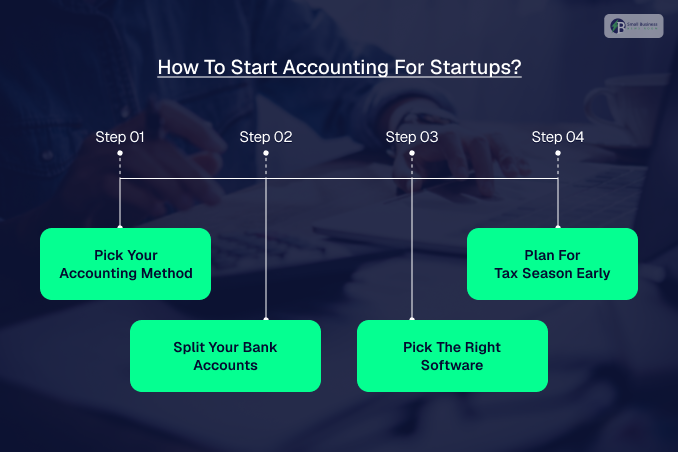
Setting up a solid money system early on gives your new business a huge advantage. Luckily, masterfully handling accounting for startups comes down to four straightforward, actionable steps.
Step 1: Pick Your Accounting Method
First, decide how you want to track your cash. You have two main choices here:
Cash Method
You record money only when it physically enters or leaves your hands. It is super simple for beginners, but it can sometimes hide your true profit trends.
Accrual Method
You log income when you earn it and expenses when they happen, even if the cash moves later.
Investors love this because it shows a highly accurate picture of your business’s health.
Tip: Most founders start with cash and switch to accrual as they grow.
Under the accrual system, your financial reporting must align with GAAP (Generally Accepted Accounting Principles) or IFRS (International Financial Reporting Standards).
This is crucial if your startup intends to offer equity incentives, issue stock options, or cross a specific regulatory audit threshold, as traditional cash-basis reporting hides long-term deferred revenue liabilities.
Step 2: Split Your Bank Accounts
Never mix your personal cash with your business funds! Seriously, go open dedicated business checking accounts and credit cards immediately.
Separating your money makes bookkeeping a breeze and keeps your records clean for tax time.
Critical Corporate Liability Advisory: Mixing personal and business cash creates a legal vulnerability known as “piercing the corporate veil.”
If your startup faces a lawsuit or bankruptcy, commingling funds can allow courts to dismantle your limited liability protection,
This further exposes your personal assets (like your home or savings accounts) to corporate creditors.
Plus, paying vendors from a real business account looks incredibly professional and builds a strong corporate credit score.
Step 3: Pick The Right Software
Do not rely on messy spreadsheets. Instead, grab cloud-based software like QuickBooks or Xero so your team can access data from anywhere.
A great system easily automates daily chores like:
- Tracking sales, bills, and project costs
- Sending customer invoices
- Running payroll and connecting to your e-commerce tools
- Creating official profit and loss statements
Step 4: Plan For Tax Season Early
No one likes tax surprises, so map out your strategy ahead of time. Keep a close eye on these four key areas:
- Your Setup: Whether you are an LLC or a C-Corp completely changes how much tax you owe.
- Sales Tax: If you sell online across state lines, you might owe taxes in multiple places.
- Payroll Taxes: Paying employees means filing strict tax paperwork on time.
- Perks and Credits: Look into government incentives like the R&D tax credit, which can save tech startups a ton of cash.
Three Costly Accounting Mistakes Early-Stage Founders Must Avoid
- Treating Funding as Revenue
Venture capital infusions or seed loans are liabilities or equity on your balance sheet, not top-line operational revenue.
Recording them incorrectly completely distorts your tax obligations and profit margins.
- Misclassifying Workers
Labeling full-time team members as independent contractors (1099 instead of W-2) to avoid payroll taxes can trigger massive government audits, back-tax penalties, and legal headaches.
- Postponing Bookkeeping Until Year-End
Trying to sort twelve months of messy receipts, software subscriptions, and bank statements during tax week leads to massive math errors, missed deductions, and extreme stress.
Top Accounting Software For Startups

Choosing the right software is a total game-changer when structuring accounting for startups.
Instead of getting lost in endless data entry and grappling with math errors, the right program mainly:
- Sutomates your invoicing,
- Tracks your spending,
- Securely stores your records in one place.
To help you determine the absolute best choice, let’s examine the top software tools, classified by specific business needs, and explore their unique offerings.
1. For Worldwide Expansion & Comprehensive Management: QuickBooks Online
If your main objective is rapid growth and you want a tool that scales with your team without glitches, Intuit QuickBooks Online is a market leader.
It can easily handle complex bookkeeping and is also very flexible in producing accounting reports to meet your needs.
Besides, it can be integrated with almost any banking app or CRM tool you currently use.
- The Features: Get your bank feeds automatically, generate detailed cash flow projections, track stocks, and create batch invoices.
- The Pricing: Basic plans generally start at $38/month for the Simple Start tier (ideal for solos) and can reach $275/month for the full-featured Advanced package.
2. For Trendy Staff & Gorgeous Co-Operation: Xero
For a neat, highly user-friendly interface that your employees can understand without constantly relying on the accountant, Xero is hands down the favorite.
It is 100% cloud-based and heavily oriented towards live financial monitoring and simple multi-currency management.
- The Features: A great mobile app for financial management on the go, smooth, smart document capture, and automatic bank reconciliation.
- The Pricing: Regular plans begin with the Starter tier at $29/month (which lets you send 20 invoices) and increase to the Premium tier at $69/month, which enables powerful multi-currency capabilities.
3. For Bootstrapped Startups & Tight Budgets: Zoho Books
Are you trying to watch every single penny while keeping your business fully compliant?
Zoho Books is an incredibly budget-friendly option that delivers high-tier accounting tools without a massive monthly price tag.
- The Features: Built-in payment gateway integrations, custom business branding, automated payment reminders, and powerful local tax compliance trackers.
- The Pricing: They offer a completely Free Plan for micro-businesses making under a specific revenue limit.
Paid upgrades are very wallet-friendly, starting at just ₹899/month (roughly $11-$12 USD).
4. For Freelancers & Service Providers: FreshBooks
If your business is primarily built around service contracts, consulting, or client invoicing, FreshBooks makes managing project cash flow remarkably simple.
- The Features: Exceptional time tracking for billable hours, custom invoice templates, and painless project expense tracking.
- The Pricing: Regular base options begin with the Lite Plan at $21/month and scale up to the Premium Plan at $65/month for larger client rosters.
5. For True Beginners With Simple Cash Flow: Wave
If you are running an incredibly early-stage business with very few monthly transactions, paying for a premium subscription might feel like overkill.
Wave is a phenomenal, completely free starting point.
- The Features: Handles basic bookkeeping entry, balances your income logs, and lets you send clean, professional digital invoices without hidden costs.
- The Pricing: Completely Free for core accounting and invoicing; you only pay standard transaction percentages if you choose to accept online credit card payments.
How To Choose The Right Tool For You
Before you put your credit card down, take a second to weigh these quick factors:
- Your Daily Needs: Do you need simple invoicing, or do you have physical products that require real-time inventory management?
- Software Integrations: Does this platform easily integrate with your bank account and e-commerce tools?
- Team Scalability: Will this tool remain effective when you hire ten more employees next year?
| Platform | Target Audience | Primary Technical Advantage | Baseline Entry Price |
| QuickBooks Online | High-growth, venture-backed scaleups | Robust multi-tier reporting & CRM integrations | $38 / month |
| Xero | Collaborative teams & remote startups | Modern dashboard layout & hub-app ecosystem | $29 / month |
| Zoho Books | Bootstrapped founders & local LLCs | Localized statutory tax compliance modules | ~$12 / month (₹899) |
| FreshBooks | Agencies, consultants & service providers | Built-in billable hour & mileage track tools | $21 / month |
| Wave | Early freelancers & micro-businesses | Zero-cost ledger baseline entry logging | 100% Free |
Accounting Costs For The Startups
When you decide to start a new company, working out your accounting planning is first and foremost.
In fact, the total expenses of doing accounting for startups can be really different from one another depending on:
- How big your company is,
- How complicated your daily transactions are,
- What exact way of managing the cash flow will you choose?
Luckily, there are three main ways you can choose from, depending on your budget and business needs right now.
We explain exactly what you will pay and what you can get if you follow each of the three ideas, so you can make the right choice for yourself.
Path 1: The Diy Approach (Best For Tight Budgets)
If you are setting up a brand-new, early-stage business with simple finances, doing your own bookkeeping would initially be the cheapest option.
You may even consider taking free online bookkeeping courses to improve your knowledge.
Besides that, you can make some bargains on price terms when you start thriving.
- Software Costs: This is your major outlay. As noted before, you can go from Wave (totally free) to QuickBooks Simple Start ($38/month) or higher levels (up to $275+/month).
- Training Material: You may purchase some online tutorials or manuals to get a good grasp of basic tax rules for anything between $20 and $100.
Path 2: The Outsourced Route (Best For Growing Teams)
As your transaction volume increases, hiring outside professionals frees up a lot of time and reduces the financial risks associated with having a full-time employee on the payroll.
- Basic Bookkeeping Services: Having a professional to sort your monthly receipts and bank statements would cost $100 to $500 per month.
- Advanced Accounting & Taxes: Formal statement creation and tax filing are priced in the thousands of dollars per month.
- Virtual CFO Services: A high-level strategist who can help with acquisitions, capital raising, and cash flow forecasting for your business can be yours for $ 1,000 to $ 5,000 a month.
Path 3: The In-House Hire (Best For Well-Funded Startups)
After a successful opening or a major raise, you will probably want a full-time finance expert around.
- Base Salaries: This is a significant commitment that largely depends on your local job market and the accountant’s level of experience.
- Hidden Overhead: Remember to include employee health insurance, retirement plan contributions, office furniture, and additional software seat licenses in your budget.
Clever Additional Costs To Remember
Even when you opt to DIY, make sure to set aside some money for these unforeseen expenses:
- Year-End Tax Prep: The cost of a tax expert who checks your accounting records and completes your annual tax return correctly.
- Official Audit Fees: If you receive venture capital funding, the investors will likely want a formal audit, which incurs separate costs.
- Specialized Consulting: Incurring expert consultation costs once or twice to help you set up complicated inventory or international sales systems.
Highlight: State-by-State Nexus Compliance Fees: If your startup operates an e-commerce model or employs remote workers in different territories, you are legally subject to economic nexus tax thresholds.
Managing cross-border sales tax registration requires specialized filing tools (like Avalara or TaxJar), which introduce incremental compliance costs.
You Can Also Check: Don’t Click Furtherbusiness.com Until You Read This: Scam Or Goldmine?
Factors To Consider While Looking For An Accounting Service
Finding the absolutely perfect financial partner can totally change the way your business grows!
When seeking a leading accountant for your startup, not only should you find a person who is able to process your numbers, but the truth is, they should do a lot more than that!
In fact, here is a list of six important qualities that could help you find the right expert:
1. Startup Experience
Besides knowing KPIs for investors and managing your cash burn rate, they should be well-informed about the high-growth culture characteristic of startups.
2. Tech-Savvy Tools
To live in the cloud using apps such as QuickBooks or Xero is what your pros must be.
This can eliminate errors and snags that result from manual work, while greatly increasing automation.
3. Room to Scale
It’s great if your helper cannot only create a simple receipt today but also handle your complex financial operations after your transaction volume explodes without any problems.
4. Strategic Mindset
Finding financial experts who are not just able to think of strategies but also deeply provide financial insights, forecasting, budgeting, and tips.
This can further help move your daily business decisions forward; that is what you should do.
5. Clear Communication
Your partner has to be able to break down complex financial terms into simple, layman’s terms so everyone on your team can understand them.
6. Industry Knowledge
On top of that, if they are experts in your field or have the knowledge of your industry-specific tax laws and standard revenue benchmarks, then it’s a great advantage.
The Key Financial Metrics Investors Expect You To Track
Here are the metrics you must know as an investor:
- Gross Burn Rate: The total amount of cash your startup spends each month on operational expenses.
Formula: Total Monthly Operating Expenses = Gross Burn.
- Net Burn Rate: The actual rate at which your startup is losing money if you already have some revenue.
Formula: Gross Burn minus Monthly Revenue = Net Burn.
- Cash Runway: The number of months your business can survive before running completely out of money.
Formula: Total Cash Balance divided by Monthly Net Burn = Runway Months.
- Customer Acquisition Cost (CAC): The total amount of sales and marketing spend required to land a single new customer.
Formula: Total Marketing Spend divided by Number of New Customers acquired = CAC.