Table Of Contents
- Quick Summary
- What Is A Statement Account? Why Is It So Important In Accounting?
- How Essential Is It To Accounting?
- What Does This Include?
- How Can You Prepare For A Statement Of Account?
- Step 1: Setting The Scene
- Step 2: Present The Figures
- Step 3. Finalise And Send Off
- The Timing To Send A Statement Of Account
- · Monthly (The Industry Standard)
- · Before Chasing Overdue Bills
- · When A Client Asks To Check The Math
- · At The Beginning Of A Credit Relationship
- · When Invoices Begin To Pile Up
- Statement Of Account: Examples
- Statement of Account
- How Can You Read And Understand A Statement Of Account?
- 1. Basics
- 2. The Financial Side
- 3. Payment Process
- What Are The Common Errors That You Must Avoid?
- How Can A Small Business Use A Statement Of Account?
The Easy Way To Read Your Statement Of Account (And Save Money!)
Running a business is exciting. But it might get messy if you are trying to keep track of the money.
Dealing with different clients, issuing several invoices and varying payment dates, it’s easy to overlook who has paid and who hasn’t.
You would think it is just a regular situation where people get paid at different times!
After a while, you can find that invoices are getting lost in all the other mail, payments are getting held up, and chasing people for money is generally awkward.
If your cash flow is getting slower because of the delay, you don’t need to get nervous.
Instead of a new problem, it is a signal that you need to change how you keep the account book. A Statement of Account (SOA) is one such tool that can be of great help.
It is more or less like an informal financial review of your relationship with your clients. It is not a bill.
What it does offer is a simple summary telling the client exactly what they bought, what they have already paid, and possibly if they still owe it.
Our guide aims to explain how to deal with statements, how much time they can save you, and how they can help you pay your debts more quickly under less stress.
Quick Summary
- Core Definition: A Statement of Account (SOA) is a summary of all financial transactions between a vendor and a customer over a specific timeframe.
- Primary Purpose: It acts as a payment reminder for clients, showing invoices sent, payments made, credits applied, and the remaining balance.
- Essential Elements: Every SOA must display invoice numbers, transaction dates, applied payments, credits, and the total outstanding balance.
- Preparation Steps: Generate statements by compiling customer transaction data, reconciling balances, and verifying accurate dates using automated accounting software.
- Optimal Timing: Send accounts monthly, quarterly, or right before payment deadlines to keep cash flow steady.Error Prevention: Double-check entries for duplicate billing, unapplied credits, and transposition errors to prevent customer disputes.
- Small Business Impact: Use SOAs to reduce late payments, clear up communication gaps, and maintain a professional billing process.
What Is A Statement Account? Why Is It So Important In Accounting?

The account statement is a straightforward page that offers summaries. It outlines every transaction between you and your client during a certain period, e.g., the last month.
How Essential Is It To Accounting?
Both can rely on this record as it unveils the real financial status that does not deceive.
The business side will benefit by getting receivables settled more easily and consequently keeping a steady flow of cash.
On the customers’ side, it is really useful because they will know which invoices have been settled and which ones are still pending.
However, they will also know the exact amount of money they owe you.
- Quick Diagnosis: It spots non-paid payments at a glance.
- Dispute Minimisation: It raises a subject early so that there will not be an unpleasant argument later.
- Efficient Time Use: It avoids the sending of numerous back-and-forth emails.
Extensive records are the highlight features here. Therefore, you can also build trust, and it will enable you to have good bookkeeping without any stress.
What Does This Include?
This is a customer account statement that provides a clear map of where the money was spent.
The summary sheet will be used to clarify the key points of these matters and prevent any sort of misunderstanding.
At first, you’ll see contact information for your business and the customer (both names and addresses).
The billing period is clearly written here, along with the billing reference number for future tracking and reference.
The remaining and most crucial part is the list that includes your actual money transactions:
- Invoices: You list the invoice number, the date it was made, and the total amount sent for that invoice at the time.
- Payments: Include the dates and amounts of payments you have already received.
- Credits: Any kind of discounts, credits, refunds, or adjustments granted to the customer.
- Outstanding balance: This refers to the total amount of money that the customer has yet to pay you after all credits and payments have been made.
How Can You Prepare For A Statement Of Account?
If you think that making an official-looking statement of account is something only can do, that might be the reason why you are stuck.
Once you know how to go about it, this whole process becomes so easy. In fact, the only thing you will find heavy about it is the weight of the money that is involved.
Here is the simplest way one can follow:
Step 1: Setting The Scene
The first thing you need to clarify is who will receive this document, from whom it comes, and what dates are covered.
- You know the Customer: Write down their name, contact details, and their ID.
- You know the Dates: Indicate the exact time period that your statement of account covers (say, just the month of May).
- You are a Brand/Logo Owner: Place your details, logo, and contact at the beginning of the document so it looks like an authentic letter from your enterprise.
Step 2: Present The Figures
To complete the statement, include the history of your transactions in sequential order.
The customer and the business should both clearly understand each step that affects the customer’s balance.
- Starting Balance: Mention any balance if still owed from the previous month.
- Invoice Numbers: Mention all invoices sent during the period and include the invoice numbers, dates, and the details of what they purchased.
- Customer Refunds/Payments: Mention the total amount the customer paid you, as well as the value, if any, of the discounts and refunds made by you.
Step 3. Finalise And Send Off
Calculate the totals and for errors to wrap up the statement and hand it off or email it.
- Balance at Any Point: Show the cumulative amount owed at every detail so that it is simple for your customer to understand what they owe you at any time.
- Final Amount: Highlight the bottom number, which is the exact amount still to be cleared from the customer by the businessman.
- Proofread and Send: It would help if you went through your draft once more before sending to ensure there are no typos and you have included all the required information.
Once you verify that all is in order, share your Statement of Account via email or send it through accounting software as you like.
Related Article For You: What You Need To Know About Implementing Stripe Tax For Your E-Commerce Store?
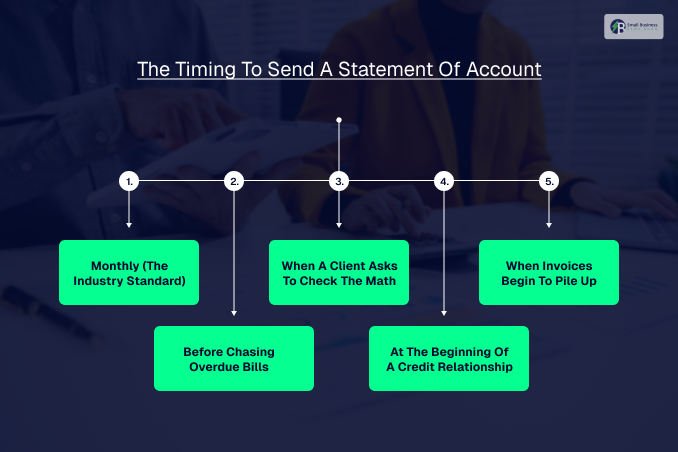
The Timing To Send A Statement Of Account
It is vital to know the right timing of the delivery besides checking the actual content. This ensures proper and ethical billing.
Issuing an account statement when required is an efficient way of tracking accounts receivable.
Not only that, but it also groups various leftover amounts due and puts them into a single document. This way, you can complete the Collections faster.
Here are the five times that are most definitely the best to send a statement of account:
· Monthly (The Industry Standard)
Handing out bills on either the last or first business day of the month is a habit-forming strategy. The regular timing will help prepare customers for payments.
· Before Chasing Overdue Bills
Send a reminder with the bill that is still outstanding as your first step. Rather than a formal, angry letter, the combined bill is a non-hostile, kind note showing them all of the facts they need.
· When A Client Asks To Check The Math
When a customer questions a charge, provide them with the latest statement to settle the issue quickly.
This way, all the financial records related to the dispute can be viewed by both parties to spot or understand their mistakes.
· At The Beginning Of A Credit Relationship
Deliver a document only a month after the new client has first started his/her business with you.
The billing structure and habit will then be set from the very first moment before payment problems arise unexpectedly.
· When Invoices Begin To Pile Up
Suppose a client has three or more unpaid bills. Do not send individual emails for each.
It is more efficient and user-friendly to deliver one combined report, as it is easier to read and not bulky.
Statement Of Account: Examples
To truly see how a statement of account works in real life, it helps to look at a simple example.
Imagine a business called International Company sending a monthly summary to their client, Retail Mart Company, for January 2025.
Here is exactly how those transactions, payments, and balances look when laid out clearly:
Statement of Account
- From: International Company
- To: Retail Mart Company
- Statement Period: January 1, 2025 – January 31, 2025
| Date | Reference | Description | Debit (Invoiced) | Credit (Paid/Returned) | Running Balance |
| Jan 1, 2025 | — | Opening Balance (Leftover from last month) | — | — | $1,200.00 |
| Jan 5, 2025 | INV-0041 | Product Delivery — Order #112 | $3,500.00 | — | $4,700.00 |
| Jan 10, 2025 | PMT-0089 | Payment Received — Thank You | — | $1,200.00 | $3,500.00 |
| Jan 18, 2025 | INV-0045 | Consulting Services — January | $1,800.00 | — | $5,300.00 |
| Jan 22, 2025 | CN-0012 | Credit Note — Returned Goods | — | $300.00 | $5,000.00 |
| Jan 31, 2025 | — | Closing Balance (Total now owed) | — | — | $5,000.00 |
Quick Summary: Total New Invoices: $5,300.00 | Total Payments/Credits: $1,500.00 | Final Amount Due: $5,000.00
You Can Also Check: 9 Best Startup Business Credit Cards With No Credit In 2026
How Can You Read And Understand A Statement Of Account?

At first look, the statement of account may look like a confusing wall of numbers to you.
But if you know its straightforward structure, it really becomes a very user-friendly and beneficial tool for your financial tracking.
We have arranged the different parts of your statement from the upper to the lower part below in order to help you understand the document better:
1. Basics
- Header: This is the top part, which contains the company’s name and logo, contact information, as well as the exact time period the document is covering.
It assures that you are looking at the right paperwork for the right month.
- Customer Info: This section gives the customer’s name, address, and account no.
This ensures that the financial transactions belong to the right customer.
2. The Financial Side
- Opening balance: This is like the starting point. It indicates the remaining balance from the previous month after any new unprocessed transactions.
- Details of Transactions: This represents the core of the document, as it records each invoice, payment, and credit note in order.
Therefore, you can see how the balance has moved with each transaction.
- Closing balance: This is the last total at the lower part. It calculates what the customer is owing right now as a result of all the transactions.
3. Payment Process
- Bank details & payment options: This part tells you the customer’s bank details and the payment methods accepted by the business.
By including this, paying becomes entirely effortless the most reliable method for getting your money faster, by the way.
- Remittance Slip: In the case of a client, it is a practical piece of paper you can add to the payment to inform the accountant of exactly which invoices they are paying off. This one small act can save you many hours trying to sort things out when going through the accounting records later.
What Are The Common Errors That You Must Avoid?
To help you protect your business reputation and maintain completely smooth financial operations, let us look at the most common mistakes and exactly how you can avoid them:
1. Disorganized Balances and Wrongful Numbers
Your calculation will be wrong from the start if your opening balance is wrong or your closing balance isn’t correct.
- How to avoid it: Omitting an entire invoice or duplicating a client payment recording will strongly alter the actual balance.
2. Labeling and Communication Issues
When you attach an invoice with a misspelled name or the wrong account number, it becomes a big mess and can stop your customers from paying.
- How to avoid it: Listing transaction data under the wrong date or period will disconnect the running balance from the rest of the financial tracking, resulting in deep confusion.
3. Forgotten Credits and Differences
At times, client money is recorded mistakenly against the wrong invoice reference numbers.
As a result, the account appears messy even though the totals tally.
- How to avoid it: Always check that the incoming payment corresponds accurately to the invoice number on the payment side of the ledger.
4. Unrecorded Sales Returns or Adjustments
Forgetting to include credit notes for returned goods or special discounts makes the final balance appear much higher than it actually is.
- How to avoid it: Thoroughly review your recent credit notes and ensure all client returns are fully updated before finalizing the paperwork.
How Can A Small Business Use A Statement Of Account?
The statement of account for a small business owner is much more than an uninteresting list of transactions.
Because of that, it’s one of the most important financial management tools, as it keeps you organized and supports wise decision-making.
Furthermore, this straightforward document serves as an excellent help in managing the money-related activities on a daily basis, including things like:
- Firstly, you can chase overdue clients by means of knowing which bills are outstanding. It enables you to send timely reminders.
- You can resolve disputes by producing evidence of a transaction, as you have an exact description of your invoices and payments.
- Lastly, you can have an accurate accounting of your books by matching them with your actual banking records at the end of the month.
Ultimately, regular review of such reports will lead to better cash flow monitoring, giving you a chance to confidently forecast your future expenses and safely expand your business.