
Table Of Contents
- What Is A Personal Loan Emi Calculator And How Does It Work?
- The Underlying Mathematical Formula
- Critical Check: Flat Rate vs. Reducing Balance Interest
- How Do You Use A Personal Loan EMI Calculator Effectively?
- 1. Entering Loan Amount And Tenure Details
- 2. Understanding Interest Rate Impact
- 3. Interpreting Emi And Total Cost Results
- Using The Personal Loan EMI Calculator? Consider These Key Factors
- How Can Calculator Results Help Your Loan Application?
- Real-World Case Study: The True Cost Of Borrowing
- Financial Insight From The Math
- Key Factors to Consider When Reviewing Your Output
- What Are The Common Mistakes To Avoid While Using The Personal Loan EMI Calculator?
- 1. Typing The Wrong Amount
- 2. Negligence Of The Loan Duration
- 3. Overlooking Interest Rates
- 4. Not Paying Attention To Processing Fees And Other Charges
- Using A Personal Loan EMI Calculator Made Easy
- Next Steps To Secure Your Loan
How To Use A Personal Loan Calculator Before You Apply
Last Updated on: August 18th, 2026
Are you jumping into a personal loan without crunching the numbers first? That’s a recipe for stress, or worse, a rejection notice.
Applying without a game plan can hit your credit score and throw your finances off balance, whether it’s:
- Medical bills
- Fixing up your home
- Clearing old debts
That’s where a Personal Loan EMI Calculator steps in. It gives you a sneak peek at what your EMIs could look like.
Additionally, you will be able to compare different loan setups, and help you figure out what’s actually doable—before you even talk to a lender.
What Is A Personal Loan Emi Calculator And How Does It Work?
Think of it as a smart little tool that does the math for you. Pop in three basics: how much you want to borrow, the interest rate, and the repayment period.
In seconds, it tells you the EMI (that’s Equated Monthly Instalment) and the total interest you’ll end up paying.
The Underlying Mathematical Formula
To determine your Equated Monthly Installment (EMI), the calculator processes three distinct variables using this standard formula:
EMI = [P x R x (1+R) ^N]/ [(1+R) ^ (N-1)]
Where:
- P (Principal): The total sum of money you intend to borrow.
- R (Monthly Interest Rate): The annual interest rate divided by 12 months, expressed as a decimal (e.g., 12% annually = 1% monthly = 0.01).
- N (Tenure in Months): The total number of monthly installments over the loan term.
Critical Check: Flat Rate vs. Reducing Balance Interest
Before trusting your calculator’s output, identify which interest type your lender is quoting:
- Reducing Balance Method
The interest is calculated monthly on your remaining unpaid loan balance. As you pay off your principal, the interest amount drops. Most online calculators use this method.
- Flat Rate Method
The interest is calculated on the entire initial loan amount for the full tenure. This means you pay interest on money you have already paid back.
A 12% flat rate is roughly equivalent to a 22% reducing rate. Ensure your EMI calculator matches the specific interest type quoted by your lender to avoid massive budgeting shortfalls.
Most banks and financial sites have these calculators for free—no sign-ups, no personal info needed.
Play around with the numbers, and you’ll instantly see how things shift if you tweak the tenure or amount.
What’s great? You can test multiple “what if” situations before hitting the apply button. Saves you time, saves you stress.
How Do You Use A Personal Loan EMI Calculator Effectively?
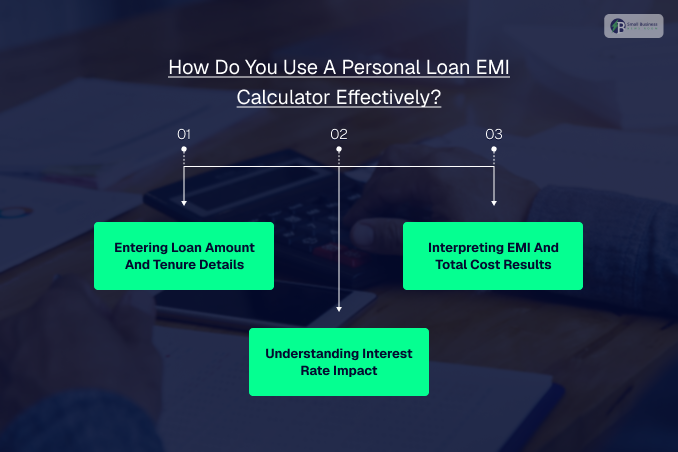
This process will help you understand how you can use a personal loan EMI calculator in the most efficient way.
1. Entering Loan Amount And Tenure Details
Start with the actual amount you need—not a padded figure “just in case.” A personal loan calculator works best when you keep it real.
Then, mess around with different tenures. Shorter terms mean bigger EMIs but less overall interest.
Go longer, and the monthly bite gets smaller, but the total cost climbs. It’s a balancing act.
2. Understanding Interest Rate Impact
Don’t stick to just one rate. Test a few. Even a 0.5% change can make a big difference in what you owe at the end. Check current market rates instead of dreaming up the lowest possible one.
When you see those numbers move, you’ll realize how important the rate really is. It’s not just a small tweak—it can change the whole picture.
3. Interpreting Emi And Total Cost Results
Once you’ve got the results, compare them to what you actually take home every month.
A good rule? Keep all EMIs combined under 40–50% of your income so you’re not gasping for air by month-end.
Also, look at the total cost vs. the principal. That gap? That’s what interest is costing you. Make sure it’s worth it before saying yes.
Using The Personal Loan EMI Calculator? Consider These Key Factors
Don’t stop at the shiny EMI number. Think about your budget after rent, groceries, and other loans.
And hey, life happens—job changes, surprise expenses, all that jazz. Can you still manage?
Also, calculators don’t usually show extra fees like processing charges or penalties for early payments.
So, add those to your mental math so you’re not caught off guard.
How Can Calculator Results Help Your Loan Application?
Walking in with numbers in hand? That’s power. You’ll know exactly what to ask for—no vague guesses.
Plus, comparing lenders gets easier. Instead of just chasing “low EMIs,” you’ll see the bigger picture: the total amount you’ll repay. That’s how you spot a real deal.
And lenders like applicants who do their homework. It makes you look prepared, which might even boost your approval chances.
Real-World Case Study: The True Cost Of Borrowing
To visualize how tenure adjustments directly impact your personal wealth, review this direct comparison of a $10,000 loan executed at a fixed 12% annual interest rate:
| Loan Attribute | Scenario A: Short-Term Payoff | Scenario B: Extended Term |
| Principal Amount | $10,000 | $10,000 |
| Annual Interest Rate | 12% (Fixed) | 12% (Fixed) |
| Repayment Tenure | 36 Months (3 Years) | 60 Months (5 Years) |
| Monthly EMI Payment | $332.14 | $222.44 |
| Total Interest Payable | $1,957.15 | $3,346.67 |
| Total Repayment Sum | $11,957.15 | $13,346.67 |
Financial Insight From The Math
Opting for Scenario B reduces your monthly commitment by $109.70.
However, it increases your total interest out-of-pocket expenses by $1,389.52.
A personal loan calculator makes this financial reality transparent instantly.
Key Factors to Consider When Reviewing Your Output
When looking at your calculated EMI, integrate these macro-financial checks into your evaluation:
- The 40% Debt-to-Income Rule
Ensure your total aggregate monthly debt commitments do not exceed 40% to 50% of your net monthly take-home income.
This includes your potential new loan, rent, credit cards, and existing car loans.
Exceeding this threshold signals high default risk to underwriting algorithms.
- Accounting For Hidden Processing Fees
Standard online calculators focus purely on principal and interest. In reality, lenders levy:
- Upfront processing fees (typically 1% to 5% of the loan amount)
- Documentation charges,
- Severe prepayment penalty percentages.
- Emergency Buffer Evaluation
You need to assess your post-EMI cash flow.
If a temporary job loss or medical emergency occurs, does your remaining monthly income leave room to preserve your credit rating?
- Fixed vs. Floating Interest Rates
If your calculator assumes a fixed interest rate, your EMI will remain identical every month.
However, if you opt for a floating interest rate tied to central bank benchmarks, your monthly EMI or loan tenure will fluctuate. This occurs every time market interest rates shift.
Always build a 1% to 2% rate spike cushion into your repayment calculations.
What Are The Common Mistakes To Avoid While Using The Personal Loan EMI Calculator?
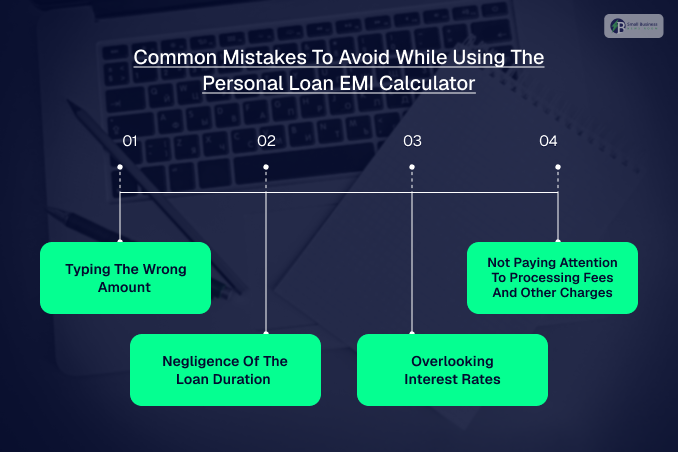
These might look obvious, but still, I know many people who continue to repeat such mistakes. You can take my word for it.
So, it’s better to be safe and sorry. Also, this is a soft reminder that you should be careful the next time you apply for a personal loan.
1. Typing The Wrong Amount
One mistake many people make when using a personal loan EMI calculator is inputting the wrong loan amount.
If you accidentally enter a figure that’s higher than what you actually intend to borrow, the resulting EMI will reflect a payment that’s bigger than what you need.
On the flip side, if you underestimate the amount and put in a figure that’s too low, you might find yourself mistakenly thinking that you can manage the loan comfortably.
This could lead to some financial strain down the road.
So, it’s always a good idea to take a moment to double-check the loan amount you’re considering.
Make sure it matches your financial situation and goals so you can make informed decisions.
2. Negligence Of The Loan Duration
It’s easy to overlook how critical the loan tenure is when borrowing. Many people might opt for a shorter tenure to save on interest.
But they often don’t think about whether their budget can handle the higher monthly EMI payments.
It’s important to take a step back and really assess your financial situation.
Then, once you have thought it out, you can choose a plan that aligns with your income and outgoings.
Finding that balance can make a big difference in your overall financial peace of mind.
3. Overlooking Interest Rates
When it comes to figuring out your personal loan EMIs, the interest rate plays a vital role.
If you overlook it, you might be in for a surprise when the actual amount due turns out to be much higher than you expected.
So, it’s a good idea to always double-check the interest rate. This little step can help you plan your EMIs more accurately.
Additionally, it will help you to avoid any unwelcome surprises down the line.
4. Not Paying Attention To Processing Fees And Other Charges
When borrowers think about taking out a loan, they often focus primarily on the loan amount and the interest rate.
However, it’s really important to look beyond that. Many people overlook other costs like
- Processing fees
- Prepayment penalties
- Late payment charges
If you don’t consider these additional charges, you might end up with an inaccurate picture of what the loan will actually cost you in the long run.
So, it’s a good idea to dig a little deeper and research all the related fees. This will help you create a more accurate and effective financial plan.
Using A Personal Loan EMI Calculator Made Easy
Personal loan calculators aren’t just nice-to-have—they’re a must before applying.
Also, they show you what’s affordable, what’s not, and how much the whole thing will cost you in the long run.
Use them smartly, and you’ll walk in confidently. Also, you will compare offers like a pro and avoid nasty surprises later.
You see, a little planning now saves a lot of stress later.
Next Steps To Secure Your Loan
If you have run your numbers through a personal loan EMI calculator and found a viable monthly payment, proceed with these steps:
- Pull Your Credit Report
Obtain your official credit report from a recognized bureau (like Equifax, Experian, or CIBIL).
This can help you verify that your score qualifies for the interest rate you used in your calculation.
- Gather Income Verification
Organize your last 3 to 6 months of payslips and bank statements to prove your debt-to-income ratio aligns with your calculator inputs.
- Request An Official Loan Estimate
Ask your shortlisted lenders for an itemized breakdown including processing fees.
So you can update your calculator with exact figures.
Read More: