
Table Of Contents
- What Is Treasury Management All About?
- The 4 Main Goals You Need To Know
- 1. Keeping Cash Flowing (Liquidity)
- 2. Balancing Your Daily Money (Working Capital)
- 3. Handling Foreign Currency Risks (FX Risk)
- 4. Managing Changing Interest Rates
- Why Your Business Needs A Treasury Management System (TMS)
- 1. Cash Management
- 2. Bank Relationship Management
- 3. Handling Payments
- 4. Risk & Financial Transactions
- 5. Visualizing Data
- 6. System Connectivity
- What Does Successful Treasury Management Look Like in the Real World?
- Beam Suntory (Future-Proofing Growth)
- Lowe’s (Taming A Massive Bank Environment)
- Align Technology (Mastering Currency Fluctuations)
Why Scaling Businesses Need A Treasury Management System (TMS)?
Treasury management is the ultimate financial backbone of any growing business.
While daily accounting handles routine bills and cash flow, treasury management takes a big-picture, strategic approach to protecting and optimizing a company’s capital.
It acts like a financial crystal ball, guiding high-stakes decisions to ensure long-term stability.
Instead of just monitoring accounts, treasury teams actively mitigate foreign currency fluctuations, manage fluctuating interest rates, secure smart corporate debt, and invest surplus funds wisely.
Ultimately, it keeps organizations resilient against unpredictable market shifts, making sure money is always working efficiently to fuel future business growth safely.
What Is Treasury Management All About?

The heart of treasury management revolves around helping companies achieve both their short-term and long-term goals.
Like a final financial protection network, it helps the company handle and monitor its cash flow efficiently, avoid risks, and utilise money to the best extent possible.
It’s also a crucial factor in planning for the company’s future. Take an instance: you need the correct data if you want to figure out precisely:
- The moment your company turns a profit,
- The extra amount of money you have to borrow to grow your business for the coming years.
In this way, the process can be regarded as your financial crystal balls.
The consideration of such comprehensive strategies is an everyday practice for large organisations that deal with huge volumes of money, like banks, governments, and corporations.
They need to maintain a good balance between never being short on cash and not having millions of idle dollars lying there without working.
The 4 Main Goals You Need To Know

Let’s understand the core purposes of finance teams by first identifying the four main goals that they generally focus on:
1. Keeping Cash Flowing (Liquidity)
Simply, this means having enough cash available to cover your immediate expenses, such as daily bills like paying salaries to your employees or vendors.
Moreover, if you are in a situation where your customers delay their payments, effectively managing the above-mentioned is essential, as it allows you to always have a reserve for unexpected events.
2. Balancing Your Daily Money (Working Capital)
This is what you have minus your liabilities; you’re essentially the difference. Finance departments aim at keeping this balance optimal.
For instance, if you only operate with too few funds, you will end up being unable to pay your vendors or to explore investment opportunities that you think may generate higher turnover.
3. Handling Foreign Currency Risks (FX Risk)
An enterprise that purchases or trades in another country is naturally exposed to fluctuating exchange rates.
When the value of one of the currencies used changes, it leads to a loss of profitability.
Finance directors counter this by, for example, developing internal mechanisms or agreements that allow the company to stay protected from changes in exchange rates.
Therefore retain more profits through such hedging activities.
4. Managing Changing Interest Rates
Interest rates are set based on macroeconomic conditions, which result in their fluctuation.
Imagine your company has substantial debt and suddenly the Interest rates rise.
Then, the loan repayments for your company can be very expensive if the interest rate has spiked.
Through proper arrangement and planning, one’s debts can be kept sustainable in the face of all market changes.
This whole practice plays the role of the financial backbone of an enterprise. With such a financial strategy, you will always know, money-wise, that things are under control.
There are also ways of investing, the legal aspects being dealt with, and the company getting a brighter future in sight!
Moreover, it means that all these activities are aimed at making sure an organisation is stable, legal, and growing.
You Can Also Check: 9 Best Startup Business Credit Cards With No Credit In 2026
Why Your Business Needs A Treasury Management System (TMS)
Managing money across different borders, banks, and currencies can feel like spinning plates while riding a unicycle.
This is exactly where a cloud-based Treasury Management System (TMS) steps in to save the day.
It untangles the chaos, automates the boring stuff, and gives you a single, clear dashboard to manage your entire financial world.
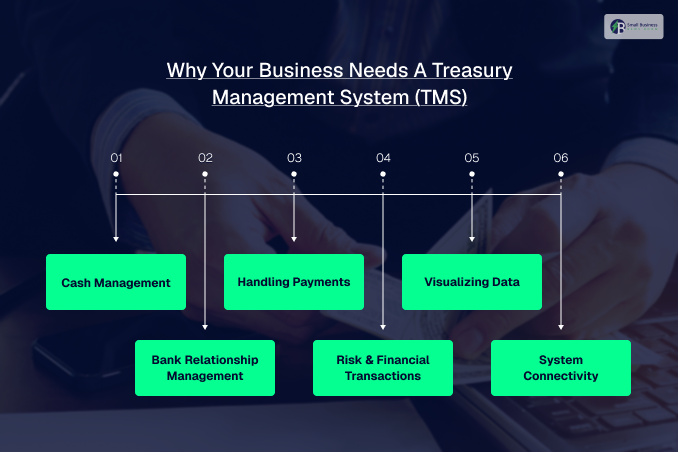
To show you exactly how a cloud-based TMS turns major financial headaches into easy wins, here is a quick breakdown:
1. Cash Management
Common Headaches: It is incredibly hard to get a clear, global view of your cash and accurate forecasts.
This lack of visibility wastes time and leaves extra money sitting idle instead of earning returns.
How a Cloud-Based TMS Helps: It hooks up directly to all your global banks to automatically calculate your cash positions and forecasts.
Moreover, this frees up your team to focus on smart investing.
2. Bank Relationship Management
Common Headaches: Managing dozens of different bank accounts makes it nearly impossible to keep track of:
- Who is allowed to sign off on accounts,
- Or if you are being overcharged on fees.
How a Cloud-Based TMS Helps: It bundles everything into a centralised suite.
You can easily track official account signatories, manage international reporting compliance, and audit your bank fees.
3. Handling Payments
Common Headaches: Using multiple different bank logins to make payments drives up operational costs and creates massive security blind spots for fraud.
How a Cloud-Based TMS Helps: It acts as a single, highly secure payment hub. It comes with built-in fraud prevention tools and standard bank file formats, reducing security risks.
4. Risk & Financial Transactions
Common Headaches: Financial data often gets trapped across scattered spreadsheets and separate ERP systems.
This is what leaves you completely blind to market shifts.
How a Cloud-Based TMS Helps: It brings your foreign exchange (FX) exposure, interest rates, debt, and investments into one place.
It also handles complex risk analysis and hedge calculations for you.
5. Visualizing Data
Common Headaches: Financial leaders need custom dashboards to make quick decisions.
However, building them without a dedicated system is a nightmare.
How a Cloud-Based TMS Helps: It builds tailored dashboards and visual reports using live data from your internal enterprise platforms and external market sources.
6. System Connectivity
Common Headaches: Treasury teams struggle to pull real-time data from trading systems, market providers, and custodians simultaneously.
How a Cloud-Based TMS Helps: Leading systems offer specialized “Connectivity-as-a-Service” features, giving you an end-to-end link to the entire global financial ecosystem.
Related Article For You: Tax Compliance for Startup Entrepreneurs: How to Do It? (2026)
What Does Successful Treasury Management Look Like in the Real World?
There is not just one single way to transform your financial operations. You can start by fixing your payment setups, cutting down on bank fees, or standardizing your daily workflows.
And this depends on what your business needs most right now,
Here are three real-world examples of how major global brands used a TMS to level up their finances:
Beam Suntory (Future-Proofing Growth)
The massive beverage company behind brands like Jim Beam chose to modernise their global operations across a highly decentralised team.
They built a resilient, seamless network by connecting their ERP systems, TMS, and payment platforms together.
Moreover, this gave them total confidence in their daily cash visibility and protected their long-term business continuity.
Lowe’s (Taming A Massive Bank Environment)
Imagine trying to manage over 2,000 separate bank accounts spread across 33 different banks!
That was the reality for the home improvement giant Lowe’s.
They can now instantly run big-picture reports to spot banks overcharging them by using specialised bank fee analysis tools.
Moreover, they can easily drill down to the store level to catch unapproved account activity.
Align Technology (Mastering Currency Fluctuations)
The makers of Invisalign built a robust foreign exchange hedging program to protect their profits from wild currency swings.
They seamlessly integrated their TMS software with their central SAP ERP system, allowing them to:
- Instantly run data integrity checks,
- Validate their financial exposure,
- Catch data errors before they caused problems.
At the end of the day, whether you are trying to wrangle thousands of bank accounts or protect your earnings from shifting global markets, a great treasury setup gives you the clarity and control you need to scale safely.