
Table Of Contents
- What Is Transactional Leadership?
- The Core Characteristics Of A Transactional Leader
- 1. Emphasis On Organization And Hierarchy
- 2. Management By Exception
- 3. Practical And Realistic
- 4. Monitoring And Micromanagement (Depending On The Context)
- Real-Life Examples Across Industries
- 1. The Automobile And Sales Industries
- 2. The Healthcare Industry
- 3. The Hospitality Industry
- 4. The Technology Industry
- Transactional Vs. Transformational Leadership: The Direct Comparison
- The Bright Side: Benefits Of Transactional Leadership
- The Dark Side: Challenges And Limitations
- Crushes Innovation And Creativity
- Creates Low Morale And Stress
- Fails To Inspire "Extra Effort"
- Fosters Unhealthy Internal Competition
- Expert Tips: How To Balance And Implement It Successfully
- 1. Inject Purpose Into Everyday Tasks
- 2. Involve Your Team In Goal Setting
- 3. Personalize Your Rewards System
- 4. Invest In Employee Growth And Development
Why Transactional Leadership Is The Secret Engine Of Successful Companies?
Many of us had a boss who set targets on day one, monitored our progress daily, and offered explicit rewards to those who delivered and swift corrections to those who didn’t.
This is transactional leadership, and in the business world, it’s often derided as ineffective vis-à-vis transformational leadership.
But with industry experience, you realize there is no transformational leadership without the rock-solid foundation of transactional leadership.
After all, grand visions and mission statements will never be realized if no one knows who is responsible for what or who manages the inventory.
This ultimate guide to transactional leadership explains its definition, examples, advantages, and disadvantages, as well as how to balance it with other leadership styles to maximize productivity.
What Is Transactional Leadership?
Simply put, transactional leadership is a transaction-based approach to management that focuses on the exchange between the leader and the follower.
In other words, it emphasizes rewards for performance and expressions of satisfaction with the status quo.
It is a task-oriented, incentive-driven leadership style that prioritizes stability through rewards for good performance and punishment for failures.
Transactional leaders motivate their followers by providing extrinsic rewards for desired behaviors and punishing them for undesirable behaviors.
They focus heavily on the present and have little interest in future-oriented discussions, innovation, and transformation.
The Core Characteristics Of A Transactional Leader
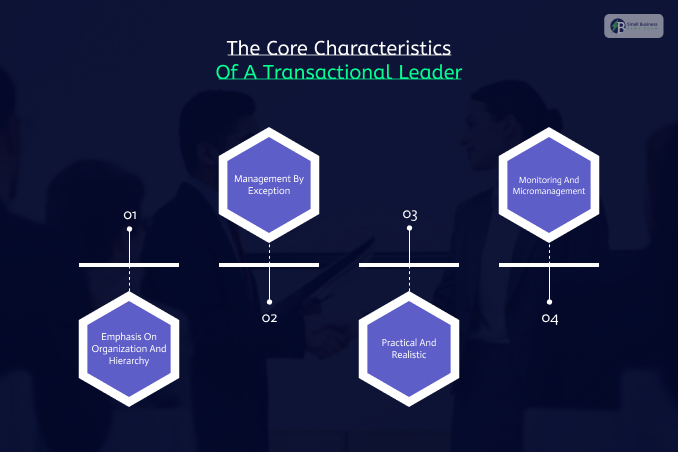
To truly understand how this style plays out in real life, let’s look at the primary traits that define a transactional leader:
1. Emphasis On Organization And Hierarchy
Within a transactional framework, the rules are clear, and the organization chart has little room for ambiguity.
Furthermore, the leader bears responsibility, and employees are expected to carry out their duties as ordered without questioning or hesitation.
2. Management By Exception
In other words, transactional leaders adopt a wait-and-see attitude and only intervene when processes are not performing up to standard.
As such, their feedback is mostly corrective and occurs when a problem has occurred, not as a proactive measure.
3. Practical And Realistic
Transactional leaders dislike lofty ideas, theories, or concepts and prefer realistic, pragmatic approaches to solving immediate problems.
They rely on tested and proven methods and avoid speculation or extrapolation from past experiences.
4. Monitoring And Micromanagement (Depending On The Context)
Because the primary objective of transactional leadership is to ensure nothing goes wrong, the leader must constantly review subordinates’ performance.
This may involve micromanagement to ensure total compliance with the standard operating procedures and promote uniformity in production.
Real-Life Examples Across Industries
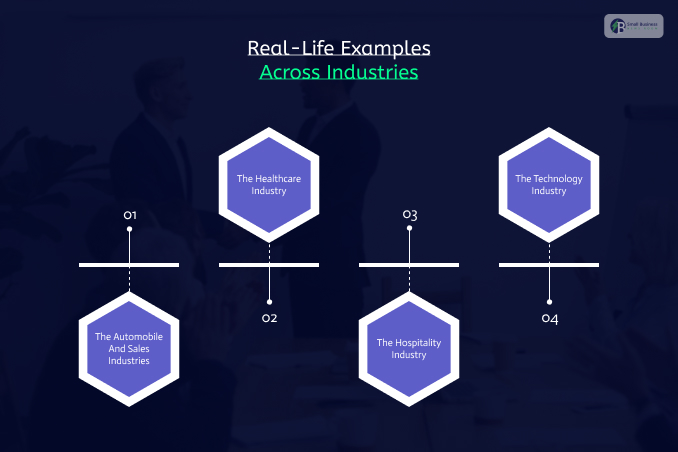
Transactional leadership is the default leadership style in several industries that require a high degree of specialization, standardization, and monitoring.
Here are some real-life examples.
1. The Automobile And Sales Industries
When you visit a local car dealer, you’re likely to see a prime example of transactional leadership in action.
The sales manager has specific and measurable targets for the quarter or the year.
If a car salesperson meets their targets, they reward them with a hefty commission and the title of “Salesperson of the Month” – and punish them if they underperform.
This dynamic is a perfect example of a transactional exchange of value.
2. The Healthcare Industry
Healthcare workers operate in a highly regulated environment where mistakes can mean the difference between life and death.
Moreover, hospital administrators and head nurses use transactional leadership to encourage staff to strictly follow uniform procedures when caring for patients and operating the facility’s delicate machinery.
As such, nurses cannot take liberties with the specific drugs, dosages, and procedures required to treat particular illnesses.
By minimizing deviations, the chance of errors is greatly reduced.
3. The Hospitality Industry
Whether you visit a fast-food joint or a fine-dining restaurant, meals often taste much the same, and staff greet you and escort you to your table in a similar way.
This happens because the hospitality industry relies on strict standards to maximize customer satisfaction, and transactional leadership best supports that goal.
Managers set specific standards for their employees and reward them handsomely for meeting them.
4. The Technology Industry
IT professionals operate in a precise environment focused on minimizing downtime and ensuring customer satisfaction.
As such, a helpdesk manager sets specific, measurable targets for developers, testers, and technical support analysts.
For example, they set a strict Time-to-Resolution (TTR) threshold for tickets. Employees who meet this standard earn quarterly monetary rewards, while those who miss it face performance reviews.
Transactional Vs. Transformational Leadership: The Direct Comparison
To understand where transactional leadership fits in your organization, it helps to compare it with transformational leadership.
| Feature | Transactional Leadership | Transformational Leadership |
| Primary Focus | Short-term goals, daily tasks, and operational efficiency. | Long-term vision, big changes, and innovation. |
| Motivation Type | Extrinsic (rewards, bonuses, penalties). | Intrinsic (shared values, purpose, passion). |
| Work Environment | Thrives in stable, structured, predictable settings. | Thrives in dynamic, creative, changing settings. |
| Leader’s Role | Monitors progress closely and fixes errors. | Acts as a coach, mentor, and visionary role model. |
| Employee Behavior | Completes required tasks efficiently without extra effort. | Puts in “extra-role” effort to go above and beyond. |
The Bright Side: Benefits Of Transactional Leadership
When implemented correctly, transactional leadership offers massive benefits that keep businesses profitable and stable:
Absolute Clarity: Everyone knows their job description, who they report to, and how their success is measured.
This eliminates workplace confusion and reduces standard onboarding time for new hires.
High Efficiency and Consistency: Standardized processes keep work quality predictable and reliable. Tasks are completed on time and meet strict company standards.
Strong Individual Accountability: The direct link between performance and rewards keeps employees focused on their metrics.
It creates an environment where hard work is instantly tangibly rewarded through bonuses or incentives.
Excellent Fast Problem-Solving: Because the leader is focused on numbers, any dip in performance is spotted immediately.
Furthermore, this lets the team correct course before a small issue becomes an expensive disaster.
You Can Also Check: What Is Human Resource Management And How It Secretly Drives Profit
The Dark Side: Challenges And Limitations

Despite its operational strengths, if you are planning to rely on transactional leadership for your business, it might cause you serious issues over the long haul:
Crushes Innovation And Creativity
If employees are only rewarded for following existing rules, they will never suggest new or better ways of doing things.
Furthermore, this makes the organization highly vulnerable when market conditions suddenly change.
Creates Low Morale And Stress
Constant monitoring and strict metrics can make employees feel like replaceable cogs in a machine.
Moreover, over time, this leads to emotional burnout and high staff turnover.
Fails To Inspire “Extra Effort”
Under pure transactional leadership, employees will do exactly what is required to get their paycheck or bonus—but nothing more.
They will rarely volunteer to help a teammate or improve company culture.
Fosters Unhealthy Internal Competition
When rewards are heavily tied to individual performance metrics, team members may begin competing against one another.
This helps create workplace tension and kills collaboration.
High pressure on strict metrics and a lack of intrinsic motivation lead to high burnout, which ultimately damages employee retention over the long haul.
Expert Tips: How To Balance And Implement It Successfully

The secret to great leadership is realizing that transactional and transformational styles are not enemies.
Instead, you can say they’re two halves of a whole. Transactional leadership builds the firm administrative foundation, while transformational leadership builds the inspired company culture.
If you want to use transactional methods without destroying team morale like the ethical leadership, follow these expert implementation tips:
1. Inject Purpose Into Everyday Tasks
Do not just tell your team what the target is. Explain why it matters.
For example, if you run a tech support team, remind them that resolving tickets quickly is not just about keeping the chart green.
It is about helping a frustrated small business owner get their shop back online.
Moreover, connecting tasks to a larger purpose completely transforms how employees view routine work.
2. Involve Your Team In Goal Setting
Sit down with your employees and get their input when creating team goals, instead of handing down strict quotas from a hidden boardroom,
When people feel like they have a voice in defining their expectations, their sense of ownership and personal accountability skyrockets.
3. Personalize Your Rewards System
Not every employee is motivated purely by money. Now, the bonuses are great. Some team members might value extra paid time off more.
Moreover, public recognition during a company meeting or a funded spot in a professional development course.
Taking the time to tailor your rewards shows your team that you value them as unique individuals.
4. Invest In Employee Growth And Development
Even within a highly structured system, make sure your team has a clear path forward. Act as a coach or mentor. Also, provide regular constructive feedback that helps them build new skills so they don’t feel stuck in repetitive, boring routines.