
Table Of Contents
- What Exactly Are Employee Benefits?
- Why Do Employee Benefits Matter So Much?
- 1. Attracting High-Quality Workers
- 2. Decreasing Employee Turnover
- 3. Increasing Workplace Satisfaction
- 4. Enhancing Workplace Productivity
- 5. Ensuring Compliance And Safety
- The Three Core Tiers Of Modern Workplace Perks
- Deep Dive: 8 Essential Categories Of Employee Benefits
- Healthcare And Wellness Support
- Financial Benefits
- Paid Time Off And Leave Benefits
- Flexible Work Benefits
- Learning And Development Benefits
- Family Benefits
- Commuter Benefits And Office Perks
- Fun Lifestyle Additions
- Step-By-Step Guide: How To Build A Stellar Benefits Package
- Step 1: Set Your Realistic Budget
- Step 2: Survey Your Current Team
- Step 3: Cover The Legally Required Minimums
- Step 4: Layer In Competitive, Industry-Standard Rewards
- Step 5: Communicate The Benefits Clearly
A Guide To Modern Employee Benefits: How Ethical Leadership Drives Retention And Workplace Morale
An excellent employee benefits package offers numerous perks that go beyond the average paycheck to support an individual’s health, family, and finances.
Transactional leadership prefers to view compensation as a give-and-take tool for short-term productivity.
Benefits are unlikely to drive strong performance and workplace commitment in the long term.
Instead, ethical leadership should base employee benefits on a combination of moral principles and compensation policies in order to attract and retain high-quality workers.
After all, comprehensive health benefits, flexible working hours, and retirement benefits are critical elements of an employee benefits package designed to improve workers’ well-being and organizational performance.
What Exactly Are Employee Benefits?
An employee benefits package includes compensation and rewards provided to workers in addition to their salary.
In short, benefits are a form of welfare employers provide to help workers live and thrive both inside and outside the office.
Some benefits are mandatory by law, while others employers add at their discretion.
Benefits can also be viewed as incentives for both employees and employers.
The former requires individuals to dedicate their time, effort, and skills to the organization, while the latter provides compensation, job stability, and a safe working environment in return.
Why Do Employee Benefits Matter So Much?
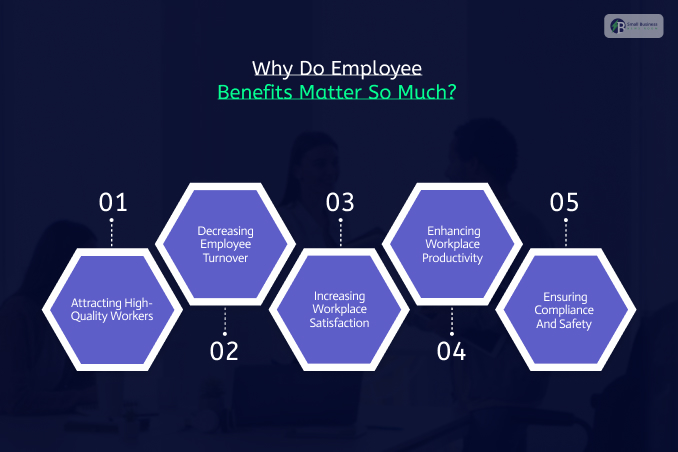
Large corporations no longer view a comprehensive, attractive benefits package as a luxury.
Instead, offering a diverse range of employee benefits has become a necessity for organizations that want to remain competitive in their market.
Below are the main reasons why an employer should invest in employee incentives:
1. Attracting High-Quality Workers
The modern workplace environment is highly competitive. As a result, employers must offer attractive benefits to recruit qualified workers.
In particular, job seekers not only review the offered salary range but also compare the benefits offered by different employers.
This is especially important for specialists, as attracting qualified workers in fields such as IT or engineering is extremely difficult and time-consuming.
2. Decreasing Employee Turnover
Recruiting and training new workers is time- and resource-consuming.
Therefore, organizations must provide workers with the benefits needed to promote retention.
More specifically, people are more likely to stay with an organization if their health, retirement, and family needs are addressed.
3. Increasing Workplace Satisfaction
Employers must support employees’ emotional needs if they want loyalty and commitment from their subordinates.
For instance, individuals who are constantly concerned about financial or health-related issues cannot provide their employer with the necessary dedication and productivity.
4. Enhancing Workplace Productivity
Sick and exhausted workers are far less productive than those with the tools to maintain a healthy, balanced lifestyle.
An effective way to increase workplace productivity is to provide employees with adequate paid time off and wellness benefits.
5. Ensuring Compliance And Safety
Employers must provide certain employee benefits because the law requires them.
Therefore, organizations must remain compliant to avoid litigation and legal repercussions.
The Three Core Tiers Of Modern Workplace Perks
Before diving into specific examples, it helps to understand how corporate perks are structured.
Generally, everything an employer offers falls into one of three distinct categories:
| Benefit Tier | Definition | Core Examples |
| Mandatory Benefits | Perks strictly required by federal, state, or local labor laws. | Social Security, Workers’ Compensation, Unemployment Insurance. |
| Industry-Standard Benefits | Expected perks that are not legally required but crucial to stay competitive. | Group Health Insurance, 401(k) Match, Paid Annual Vacation. |
| Fringe / Lifestyle Benefits | Creative, optional extras used to delight teams and improve daily life. | Gym Memberships, Home Office Allowances, Free Office Snacks. |
Deep Dive: 8 Essential Categories Of Employee Benefits
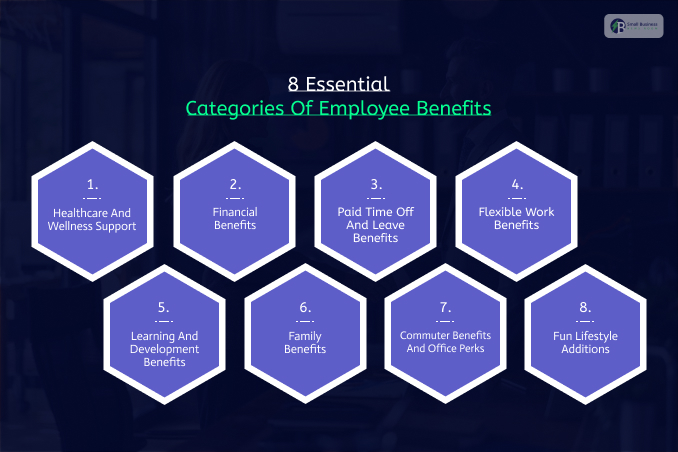
To build a world-class workplace culture, an organization should offer employees a comprehensive set of benefits that support different areas of life.
Let’s take a closer look at the key types of employee benefits packages that a company may consider offering in the modern workplace:
Healthcare And Wellness Support
Health insurance is the top priority in any benefits package because medical bills can be crippling at any time. High-quality healthcare assistance includes the following:
- Comprehensive health insurance that covers inpatient and outpatient procedures, treatments, and prescriptions.
- Dental and vision care that helps employees access affordable dentists, optometrists, braces, contacts, and more.
- Emotional wellness support that helps staff access confidential counseling, therapists, and premium mental health apps.
- Telemedicine that allows doctors to conduct video consultations with employees to avoid long queues at the clinic.
- Wellness stipends that provide a monthly allowance for working out at the fitness center or buying ergonomic chairs.
Financial Benefits
Financial benefits are also critical because they help employees save for a comfortable retirement.
There are several types of financial benefits, including the following:
- Retirement benefits include 401 (k) savings plans and pensions. They allow employees to make annual contributions to their retirement funds on a pre-tax basis, with the company’s tax deduction.
- Life insurance is essential to provide financial support to an employee’s dependents in case of death.
- Disability benefits offer salary replacement to employees who are temporarily disabled due to an illness or accident.
- Flexible spending accounts and health savings accounts allow workers to make tax-free contributions to pay for eligible medical expenses.
- Employers can cover student loan repayments to help young professionals pay off their college debt.
Paid Time Off And Leave Benefits
Employers must offer paid time off and leave benefits to help the staff rest and recover between two work assignments. The following benefits fall under this category:
- Vacation or personal leave is a type of paid time off that allows employees to take a break and go on a trip.
- Unlimited PTO (personal time off) lets workers take as much vacation time as they need to recharge.
- Sick leave is a form of paid time off that lets people stay home when they are sick or need to care for a dependent with a contagious illness.
- Parental and maternity leave benefits let expecting mothers and fathers take a break before and after childbirth.
- Sabbaticals are another type of paid time off, and they usually last 1-3 years and are available after every 5 years of work.
Flexible Work Benefits
The modern workforce is obsessed with flexibility and demands remote work arrangements as a minimum viable requirement.
Flexible work benefits play a critical role in supporting a healthy work-life balance and promoting staff satisfaction.
- Working from home eliminates the need to commute to the office.
This option is also essential for multinational corporations, since physical proximity can create geopolitical issues.
- Flexible hours allow people to manage their schedules and responsibilities.
- A four-day workweek is another way to help people find a better work/life balance. It suggests that the standard workweek should only consist of 4 days instead of 5.
- Summer Fridays are the Fridays during the summer when workers can leave early on a regular basis.
Learning And Development Benefits
Employers must offer learning and development benefits to help the staff gain new competencies and achieve professional growth.
- Tuition reimbursement programs are one of the best ways to support employees in acquiring new skills.
In exchange for the employer’s annual payments, students should commit to working for the company for at least 5 years.
- Learning stipends are funds a company provides to help a worker pursue an advanced degree. Usually, the employer covers a percentage of the tuition fee.
- Education assistance programs are another type of learning stipend, designed for employees who must attend conferences, seminars, or training sessions. The organization covers travel, lodging, and meal expenses.
- Mentorship programs allow mentors and mentees to build relationships and exchange expertise, which ultimately leads to faster career growth.
Family Benefits
Employers should also provide a comprehensive set of family benefits to reduce the stress associated with raising and educating children.
- Childcare benefits can be in the form of company-sponsored day-care centers or reimbursements for these expenses.
They are necessary for both parents who have to return to work after maternity leave.
- Family leave is another benefit that allows workers to spend more time with their children.
- Family planning assistance is another type of family benefit that offers a wide range of support to help employees and their partners decide to have a child.
Commuter Benefits And Office Perks
Commuter benefits and office perks are essential to ensure business continuity and support high standards of living for the staff.
- Firstly, commuter benefits include tolls, public transport fares, and parking passes.
Alternatively, an employer can offer shuttle services and childcare benefits. Other perks include company-owned cars and airline passes for the executive team.
- Office perks are also critical to maximize efficiency and employee satisfaction.
Perks vary by company but usually fall into categories like food, drinks, and home furnishings.
- A company can provide a stipend to remote workers to buy monitors and other office equipment.
Fun Lifestyle Additions
Fringe lifestyle perks are optional and add personality to your brand while making your employees’ day-to-day lives more enjoyable.
- Corporate pet insurance can help dog or cat owners save thousands of dollars a year on expensive veterinarian bills.
- Exclusive employee discounts are another way to show your staff appreciation. You can partner with different retailers, gyms, airlines, and movie theaters to provide substantial benefits.
You May Also Love To Read: How To Master Target Company Url Research: A Complete Guide To Cleaning Your B2B Data.
Step-By-Step Guide: How To Build A Stellar Benefits Package
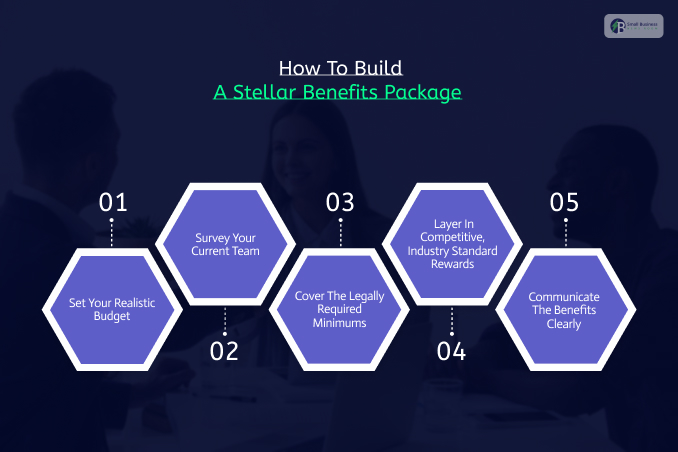
If you are an entrepreneur or manager designing a great perks strategy, you may feel overwhelmed.
Here are the most critical steps to build a winning benefits package your employees will love:
[1. Set a clear budget] ➔ [2. Survey team needs] ➔ [3. Cover legal minimums] ➔ [4. Add key standard perks] ➔ [5. Communicate clearly]
Step 1: Set Your Realistic Budget
Before you start looking for insurance companies, establish how much your business can reasonably afford.
Step 1 includes direct costs of implementing a benefits package, plus indirect costs (additional software, hours spent on administrative tasks).
Step 2: Survey Your Current Team
Don’t assume you know your employees’ needs. Instead, conduct anonymous surveys or organize meetings with your team to understand what they value most.
A group of young remote graduates will have different preferences versus a team of experienced parents.
Step 3: Cover The Legally Required Minimums
You need to meet federal and regional regulations to avoid getting into legal issues. Step 3 serves as a vital foundation for the rest of your compensation strategy.
Step 4: Layer In Competitive, Industry-Standard Rewards
Research the most popular benefits at your competitors’ workplaces and think about what your employees value most.
Then, identify high-priority items like comprehensive health insurance and a 401K match.
The latter is a must because it helps your company grow its talent pool.
Step 5: Communicate The Benefits Clearly
Your employees will benefit from a well-structured digital guide that will explain how they can maximize the advantages of your perks strategy. A clear, concise communication strategy ensures workers can actively engage with the different benefit offerings.
Additional Resource: Why Your Business Will Fail Without It: What Is Human Resource Management And How It Secretly Drives Profit