Table Of Contents
- What Is An ATM Business And How Does It Work?
- · The Surcharge Fee
- · Interchange Revenue
- · More Foot Traffic
- Biggest Benefits Of Starting An ATM Business
- How To Start An ATM Business?
- Step 1: Establish Your Legal Entity
- Step 2: Find The Right Locations For Your ATM
- Step 3: Choose An Atm Payment Processor
- Step 4: Buy An ATM Machine
- Step 5: Install And Setup Your ATM
- Step 6: Load Cash And Start Earning
- Starting An ATM Business: Is It Profitable?
- Where To Buy Your ATM Machine
- New vs. Refurbished ATM
- Important Pre-Purchase Checklist
- Two Ways To Get An ATM Into A Store
- The Buying Option
- The Placement Program
- Setting Up The Machine
- How To Manage Your ATM Service On A Daily Basis
- · Cash Reloading
- · Software Monitoring
- · Maintenance
- Important Legal Requirements
The Ultimate ATM Business Blueprint: How To Make $5,000/Month In Pure Passive Income On Autopilot!
Imagine waking up and checking your phone, only to realise you have made money while you slept.
Truly, this is one of the scenarios one can consider when starting an ATM business.
In fact, you can start making a decent monthly income from your investment in the machines as a matter of fact.
You stand a chance of earning $300 to $1,000 per machine per month.
The whole process is rather simple. The company sells you the machine, and you install it in a local establishment.
You split the small fee that the establishment makes on every transaction in half, and you are off to the races.
The only work you have to do from then on is to show up every now and then and ask them to load the machine with cash.
Moreover, the total investment in the machine could range from $3,000 to $10,000.
It is rather easy to jump on board with this business, and you do not even have to worry about licenses in most cases.
However, there is one major caveat. The location is everything.
If you can get a machine placed in a high-end bar or restaurant that is booming with cash transactions, you might just be able to recoup your investment in less than six months.
On the other hand, if you cannot find such a location, it might take significantly longer for the business to turn a profit.
Are you ready to discover how to secure the best locations, sell to the local shop owners, and turn a decent profit? Let’s get started.
What Is An ATM Business And How Does It Work?
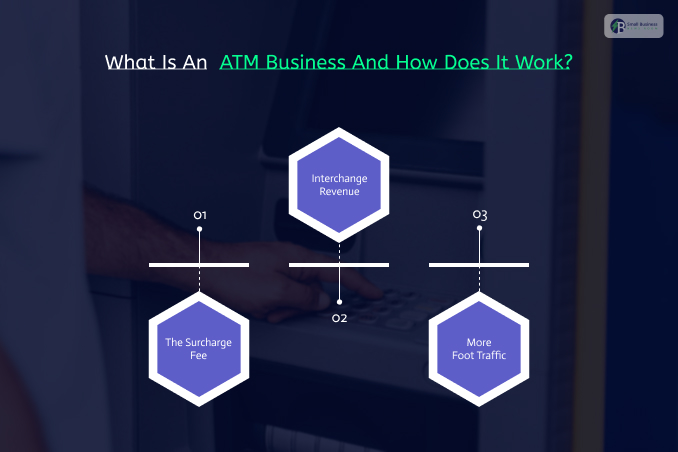
An atm business is an excellent source of passive income. You buy or host an atm, place it in a convenient location, and profit from every customer’s withdrawal.
However, the atm business model allows you to make money in three different ways:
· The Surcharge Fee
The most substantial source of revenue in the atm business is the convenience fee for using your machine. Most customers are charged $2.50 to $4.00 per withdrawal.
· Interchange Revenue
In addition to the surcharge, you can earn money when the customer’s bank processes the withdrawal.
· More Foot Traffic
If you already have a retail shop, installing an ATM can attract more customers willing to spend money.
Despite the prevalence of digital transactions, cash remains king in the modern economy. Local convenience stores, barbers, nightclubs, gas stations, dispensaries, and other retail shops are highly dependent on physical money.
Biggest Benefits Of Starting An ATM Business
With low overhead and high profitability, this is one of the best side hustles you can ever think of:
- Low startup costs: You can purchase your first machine without spending a fortune
- High-profit margins: You retain a significant percentage of the revenue from every transaction
- Fast cash flow: Most atm owners recover their startup costs within 3 to 6 months
- Passive income: You can make money 24/7 with little effort
- Minimal maintenance: Your machines only require occasional cash refills
- Easy scalability: You can significantly grow your business by adding more machines to your network
If you want to learn how to start an atm business the right way and avoid the most common mistakes, this guide will help you tremendously.
How To Start An ATM Business?
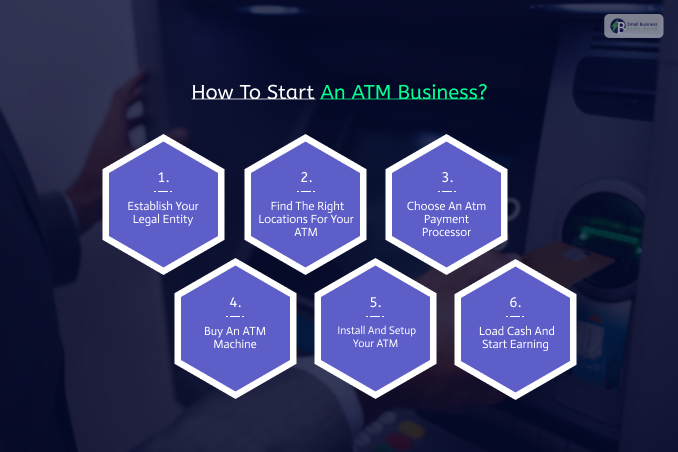
An ATM business is an excellent way to generate passive income, but it is crucial to follow a specific plan to avoid losing your investment.
Below, you will find a simple step-by-step guide to help you open your first ATM and start earning in 2026.
Step 1: Establish Your Legal Entity
Before purchasing an atm machine, you need to complete several legal formalities to protect your business.
First, set up an LLC and get an EIN from the IRS. Then, open a business bank account to hold the money from your ATM.
Step 2: Find The Right Locations For Your ATM
Now, you need to find the right places for your atm. The best locations are usually in bars, nightclubs, laundromats, gas stations, barber shops, and other cash-intensive businesses.
Explain the benefits of installing your machine to the owner, and agree on the commission percentage you will pay them (usually $0.25 to $1.00 per withdrawal). Always sign a contract with them that will outline their terms and conditions.
Step 3: Choose An Atm Payment Processor
You also need to find an atm payment processor that will facilitate the transactions between your machine and the banks.
Choose the processor with the best fee schedule that refunds the full surcharge and offers a mobile app for managing your ATM.
Step 4: Buy An ATM Machine
Now, it is time to purchase an atm machine. You can choose from various providers that offer different models of atm machines.
Make sure to buy the most reliable machine with the latest technology.
Step 5: Install And Setup Your ATM
After buying your machine, you need to install and set it up in your location. You can either do it yourself or hire a professional installer. Make sure to bolt the machine to the floor and connect it to the internet.
Step 6: Load Cash And Start Earning
The final step is to load cash into your machine and start earning money. You can do it by inserting your vault cash directly into the machine.
Set your surcharge fee (usually $2,000 to $3,000 in nice bills of $20). Then, monitor your atm’s performance from your mobile app and periodically reload cash to keep it running.
Starting An ATM Business: Is It Profitable?
Yes, an atm business is highly profitable if you pick the right spot! Let’s take a look at the numbers.
On average, a good machine handles 6 to 8 transactions daily. With a standard fee of $3.00 per withdrawal, one machine easily pulls in $500 a month in clean, passive cash.
Because of this steady flow, most owners recoup their initial setup costs in just 5 to 6 months.
After that, your only real expense is splitting a small cut with the store owner.
Therefore, once you scale up to just five busy machines, you are looking at an extra $2,500 every month. It is a proven, data-backed way to build real wealth with very little daily effort.
Where To Buy Your ATM Machine
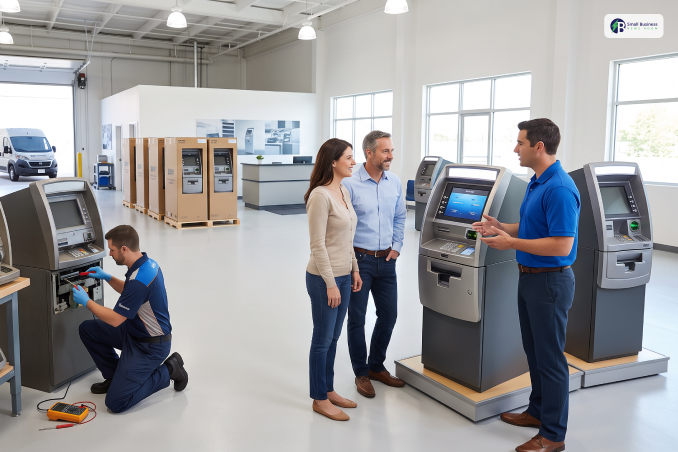
When buying an ATM machine, it is advisable to purchase it from a trusted dealer rather than a peer-to-peer marketplace.
For instance, you can buy a new ATM machine from ATMTrader, as they provide excellent customer support and technical expertise backed by NationalLink’s 30+ years in the industry.
New vs. Refurbished ATM
You can also buy a refurbished atm machine to save some money on your business. However, make sure to purchase it from a reliable dealer that offers technical support and parts replacement. New ATMs are usually the best option, as they offer the latest technology and security features.
Used ATM machines are cheaper, but you have to ensure that they are not outdated and have all the necessary parts.
Important Pre-Purchase Checklist
You just need to make sure it ticks these four essential boxes before you hand over your money for any machine:
| Requirement | Why It Matters |
| EMV Chip Compliance | Protects your business from fraud by securely reading modern chip cards. |
| ADA Accessibility | Ensures the machine is at the right height and has features for customers with disabilities. |
| Right Cash Capacity | Matches how much money the machine holds with how busy the location actually is. |
| Processor Compatibility | Connects smoothly to your banking network and supports tap-to-pay (NFC). |
Two Ways To Get An ATM Into A Store
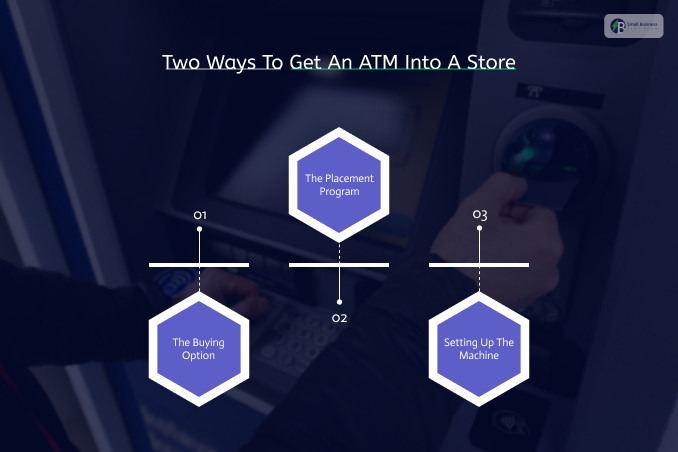
If you are a store owner, here are generally two options open to you:
The Buying Option
This involves buying the machine yourself and, consequently, keeping 100% of the fees.
However, you have to manage and install it yourself, and reload the cash as well.
The most popular machines in this category are Hyosung Halo II and Genmega G2500.
The Placement Program
Under this option, the company installs the machine in your store for free and manages it, including cash reloading.
However, you only get 20 – 30% of the fees. What you have to do is provide the floor space for the machine and the electrical supply.
Setting Up The Machine
Indoor ATMs generally require a flat surface to stand on, a standard power outlet, and internet access.
Your machine can be connected to the internet through WiFi, an Ethernet cable, or a cellular modem. The following are the primary steps involved in the installation:
1. Anchoring: Make sure to bolt the machine to the floor for security reasons.
2. Power and Internet Connections: Connect the machine to the power supply and the internet.
3. Booting: Boot the machine and the associated software with your payment processor.
4. Loading Cash: Load cash into the machine’s cassette.
For outdoor machines, make sure they are properly protected by installing bright lights, security cameras, a secure enclosure, and bollards.
How To Manage Your ATM Service On A Daily Basis
Managing your ATM network involves a few essential processes, including cash reloading, software monitoring, and basic maintenance.
· Cash Reloading
You are required to keep approximately $2,000 to $5,000 in cash in the machine, depending on transaction volume.
The cash has to be taken from your bank account, loaded into the machine, and then transferred back to your account as withdrawals are made.
· Software Monitoring
You can monitor withdrawals and profits through the mobile application. Moreover, it also helps you stay updated about malfunctions.
· Maintenance
For your ATM machine, you must regularly replace the receipt paper rolls and clean the card reader.
In the event of serious hardware issues, you should contact professional repair services to avoid further damage to the machine.
Important Legal Requirements
It is mandatory to follow the following regulations to avoid heavy penalties:
- Fee Disclosure: According to Regulation E, it is mandatory for your ATM to clearly display the fees charged to customers on the screen during a completed withdrawal.
- Data Security: Your system must be equipped with appropriate tools and encryption to protect consumer data in accordance with the PCI Security Standard.
Permits: Contact your local city government to determine if there are any permit requirements for signage or electrical work.