



Table Of Contents
- Why Critical Thinking Still Matters in 2026?
- 1. The Rise of AI-Generated Content
- 2. Information Overload
- 3. Misinformation and Polarization
- 4. Workplace and Leadership Demands
- What Are The Essentials Of Critical Thinking?
- Categories Of Critical Thinking Questions
- 1. Clarifying Questions
- Examples
- Why They Matter?
- 2. Assumption-Challenging Questions
- Examples
- 2026 Relevance
- 3. Evidence and Data Evaluation Questions
- Examples
- Why This Is Critical Today?
- 4. Perspective and Bias Questions
- Examples
- Key Insight
- 5. Logical Consistency Questions
- Examples
- Modern Application
- 6. Implication and Consequence Questions
- Examples
- Why They Matter?
- 7. Ethical and Values-Based Questions
- Examples
- 2026 Context
- Various Grade Levels Of Critical Thinking Questions
- How to Develop and Adapt Critical Thinking Questions
- How Can You Apply Critical Thought to Everyday Life?
- Assessing and Refining Effective Critical Thinking
- Creating a Culture of Critical Thinking
- Critical Thinking in Education (2026 Perspective)
- Sample Classroom Critical Thinking Questions
- Critical Thinking in the Workplace
- Workplace-Oriented Questions
- What Are The Issues And Challenges Of Critical Thinking?
- What Are The Tools And Resources That Can Help You Get Going?
- Frequently Asked Questions
- What is the difference between critical thinking and analytical thinking?
- Can critical thinking be learned, or is it an innate ability?
- How can critical thinking help in the age of AI and automation?
- What are the most common mistakes people make when trying to think critically?
- How can students practice critical thinking outside the classroom?
- Does critical thinking slow down decision-making?
- Can critical thinking improve emotional intelligence?
- Is critical thinking the same as questioning authority?
- How long does it take to develop strong critical thinking skills?
- Why are critical thinking questions more important than answers?
Critical Thinking Questions: The Keys To Wiser And Profound Thinking
Last Updated on: September 26th, 2026
In an age of artificial intelligence, algorithm-driven information, social media influence, and constant digital noise, thinking deeply has become a rare and valuable skill.
While information is everywhere, wisdom is not. This is where critical thinking questions play a transformative role.
Critical thinking questions help individuals move beyond surface-level understanding and develop clarity, discernment, and intellectual independence.
They are not about arguing or doubting everything blindly; rather, they are tools for wiser judgment, better decision-making, and profound understanding.
This article explores what critical thinking questions are, why they matter more than ever in 2026, and how to use them effectively in education, work, leadership, and daily life.
Why Critical Thinking Still Matters in 2026?
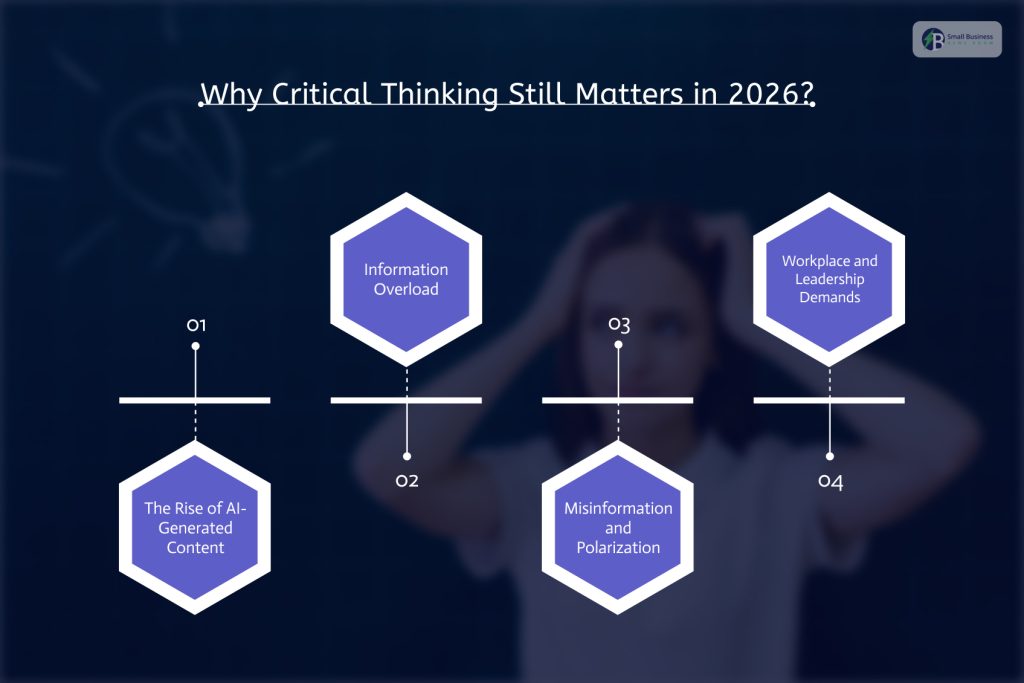
1. The Rise of AI-Generated Content
AI can produce convincing text, images, and videos—but it cannot guarantee truth. Critical thinking questions help people:
- Verify sources
- Detect hallucinations or inaccuracies
- Distinguish expertise from confidence
2. Information Overload
With constant notifications and endless content, critical thinking helps individuals:
- Prioritize relevant information
- Avoid cognitive fatigue
- Focus on meaningful insights
3. Misinformation and Polarization
Critical thinking questions counteract:
- Echo chambers
- Emotional manipulation
- Confirmation bias
They promote intellectual humility and balanced reasoning.
4. Workplace and Leadership Demands
Modern workplaces value employees who can:
- Solve complex problems
- Evaluate risks
- Make ethical decisions
Critical thinking is now considered a core professional competency, not a soft skill.
What Are The Essentials Of Critical Thinking?
Critical thinking goes back to the earliest beginnings of philosophy. These early thinkers, including Socrates, Plato, and Aristotle, all believed that truth could only be reached through questioning.
Socrates famously utilized the method of dialogue to question assumptions and lead his students toward increased understanding, a technique that is still used today.
Moreover, contemporary models are an extension of the above concepts. Perhaps the most popular comes from Dr. Richard Paul and Dr. Linda Elder, who have come up with the “Elements of Thought” model.
They proposed that all reasoning involves purpose, questions, information, interpretation, assumptions, and points of view. To think well, we must also raise intellectual standards like clarity, accuracy, logic, and fairness.
Critical thinking, though, is not only a capacity but also a habit. Those individuals who are critical thinkers are
Open
Curious, and
Humble-minded.
They are not prone to making assumptions, and they have no qualms admitting they are incorrect.
Cognitive science is an additional level of this insight. Our minds make rapid judgments through shortcuts, or cognitive biases. These are capable of warping our thinking without us even noticing. Identifying them is the beginning of the path towards better thinking.
Categories Of Critical Thinking Questions
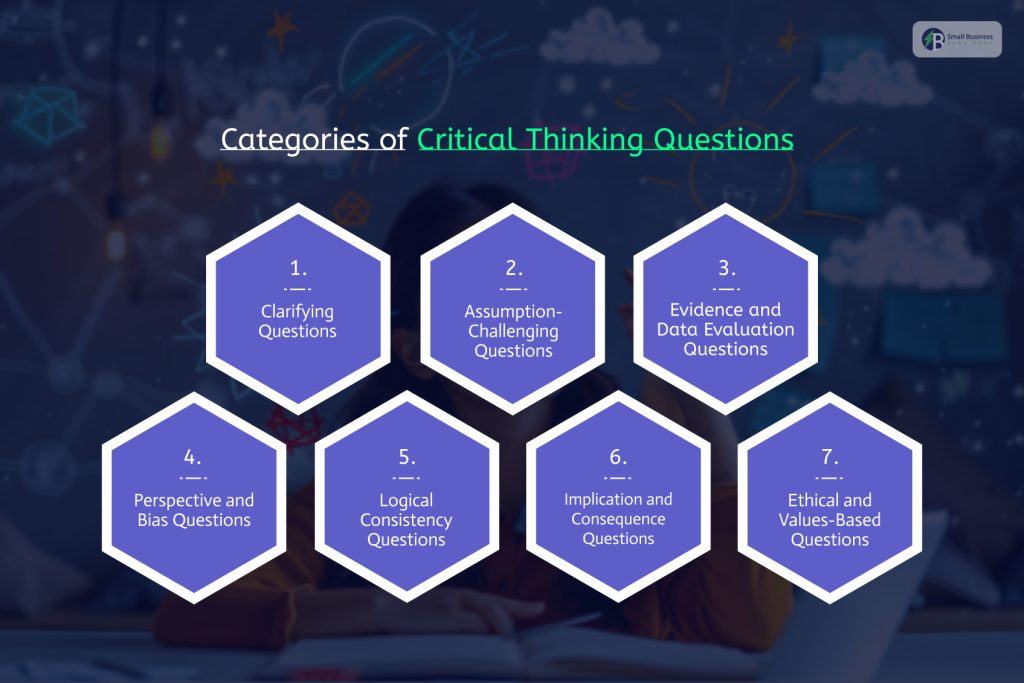
Critical thinking questions can be grouped into distinct categories, each serving a specific purpose.
1. Clarifying Questions
These questions ensure you fully understand the issue before forming judgments.
Examples
- What exactly does this statement mean?
- Can you explain this idea in simpler terms?
- What is the main issue being discussed?
Why They Matter?
Misunderstanding leads to flawed conclusions. Clarification prevents false assumptions.
2. Assumption-Challenging Questions
These questions uncover hidden beliefs that influence thinking.
Examples
- What assumptions are being made here?
- Are these assumptions justified?
- What happens if this assumption is wrong?
2026 Relevance
AI tools and persuasive media often embed assumptions that go unquestioned unless actively challenged.
3. Evidence and Data Evaluation Questions
These questions assess the quality and reliability of information.
Examples
- What evidence supports this claim?
- Is the source credible and unbiased?
- Is this data recent and relevant?
Why This Is Critical Today?
In an era of deepfakes and manipulated statistics, evidence evaluation is essential for truth-seeking.
4. Perspective and Bias Questions
These questions expand understanding beyond a single viewpoint.
Examples
- Who benefits from this narrative?
- Whose voices are missing?
- How might someone with a different background view this?
Key Insight
Wiser thinking comes from recognizing context, not just content.
5. Logical Consistency Questions
These questions test whether reasoning holds together.
Examples
- Does this conclusion logically follow from the premises?
- Are there contradictions in the argument?
- Is correlation being mistaken for causation?
Modern Application
These questions are vital when analyzing trends, business forecasts, or policy claims.
6. Implication and Consequence Questions
These questions explore outcomes and long-term effects.
Examples
- What are the short-term and long-term consequences?
- Who might be affected negatively?
- What unintended outcomes could arise?
Why They Matter?
Profound thinking considers impact not just intention.
7. Ethical and Values-Based Questions
Critical thinking is incomplete without ethical reflection.
Examples
- Is this action fair or just?
- Does this align with stated values?
- Who bears the moral cost of this decision?
2026 Context
With emerging technologies and automation, ethical questioning is more important than ever.
Various Grade Levels Of Critical Thinking Questions
Not all questions are of the same quality. Some of the questions just test facts, and some test long-held assumptions. To grasp this, just consider the case of the simple series.
Below are the fact questions, which are meant to make us clearer about what we already know. For example
“What does this term refer to?”
“What evidence exists for this statement?”
Next are analytical questions, which probe for cause and connection. You would say,
“Why did this occur?”
“What am I observing for patterns?”
After that, we have inferential questions, which encourage prediction or hypothesis.
“What might happen if this continues?”
“What could explain this situation?”
And then there are judgment questions, where the questioner wants us to render judgment.
“Is this argument convincing?”
“How trustworthy is this source?”
The metacognitive questions are our own.
“What am I assuming?”
“How would my own beliefs affect my judgment?”
Such critical thinking questions can be framed for any discipline. A scientist may ask what evidence proves a theory, while a reporter would ask who benefits from the story.
Moreover, a corporate leader may ask what risks are overlooked. The idea is that each good question spawns another, and so the curiosity chain gets us closer and closer to reality.
How to Develop and Adapt Critical Thinking Questions
Question construction is both an art and a science. Good questions are open-ended-they encourage exploration, not the giving of simple yes/no answers.
For instance, where the question would be “Is this idea correct?”, you are better off posing the question “Why might this idea be correct or incorrect?”.
It’s also required to make questions specific to the audience. You would use everyday examples and simple language with children, but you would ask strategic or problem-solving questions of a business consultant.
It’s all about engaging people where they are and bringing them to higher levels of thought incrementally.
Good questioning frequently takes the form of something called scaffolding. You begin with basic comprehension and build toward interpretation, evaluation, and reflection.
You think of it as constructing the ladder. Your question gets you just one step higher. It is just as crucial to avoid traps.
Certain questions are too broad or too personal to be of any help. Others are potentially leading questions, which nudge respondents toward the desired reply. An effective question should expand the mind, not trap it.
How Can You Apply Critical Thought to Everyday Life?
Critical thinking should not remain limited to textbook concepts. It becomes most influential when practiced on real scenarios.
Firstly, teaching can adopt the Socratic method! This is a form of communication where students pose critical thinking questions and engage in critical thinking, learning the answers rather than by rote. Questioning,
“How else would we be able to view this challenge?”
“Why do you think the solution proposed yields results?”
These methods make the class learn not only by rote but also by discovery.
Secondly, critical thinking is also required within the workplace. Teams are frequently under stress of having to act now, but pausing to pose insightful questions helps to avoid costly errors.
At meetings, brief questions of the type
“What evidence does this proposal rest upon?”
“What are the risks of proceeding?”
This fosters balanced decision-making and guards against future groupthink.
Thirdly, critical thinking questions are our best bulwarks against misinformation in our virtual lives. Stop and think, as you browse the web:
“Who put this stuff together?”
“Why was it put together?”
“Who has evidence to the contrary?”
These little habits of curiosity render us less vulnerable to manipulation.
Fourthly, even while communicating through technological products, critical thinking does not go out the window. Asking,
“Where did this information come from?”
“What data might the AI be ignoring?”
This further promotes responsible use of technology.
Assessing and Refining Effective Critical Thinking
What gets measured gets improved. Measures of critical thinking reveal where you are and how you can develop.
In schools or the workplace, tests may be formative, yielding feedback along the way, or summative, checking learning after a task. Self-evaluation is another strong type of test; it allows individuals to assess their own thinking.
Most instructors are using rubrics to assess values such as
Clarity,
Accuracy,
Depth,
Relevance.
Other commercially available tests, such as the California Critical Thinking Skills Test or the Watson-Glaser Appraisal, are equally popular.
But of all these, reflection and feedback are most essential. If you define your thinking and receive thoughtful feedback, you learn patterns in your thought processes.
Writing a journal or “thinking log” is an informal but excellent way to note long-term progress.
Creating a Culture of Critical Thinking
Individual abilities are only useful so long as the culture reinforces them. A genuine culture of critical thinking promotes open discussion, diversity of opinion, and constructive disagreement. It’s all about creating spaces where challenge is not met with defiance but with inquiry.
It needs patience and humility. Individuals should be comfortable saying they do not know or that they may be incorrect.
These institutions, communities, businesses, or schools have their role by rewarding considered inquiry and not blind agreement.
Moreover, with time, habits of reflective journaling, of mindfulness, and of frequent reading serve to buttress this mindset.
Furthermore, they help us remember that the ability to think critically is not something accomplished once but is an ordinary part of life, requiring constant growth.
Critical Thinking in Education (2026 Perspective)
Modern education emphasizes:
- Inquiry-based learning
- Socratic questioning
- Problem-based learning
Educators now prioritize how students think, not just what they memorize.
Sample Classroom Critical Thinking Questions

- Why might this theory be challenged?
- What evidence would change your conclusion?
- How does this concept apply in real-world contexts?
Critical Thinking in the Workplace
Employers increasingly assess critical thinking during hiring and promotions.
Workplace-Oriented Questions
- What risks are we overlooking?
- How does this align with our long-term goals?
- What data contradicts our preferred outcome?
These questions lead to better strategies and fewer costly reminders.
What Are The Issues And Challenges Of Critical Thinking?
Though invaluable, critical thinking has numerous challenges today. Cognitive biases still obscure judgment. Emotions, culture, and personal views may deflect objectivity.
Furthermore, combinations of difficulties brought by technology include algorithms presenting us with content we agree with, making balanced thinking increasingly impractical.
Moreover, Artificial intelligence also raises the question of truth and trust. With the increasingly realistic text, imagery, and even footage produced by the software’s growing power, there is a greater need for human critical thinking.
We must not only learn how to question others, but also question those of our own machines.
Critical thinking of the future involves the ability to adapt to complexity, recognize the reality that all problems have only one solution, and sometimes the best solution is a better question.
What Are The Tools And Resources That Can Help You Get Going?
To develop your ability to think critically, start humbly. Read books like Thinking, Fast and Slow by Daniel Kahneman or The Miniature Guide to Critical Thinking by Paul and Elder.
Explore the internet resources like CriticalThinking.org or MindTools for routines and templates.
First and foremost, practice each day. When you come upon new information, take the time to ask yourself:
Is this trustworthy?
What am I most likely to be missing?
The more you question, the clearer your thinking gets.
Frequently Asked Questions
Here are a few questions and queries on the topic of critical thinking questions that others have asked that you might find helpful at the same time.
What is the difference between critical thinking and analytical thinking?
While the two are closely related, they are not identical.
Analytical thinking focuses on breaking information into parts to understand how they work together. It emphasizes structure, patterns, and logical relationships.
Critical thinking, on the other hand, goes further. It includes:
- Evaluating the credibility of sources
- Challenging assumptions
- Recognizing bias (including one’s own)
- Considering ethical implications
- Making reasoned judgments
In 2026, critical thinking is considered a broader, more holistic skill because it integrates emotional awareness, ethical reasoning, and contextual understanding alongside analysis.
Can critical thinking be learned, or is it an innate ability?
Critical thinking is not an inborn talent reserved for a few—it is a learnable and trainable skill.
While individuals may differ in curiosity or cognitive style, critical thinking improves through:
- Practice with intentional questioning
- Exposure to diverse perspectives
- Reflection and self-assessment
- Feedback and discussion
Educational systems, professional training, and even daily habits can significantly strengthen critical thinking abilities over time.
How can critical thinking help in the age of AI and automation?
In 2026, AI systems can generate answers quickly—but they cannot independently evaluate truth, ethics, or long-term impact.
Critical thinking helps individuals:
- Verify AI-generated information
- Detect bias or inaccuracies
- Decide when not to rely on automation
- Ask better prompts and follow-up questions
Rather than competing with AI, critical thinking allows humans to use AI wisely and responsibly.
What are the most common mistakes people make when trying to think critically?
Some frequent mistakes include:
- Confusing skepticism with negativity
- Overanalyzing instead of making decisions
- Ignoring emotional or ethical factors
- Relying too heavily on authority or popular opinion
- Believing that critical thinking means always being right
True critical thinking values curiosity, humility, and openness, not intellectual superiority.
How can students practice critical thinking outside the classroom?
Students can develop critical thinking in everyday life by:
- Questioning news headlines and social media posts
- Comparing multiple sources before forming opinions
- Reflecting on personal beliefs and where they originated
- Engaging in respectful debates and discussions
- Journaling about decisions and outcomes
Real-world application is often more effective than formal exercises alone.
Does critical thinking slow down decision-making?
Initially, yes—but strategically.
Critical thinking may slow decisions at first because it encourages deeper evaluation. Over time, however, it improves decision quality, reduces costly errors, and increases confidence.
Experienced critical thinkers learn when to:
- Think deeply
- Act decisively
- Balance speed with accuracy
This adaptability is especially valuable in leadership and high-stakes environments.
Can critical thinking improve emotional intelligence?
Absolutely.
Critical thinking enhances emotional intelligence by:
- Encouraging reflection before reaction
- Identifying emotional triggers
- Separating feelings from facts
- Improving empathy through perspective-taking
In 2026, the integration of emotional intelligence and critical thinking is considered essential for effective communication and leadership.
Is critical thinking the same as questioning authority?
Not necessarily.
Critical thinking does not reject authority outright—it evaluates authority based on:
- Expertise
- Evidence
- Transparency
- Track record
Healthy critical thinking respects knowledge while remaining open to revision when better information emerges.
How long does it take to develop strong critical thinking skills?
There is no fixed timeline.
Basic improvements can occur within weeks through conscious practice, while deep mastery develops over years of:
- Lifelong learning
- Exposure to complexity
- Continuous self-reflection
Critical thinking is best understood as a continuous journey, not a final destination.
Why are critical thinking questions more important than answers?
Answers can change with new information, but good questions remain relevant.
Critical thinking questions:
- Guide exploration
- Prevent blind acceptance
- Encourage intellectual growth
- Foster wisdom rather than certainty
In a rapidly changing world, the ability to ask meaningful questions is more valuable than memorizing fixed answers.
Read Also:


