Table Of Contents
- Quick Summary Table!
- What Is Freight Shipping?
- How Does Freight Shipping Work For Small Businesses?
- Deep Dive: LTL vs. FTL
- What Is Freight Delivery vs. Regular Delivery?
- What Types Of Freight Shipping Can I Choose From?
- The Golden Rule Of Freight: Understanding Freight Class
- How Much Does Freight Shipping Cost?
- What Mistakes Should New Business Owners Avoid In Freight Shipping?
- Do I Really Need Freight Shipping As A Small Business?
- How To Get Started With Your First Freight Shipment
- Wrapping It Up!
What Is Freight Shipping? A Friendly Guide For Small Business Owners
Last Updated on: September 29th, 2026
When you start a new business, you’ll have a million questions. One of the big ones you’ll eventually face is: What is freight shipping?
If you’re just mailing out a few packages here and there, you’re probably fine with regular parcel services.
But as soon as your orders get bigger or heavier, you’ll run into shipping options that sound more complicated than they actually are.
And there are a lot more benefits that come with freight shipping, such as,
- Cost-effective for bulk orders
- Can easily accommodate large and heavy items
- Helps you improve your inventory management
- And most importantly, it can help you enhance security
Now you know why you need a freight service for your small business. But don’t worry, I’ll walk you through it step by step to help you make the right decision for your small business.
Quick Summary Table!
| Feature | Regular Parcel Delivery | Freight Shipping |
| Weight Limit | Typically up to 70–150 lbs | Over 150 lbs up to 40,000+ lbs |
| Packaging | Individual cardboard boxes, poly mailers | Pallets, crates, skids, containers |
| Handling | Automated conveyor belts, manual sorting | Forklifts, pallet jacks, liftgates |
| Pricing Model | Dimensional weight and zone-based | Freight class, weight, distance, NMFC codes |
What Is Freight Shipping?
I have a simple answer! Freight shipping moves large or heavy items.
Mostly, businesses use this shipping process for items that are too big for regular delivery services like UPS or FedEx.
So, you won’t have to ship one box at a time. You can send pallets or crates weighing hundreds or even thousands of pounds.
Another question you might have is, “Why should I care?”
Well, let’s say your business has started to grow. In that case, shipping one item at a time might feel inconvenient. It is not even cost-effective either.
That’s where freight shipping can help! It helps you move bigger loads in one go. In return, you can save money and headaches.
How Does Freight Shipping Work For Small Businesses?
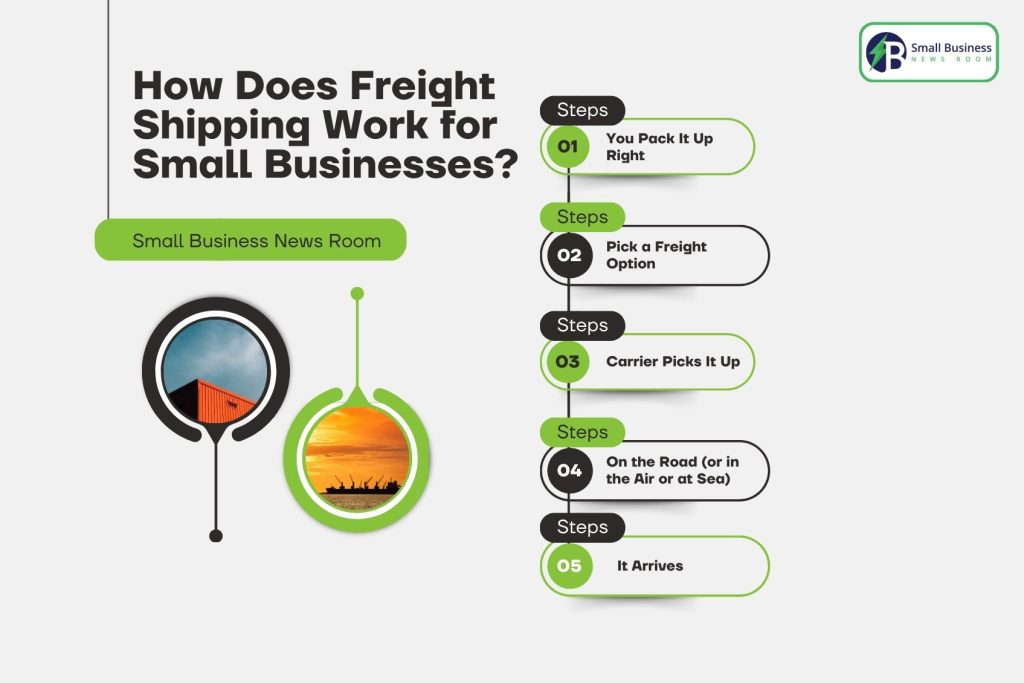
Let’s look at how freight shipping works.
- You Pack It Up Right
Unlike small parcels, freight isn’t just tossed in a box. Your goods get stacked on wooden pallets, shrink-wrapped, or packed in sturdy crates so they survive the ride.
- Pick A Freight Option
You’ll choose the freight shipping option that makes sense—like sharing a truck with other businesses (LTL) or booking a whole truck for yourself (FTL).
Deep Dive: LTL vs. FTL
- Less-Than-Truckload (LTL)
Your cargo occupies only a portion of the trailer (typically 1 to 6 pallets). You only pay for the space you use.
Your goods will be transferred across multiple distribution hubs, which means longer transit times but major cost savings for small batches.
- Full Truckload (FTL)
Your goods occupy the entire dedicated truck (usually 24 to 30 pallets).
The truck drives directly from your pickup location to the destination with no intermediate stops.
This is ideal for fragile, high-value, or time-sensitive shipments.
- Carrier Picks It Up
Once you pick a freight option, the shipping company will show up! They will load your stuff and get it moving.
- On The Road (Or In The Air Or At Sea)
You can ship by truck, plane, train, or ship. So, you just need to pick the right option based on your shipping needs.
- It Arrives
Your freight gets delivered either to your warehouse or retail shop. It can also be sent directly to your customer.
What Is Freight Delivery vs. Regular Delivery?
You might be wondering: “Okay, but what is freight delivery and how’s it different from the normal deliveries I get at home?”
Here’s the difference:
- Regular delivery is what happens when you order a phone case online and it shows up in your mailbox.
- Freight delivery is when you’re shipping pallets of phone cases (hundreds at a time) to a store.
- Freight delivery involves trucks, forklifts, and sometimes big warehouses. It’s made for businesses, not just individuals.
What Types Of Freight Shipping Can I Choose From?
When you first look into freight, you’ll notice there are different “flavors.” Here’s the menu:
| Less Than Truckload (LTL) | Perfect if you don’t have enough goods to fill an entire truck. Your stuff rides along with other businesses’ shipments. |
| Full Truckload (FTL) | Best when you’ve got enough to fill a whole truck. Faster, safer, and only your goods are onboard. |
| Air Freight | Crazy fast, but also expensive. Good for urgent or high-value shipments. |
| Ocean Freight | Slower but way cheaper for international deliveries. |
| Rail Freight | Great for bulk shipments across long distances, especially within a country. |
As a small business, you’ll probably start with LTL. It’s cost-effective and beginner-friendly.
The Golden Rule Of Freight: Understanding Freight Class
Unlike regular mail, ground freight pricing relies heavily on Freight Class, established by the National Motor Freight Traffic Association (NMFTA).
There are 18 different classes ranging from Class 50 (cheapest) to Class 500 (most expensive).
Your class is calculated using four metrics:
- Density: The weight per cubic foot. Heavy, compact items have low classes and cost less to ship.
- Stowability: How easily the item can be stacked with other freight.
- Handling: The level of care required to load and unload the items.
- Liability: The value of the goods and their susceptibility to theft, breakage, or damage.
How Much Does Freight Shipping Cost?
This is usually the first thing business owners want to know (and for good reason). The truth is, freight shipping costs depend on a mix of factors:
1. Weight and size of your shipment
2. Distance (local vs. cross-country vs. international)
3. Type of freight (LTL, FTL, air, sea)
4. Speed (standard vs. expedited)
Here’s a pro tip: if you can, combine smaller shipments into one big freight order. That way, you save on multiple small-package costs.
Some small businesses even negotiate better rates once they start shipping regularly.
5. Accessorial Fees: These are charges for services beyond standard dock-to-dock pickup.
Examples include liftgate fees (if you don’t have a loading dock), residential delivery surcharges, and inside pickup/delivery fees.
6. Fuel Surcharges: Fluctuating costs added by carriers to offset fuel price volatility.
What Mistakes Should New Business Owners Avoid In Freight Shipping?
Since this is a guide, let’s talk about the “don’ts” so you don’t learn the hard way:
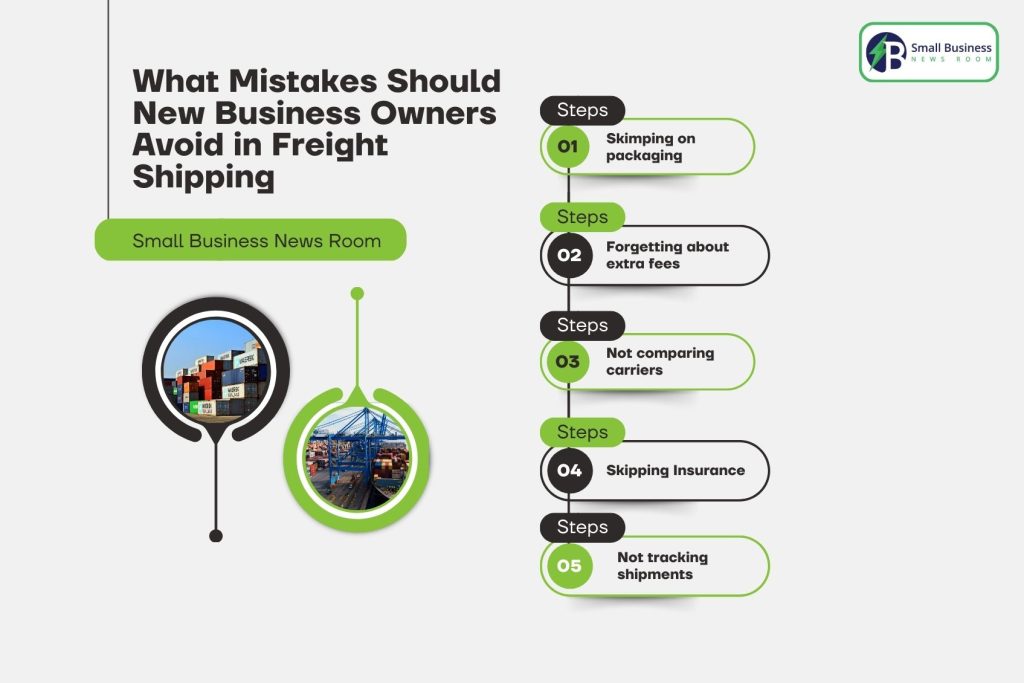
- Skimping on packaging: A few rolls of tape won’t protect a pallet of fragile goods. Invest in proper packing.
- Forgetting about extra fees: Liftgate service, residential delivery, or oversized items can add charges you didn’t expect.
- Not comparing carriers: Prices and service vary a lot; don’t just grab the first quote.
- Skipping insurance: Damage does happen, and insurance saves you from major losses.
- Misidentifying the Bill of Lading (BOL): The BOL is the legally binding contract between you and the carrier.
Messing up the weight, description, or freight class on this document can result in severe re-weigh fees and delayed shipments.
- Not tracking shipments: Your customers will ask for updates, and you will too.
Do I Really Need Freight Shipping As A Small Business?
Suppose you are still shipping a handful of small boxes, probably not yet. But once you’re moving bigger quantities or bulkier products, freight becomes a lifesaver.
Here’s why:
- Firstly, it’s cheaper than mailing dozens of individual boxes.
- Secondly, it’s faster for larger orders.
- Lastly, it’s easier! You won’t have to lug heavy packages to the post office anymore.
Getting familiar with what is freight shipping now means you’ll be ready when your business hits that growth spurt. And trust me, it’s better to learn ahead of time than scramble later.
How To Get Started With Your First Freight Shipment
Ready to take the leap into commercial logistics? Booking your first shipment doesn’t have to be overwhelming if you follow a structured approach.
Use this simple step-by-step checklist to guide your inventory safely from your business to its destination:
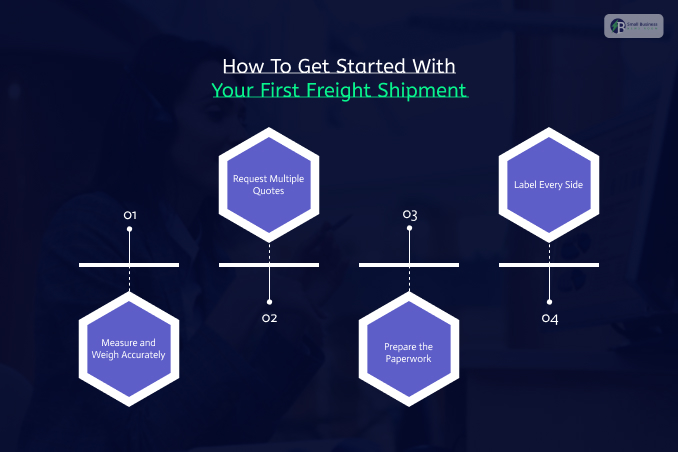
- Measure and Weigh Accurately: Measure the length, width, and height of your fully packed pallet. Weigh it using an industrial scale.
- Request Multiple Quotes: Use a freight broker or a digital marketplace to compare rates across different regional and national carriers.
- Prepare the Paperwork: Generate an accurate Bill of Lading (BOL). Hand a copy directly to the driver at pickup.
- Label Every Side: Securely attach freight labels to all four sides of your pallet so barcodes remain easily scannable by forklift operators.
Wrapping It Up!
So, here’s a quick recap! What is freight shipping? It’s a system your business can use to move large and heavy items efficiently.
You just need to have the patience to understand two things:
- How does freight shipping work
- What makes freight delivery different from regular delivery
You just have to understand the entire thing, and that’s it! The process will start to feel less intimidating!
So what’s the bottom line? Well, freight shipping is all about moving from beginner-level shipping to pro-level logistics.
As your small business grows, freight shipping can help you save money, keep customers happy, and focus on running your business.
You don’t even have to worry about getting your products from point A to point B.
Read More: