



Table Of Contents
- So, What Exactly Is Startup Booted Financial Modeling?
- Why Do You Need It?
- Bootstrapped vs. VC-Backed Models
- What Are The Key Features Of Startup Booted Financial Modelling?
- 1. Forecasting Revenue
- 2. Cost Structure
- 3. Forecasting Of The Cash Flow
- 4. Burn Rate And Your Runway
- 5. Break-Even Analysis
- 6. Unit Economics
- 7. Three-Statement Model
- A Step-By-Step Guide On How You Can Build A Startup Financial Model?
- Step 1: Define Your Business Model
- Step 2: Categorise Revenue Streams
- Step 3: Figure Out Customer Acquisition
- Step 4: Anticipate Costs
- Step 5: Build A Forecast For Cash Flow
- Step 6: Burn Rate And Your Runway TO Calculate
- Step 7: Break-Even Revenue For Calculation
- Step 8: Add All Of The Case Scenarios
- Step 9: Review Your Actuals Each Month
How To Build A Startup Booted Financial Modeling System That Guarantees Runway (Without Investor Funding)
Startup booted financial modeling is basically a crystal ball for your business. The process helps you to map out your future sales, costs, and profits as you grow without outside investors.
Many founders focus solely on acquiring customers, yet they still go broke. Why? Because they do not track their cash flow or how fast they spend money.
When you bootstrap, you do not have a million-dollar cushion in the bank. Therefore, every single hiring choice or software subscription directly impacts your survival.
Think of this model as your ultimate operational dashboard.
It shows you exactly when you can safely hire help, how long your cash will last, and when you will finally hit profitability.
In this easy guide, we will break down exactly how to build your own forecast step-by-step. Let’s dive in and learn how to scale sustainably on your own terms!
So, What Exactly Is Startup Booted Financial Modeling?

In simple terms, it is a blueprint that helps you manage your cash flow when you are funding the business with your own savings or sales.
This tool, in fact, could be considered your daily best friend, as it is a great help to steer you through your questions.
Moreover, getting to know your expenses alongside your revenues is possible with this tool. It will give you an instant indication of whether you can afford to hire someone.
Besides, it is like a safety net. It accurately shows you what would happen if your sales volume suddenly decreased.
While companies backed by venture capital are likely to spend heavily to pursue aggressive growth, your bootstrapped business plan is centred on mere survival.
Furthermore, the instructions should be very true to life and quite prudent.
Basically, it safeguards your money so that you can continue to grow at your own pace without any unnecessary pressure.
Why Do You Need It?
Running out of money is the main reason why many startups have to close their doors.
Thus, it is even a possibility that your business might crash if your clients are late with their payments, even though you are profitable on paper.
The good news is that a proper startup booted financing modeling system will show you exactly when your money is flowing in and out at all times.
That is why this approach to math will keep your runway intact.
To illustrate, you might have about $ 40,000 remaining and spend about $ 5,000 per month, which means you can only survive for 8 months.
In the end, such a calculation will be able to get rid of all your uncertainties and give you the opportunity to make a thorough analysis of your business situation.
Bootstrapped vs. VC-Backed Models
Honestly, bootstrapping is a completely different ballgame compared to using venture capital.
Moreover, VC-backed startups get large sums of investor capital, so they spend aggressively to capture the market quickly.
On the flip side, startup booted financial modeling is all about lean survival and realistic growth. You only hire people when your actual revenue can support it.
| Feature | Bootstrapped Model | VC-Backed Model |
| Money Source | Sales & Savings | Investor Capital |
| Main Goal | Staying Alive | Rapid Growth |
| Spending Style | Very Lean | Aggressive |
| Risk Comfort | Low | High |
Never copy a VC playbook. Spending like a funded company without actual funding will empty your bank account fast.
What Are The Key Features Of Startup Booted Financial Modelling?
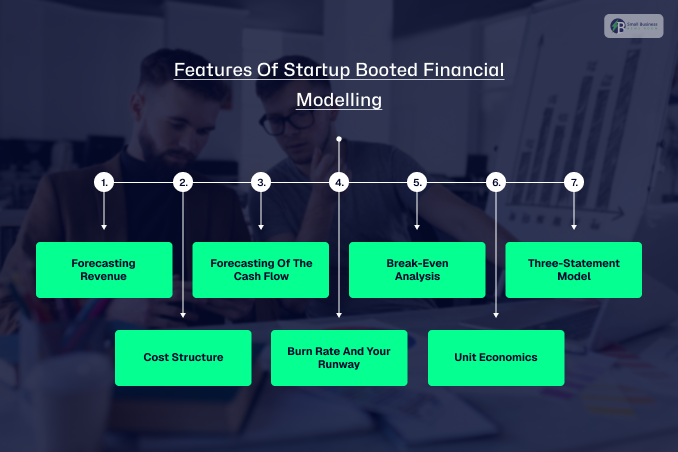
A strong startup booted financial model must have the strong financial areas that can possibly affect cash, survival, as well as growth.
1. Forecasting Revenue
Predicting your sales should never be a guessing game. For instance, claiming you will capture 1% of a $10 billion market is highly unrealistic.
Instead, startup booted financial modeling relies on real, bottom-up numbers.
Moreover, a realistic approach looks at your current data: if you close 8 customers a month, a 10% improvement means hitting 9 or 10 customers.
This section of your model simply tracks day-to-day metrics like monthly recurring revenue, subscription sign-ups, average order value, and customer churn rate.
2. Cost Structure
To keep your budget healthy, you need to split your expenses into two distinct categories:
- Fixed Costs: These are regular bills such as salaries, rent, hosting, software, and insurance that remain the same regardless of sales.
- Variable Costs: These are fluctuating costs like payment fees, shipping, freelancers, and ads that only rise when you sell more.
As a bootstrapped founder, keeping fixed costs low is vital.
Because these bills stay the same even when sales drop, keeping them lean gives you the flexibility to survive rough patches.
3. Forecasting Of The Cash Flow
One of the major drawbacks is that, on paper, your business is making money, but actually, you are going to be out of cash.
It could be the case that your customers pay their invoices after a long period. For instance, you generate $ 20,000 in sales this month.
However, your clients pay within 60 days. You must still have the cash available to pay today’s bills.
A detailed cash flow projection enables you to track your opening balance, expected payments, wages, software subscriptions, and your final closing balance.
Additionally, many business owners use a short-term 13-week cash forecast to recognise these risks early each week.
4. Burn Rate And Your Runway
The burn rate is your cash loss each month, and the runway is how many months you can keep going before your bank account reaches zero.
Here is a quick illustration:
- Cash you have in Bank: $50, 000
- Monthly Inflow: $8, 000
- Monthly Outflow: $13, 000
- Net Burn Rate: $5, 000
- Runway: 10 Months
So, basically, you have 10 months left if there are no changes. And if your runway ever drops below 6 months, it is time to review your costs and pricing immediately.
5. Break-Even Analysis
Getting to the break-even stage is an incredible achievement because it implies that your income fully pays for your costs, so you are no longer dependent on your personal savings.
Having a monthly fixed cost of $ 10,000 and a gross margin of 80% means your break-even revenue will be exactly $ 12,500.
This is because 20% of your sales will still go directly to variable costs. Once you pass this point, your business can sustain itself.
6. Unit Economics
Unit economics is a method for assessing whether every customer generates a profit. In order to do this, you need to measure your:
- Cost to acquire a customer (CAC)
- Lifetime value (LTV) of a customer
- Your average sales per customer (ARPU) and customer turnover.
For instance, if a Software-as-a-Service (SaaS) entrepreneur sets the price at $49 per month and the customer turnover rate is 4%.
Then the entrepreneur will need to continue for 5 to 6 months just to recover marketing expenses.
When it costs $300 to get a customer who generates only $200, then money is being lost.
7. Three-Statement Model
When your business expands, you may require a comprehensive three-statement financial model.
This consists of:
- Income Statement (recording revenues and expenses)
- Cash Flow Statement (recording the inflows and outflows of cash)
- Balance Sheet (recording assets and liabilities).
Although startups in the initial stage may not require these sophisticated tools immediately, later these are the ones that will show your financial condition unambiguously over the long term.
A Step-By-Step Guide On How You Can Build A Startup Financial Model?

You just need to follow this simple, stress-free framework to map out your numbers.
Step 1: Define Your Business Model
First off, analyse precisely how your startup earns money. For example, is it through selling monthly subscriptions, physical products, or offering one-time services?
A SaaS platform, a retail e-commerce site, and a digital marketing firm are all very different in their way of working.
So, identifying your precise business model will help you lay the proper groundwork.
Step 2: Categorise Revenue Streams
Then, instead of simply throwing all your sales into a single vague figure, categorise them clearly.
Some item examples are
- Subscription revenue
- Onboarding setup fees
- Consulting income
- Product sales
- Additional upsell
Breaking them down helps you understand your whole model a lot better.
Step 3: Figure Out Customer Acquisition
Then consider how many new customers you realistically need each month.
Use your daily stats. For instance, if you have 5,000 visitors to your site and they convert into 2% leads, then you actually have 100 leads.
With a sales closing rate of 10%, you will almost certainly add 10 new customers each month.
Step 4: Anticipate Costs
You now need to record all the payments that you have to make. Mention :
- Founders’ salaries
- Staff wages
- Contractors’ fees
- Web hosting
- Advertising
- Transaction fees.
As a self-funded startup, it is best to categorise these expenses as “essential” versus “discretionary”.
So, it becomes straightforward to identify where you might cut back if necessary.
Step 5: Build A Forecast For Cash Flow
Create a simple monthly spreadsheet to watch how cash moves. Let’s look at how this plays out in action:
| Month | Starting Cash | Cash In | Cash Out | Ending Cash |
| January | $40,000 | $8,000 | $10,000 | $38,000 |
| February | $38,000 | $9,000 | $10,500 | $36,500 |
| March | $36,500 | $11,000 | $11,000 | $36,500 |
| April | $36,500 | $13,000 | $11,500 | $38,000 |
This math clearly shows you whether your bank account is growing or shrinking over time.
Step 6: Burn Rate And Your Runway TO Calculate
If your total cash out exceeds your cash in, your burn rate indicates the pace at which your funds are being depleted.
With this information, you can figure out your runway, that is, the number of months you still have left in your business life.
On the other hand, if your income exceeds your expenses, your aim becomes to make a smart profit and reinvest the extra money.
Step 7: Break-Even Revenue For Calculation
Your break-even number shows the exact amount of sales you need to stop losing money.
Make sure this number is clearly visible in your model.
Knowing this minimum revenue target helps you stay focused on day-to-day survival until your business becomes fully self-sustaining.
Step 8: Add All Of The Case Scenarios
A single forecast is never enough because things change fast. Build three different paths: a realistic base case, a dreamy best case, and a tough worst case.
For example, your worst-case scenario could show what happens if customer churn suddenly spikes or a major competitor halves your growth.
Step 9: Review Your Actuals Each Month
A financial model is completely useless if you leave it to collect dust. At the end of every month, compare your actual bank statements against your old projections. Moreover, track your real revenue, actual expenses, customer acquisition cost (CAC), and runway to make your future forecasts much more accurate.


