Table Of Contents
- What Are Remote Tech Jobs?
- The Benefits Of Remote Tech Jobs
- 1. Flexible Scheduling
- 2. Reduced Commuting Time
- 3. Global Opportunities
- Buffer And Their Remote-First Success: Real Life Example!
- Best Remote Tech Jobs 2025: What Are The Popular Remote Tech Jobs And Roles
- Software Developer
- Data Scientist
- Cybersecurity Analyst
- UX/UI Designer
- Systems Engineer
- How To Find Remote IT Roles?
- 1. Go Through The Job Listings On Websites
- 2. Visit The Career Section Of The Company Websites
- 3. Networking And Referrals
- 4. Use Extra Resources
- 5. Consider Other Options
- Tips For Succeeding In Remote Tech Jobs
- What Are The Common Challenges In Remote Tech Jobs?
- The Challenge of Isolation
- Communication Issues and Misunderstandings
- Having Boundaries Between Work And Life
- The Future Of Remote Tech Jobs
- Global Talent Pools
- Improvement In Collaboration Technology
- AI And Automation Effects
- How To Stay Productive And Connected While Working Remotely
- Productivity Tips Routine
- Using Collaboration Tools To Their Full Potential
- Frequently Asked Questions
The Ultimate Guide To Remote Tech Jobs: How To Find, Apply, And Succeed
Remote tech jobs. Mostly about performing technology-focused roles from anywhere outside a traditional office! Once it was just a workspace perk, and now? Now it has become a staple part of the modern workspace.
The surge in digital needs alongside the global shift in work culture is feeding the demand.
This evolution is bringing a substantial benefit. For the employees, it largely means greater flexibility!
I personally started looking for remote jobs to avoid the long commutes! As a result, it helped me to maintain a great work-life balance.
Data says remote work options can bring a positive change in employee turnover, up to 26%. This creates a win-win situation for tech industries.
Do you want to know more about remote tech jobs? Don’t worry, this guide will cover everything that you need to know, from determining if the job role is the right one for you or how you can prepare yourself for a remote career!
What Are Remote Tech Jobs?

You could say that remote tech jobs were such roles in the technology sector where your presence in the main office was not a prerequisite.
The digital tools, like high-speed internet, secure video conferencing, and cloud-based collaboration software, were the ones through which you completed all your requirements.
The job’s core stayed the same; the only change was in the location. Digital transformation has been the primary driver of this change.
Businesses that have gone completely online with their operations and communications have contributed to this phenomenon.
Technically, the whole industry was already there, and the transition was just a matter of time.
If a work is laptop-based, it can be done from anywhere, a concept that has gained momentum amid recent global developments.
Under the flexible structure were established the following technical roles that captured the largest share of the market:
- Software Development/Engineering: Creating, testing, and supporting applications and systems. This is likely the most popular remoting tech function.
- IT Support: Offering technical support to employees or customers using chat, email, or phone, usually from a help desk.
- Cybersecurity: Keeping systems and data safe from threats. After all, the online business is growing, and security professionals who can secure their work from home are in great demand.
- Data Science & Analytics: Helping businesses to make wise choices by deciphering difficult data sets. These positions involve a lot of computational work that can be easily done off-site.
- UX/UI Design: Concerned with the aesthetics, usability, and customer experience of web and mobile applications.
- Project Management: The use of project management software for coordinating teams and ensuring the timely completion of projects.
All these positions require good communication and a strong digital infrastructure, thus making skill set and efficiency, rather than location, what counts.
The Benefits Of Remote Tech Jobs
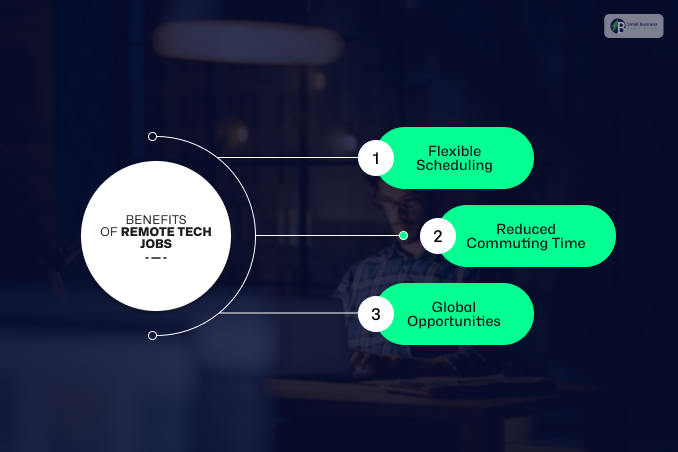
The advantages of working in a remote tech job are significant and not just limited to the fact that you don’t have to deal with traffic.
The new lifestyle totally transforms the way you see work, giving you personal life and career advantages.
1. Flexible Scheduling
The flex schedule is the most obvious benefit of remote working. Getting rid of the 9-to-5 office posture! This is common in most companies, allowing employees to take breaks and do other things during the day.
Thus, totally manage their workday around the core hours and deadlines. The new daily schedule will help better balance private and work life.
If needed, the employees are not required to take formal time off for their appointments, family duties or hobbies.
2. Reduced Commuting Time
In this case, commuting time is a big issue and may vary considerably. It is really hard to imagine getting back one or even two hours each day. This means extra time to sleep, exercise, or spend with family. Who doesn’t want that?
According to Careercircle, over 91% of employees choose to work from a remote location because it helps them to strike a balance between work and home.
Besides, this will also save a lot of money, as you will no longer be spending on gas, public transport, car maintenance, or even daily lunches out.
3. Global Opportunities
From a career standpoint, working remotely expands your reach to the entire world.
You won’t be restricted to the labour market within a 30-mile radius of your home. You can work for an innovative startup in Berlin while living in a small town in the US.
So, getting access to higher salaries and more diverse roles than before. In the end, these perks all coming together result in a less stressful and more productive work environment. This means higher overall job satisfaction for most people.
Buffer And Their Remote-First Success: Real Life Example!
Buffer, a well-known social media management platform, has practised remote working since 2015. Around 120 employees across 15 countries are working with them!
They have been successful in maintaining their productivity through transparent communication, clear documentation, and regular team-building activities.
Their annual review is a clear sign of how successful they have been in maintaining a steady revenue growth and high employee satisfaction.
Best Remote Tech Jobs 2025: What Are The Popular Remote Tech Jobs And Roles
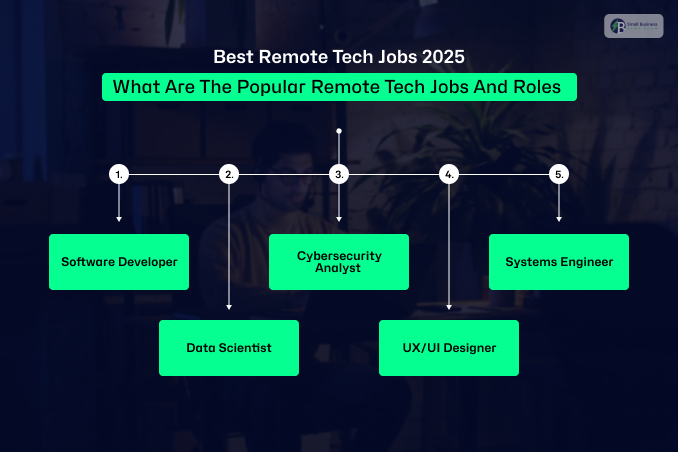
A rundown of remote tech jobs in 2025 and their basic functions, required skills, and typical US salary ranges is provided here.
Software Developer
The role of a Software Developer is to create, test, and support applications and systems.
This function ranges from the developers who create the visual parts of the site to those who build the logic and databases behind it.
It is one of the most widespread tech jobs available to remote workers that rely heavily on coding and collaborative software.
Names of Positions: Front-End Developer, Back-End Engineer, Full-Stack Developer, Mobile App Developer, DevOps Engineer.
Skills & Qualifications:
- Having the ability to program in languages like Python, Java, JavaScript, or C#.
- Possessing good reasoning and problem-solving skills.
- Knowledge of the use of Git and GitHub for version control.
- Awareness of agile practices and the software development lifecycle.
- A Bachelor’s degree in Computer Science or an impressive project portfolio from a bootcamp that teaches programming.
Salary Range (Typical US Annual): $100,000 – $185,000+, with senior and specialized roles commanding higher pay.
Data Scientist
Data scientists study, analyze, and interpret large, complex datasets, enabling organizations to make the right decisions.
They also create models that predict future outcomes, while statistical analysis reveals trends. This is making this analytical role highly regarded and remote-friendly.
Job Titles: Data Scientist, Data Analyst, Machine Learning Engineer, Business Intelligence (BI) Analyst.
Skills & Qualifications:
- Fluency in statistical programming languages, especially Python or R.
- Excellent command of SQL for database querying.
- Tools for data visualization (e.g., Tableau, Power BI) are part and parcel of such a person’s skills.
- Statistical modeling and machine learning algorithms are the areas in which the individual is well-versed.
- A Master’s degree in a quantitative field like Statistics or Computer Science is often required for senior roles.
Salary Range (Typical US Annual): $95,000 – $180,000+, with a significant impact depending on experience, specialization (such as AI/ML), and industry.
Cybersecurity Analyst
Cybersecurity analysts serve as the first line of defence to secure an organisation’s computer networks and systems against cyber threats.
They are in charge of keeping a close watch for security violations, investigating incidents, and erecting barriers against hackers. This is a critical task that can sometimes be done from a secure remote site.
Job Titles: Cybersecurity Analyst, Information Security Analyst, Incident Responder, Penetration Tester, SOC Analyst.
Skills & Qualifications:
- Understanding of network architecture, firewall control, and data scrambling.
- Experience with Security Information and Event Management (SIEM) tools.
- Quick thinking, problem-solving, and detail-oriented during a breach.
- Essential certifications like CompTIA Security+ or CISSP.
- A Bachelor’s in IT or Cybersecurity is the usual requirement.
Salary Range (Typical US Annual): $80,000 – $145,000+, with certifications often greatly increasing income potential.
UX/UI Designer
User Experience (UX) and User Interface (UI) designers are the main actors in the development of digital products!
They decide how the product will look and feel, and at the same time, they work on making it easy to use.
The collaboration with technology is the primary aspect of this role, and thus, designers can work remotely by using online design platforms.
The list of job titles includes: UX Designer, UI Designer, Product Designer, Interaction Designer, and User Researcher.
Skills & Qualifications:
- The designer must know how to use software like Figma, Sketch, or Adobe XD.
- They must be able to create wireframes and prototypes and have experience in user research.
- A strong portfolio that illustrates the design process and the final products is a must.
- Understanding from the user’s perspective and excellent visual communication skills are required.
- Educational background can range from graphic design to psychology or human-computer interaction.
Salary Range (Typical US Annual): $85,000 – $140,000+, with senior and product design roles reaching higher ranges.
Systems Engineer
The systems engineers are moreover tasked with the overall scenario of the IT infrastructure.
They make sure that the different systems and services are always up and running with great efficiency and reliability.
They handle cloud services (like AWS or Azure), server systems, and networks. While performing most of the initial physical setup, they often conduct continuous remote maintenance and monitoring.
Job Titles: Cloud Engineer, Infrastructure Engineer, Network Engineer, Site Reliability Engineer (SRE), IT Systems Administrator.
Skills & Qualifications:
- Very good knowledge of operating systems (Linux, Windows) and of the different types of networking protocols.
- Prior hands-on experience with working on cloud-stage platforms like Amazon Web Services (AWS) or Microsoft Azure.
- Good knowledge of scripting and automation (e.g., PowerShell, Bash).
- Outstanding problem-solving aptitude along with time management skills.
- Specialized vendor certifications (such as AWS Certified Solutions Architect) may be considered an asset.
Salary Range (Typical US Annual): $110,000 – $200,000+, with areas like cloud engineering and SRE roles particularly high-paying.
How To Find Remote IT Roles?

One way to uncover remote tech jobs is to use specialised job boards that focus exclusively on remote positions, such as RemoteOK, We Work Remotely, and JustRemote.
Besides that, visit the sites where companies known to hire remotely post their jobs.
You may also resort to general job boards, AI-based job search tools, and establish connections with people in organisations already operating remotely.
1. Go Through The Job Listings On Websites
RemoteOK: This website has a large database of remote jobs, including tech, design, and customer support positions.
We Work Remotely: This platform is dedicated to tech, marketing, and customer support and openly provides salary and location information.
JustRemote: The interface is user-friendly, and it offers a wide variety of remote jobs with advanced filters.
Remotive: This platform offers approved remote tech job positions in development, marketing, and customer support.
NoDesk: This is a platform that lists remote jobs from different areas, including tech and non-tech.
Startup.jobs: This is a website where new companies recruit their staff. Dice.com: This is where tech opportunities in different sectors are highlighted.
2. Visit The Career Section Of The Company Websites
Create a list of firms that are entirely remote or have a significant number of remote workers, then visit their career sections to see if there are any openings.
If a role is not clearly stated as remote, it is worthwhile to check it out, especially if the company has other remote jobs available.
3. Networking And Referrals
Remote positions are generally filled through referrals, so networking is a strategy that helps you find a job very easily.
4. Use Extra Resources
AI-Based Job Search Tools: An automated job search tool can facilitate your entire job hunt from listing to application submission.
Contact businesses directly: If you come across a job you are interested in, do not hesitate to contact the company directly.
5. Consider Other Options
There are a few freelance platforms that can help you find remote tech jobs. You can use the AI job hunters to find the kind of job that is suitable for you!
Tips For Succeeding In Remote Tech Jobs
Having a successful remote tech job implies having the essential skills, which are not limited to technical knowledge only.
It also requires a very professional and disciplined approach to handling not only work but also professional relationships.
- Proactive Communication: In addition to communicating, it is better to use a tool like Slack or Jira to share updates. An open line of communication with others will keep everybody on the same page.
- Self-Discipline: Be your own manager. Plan a daily routine and follow it so that you can be productive without anyone overseeing you.
- Good Time Management: Divide your day into work and non-work hours, and set aside a dedicated workspace. Practice the Pomodoro method to maintain your focus and prevent fatigue.
- Contribution: Make others aware of the good work you do, and not only that you work hard. Show progress, raise queries in public forums, and confirm that your job is acknowledged.
- Dependability: Your team members should consider you their rock. Always meet your deadlines and keep communicating with the team. Reliability fosters trust in a remote atmosphere.
- Tool Adaptation: Adapt quickly to the new tools your team is using for communication, project management, and development. Collaboration software knows no limits in technical skills.
| Personal Experience For Tool AdaptationIn my 5 years of working remotely, I’ve always relied on Slack to communicate with my colleagues and manage my time effectively. You can also check out Loom or Notion – both are very effective for ensuring an easy flow of communication. |
- Wellness First: When your home is your office, it can be very tempting to work extra hours.
Make it a point to take regular breaks, time to refresh yourself, and also practice work-life balance so that you can succeed in the long run.
- Learning Continuously: The IT sector is growing and changing fast. Make it a point to get certifications or enroll in online courses to keep your skills marketable and sharp in a competitive field.
What Are The Common Challenges In Remote Tech Jobs?

Remote tech jobs are very liberating, but they also come with certain difficulties that require an active approach to manage well in the long run and keep workers healthy.
The Challenge of Isolation
Professional and social isolation are among the most commonly mentioned issues. The lack of casual chat during breaks makes employees feel they are not part of the team and that the company culture is completely alien to them.
- Solution: Isolation can be overcome by being very active in the team’s non-work-related channels on Slack or Microsoft Teams.
Have regular virtual coffee chats with coworkers. Work from a co-working space or a cafe nearby a few times a week so you can be around people.
Communication Issues and Misunderstandings
Without the body language and immediate feedback one finds in an office, communication via text can very easily lead to misunderstandings.
- Solution: Clarity should be prioritized over speed. For complicated issues, do not rely on text-only communication.
Instead, you can have a quick voice or video call. Capture decisions in writing in a common project management tool or document.
This can help you to ensure everyone understands them the same way. Communicate frequently about expectations and deadlines.
Having Boundaries Between Work And Life
The hardest part for lots of remote employees is “unplugging.” If the office is the bedroom or living room, work time will likely overlap with personal time, leading to burnout.
- Solution: Set up very strict physical and time-based boundaries.
- Physical: If possible, work only in a specific area.
- Time: Have very definite starting and ending times for your working day.
After hours, turn off work notifications on your phone and strictly adhere to your schedule. Treat your personal time as if it were an appointment with a CEO, i.e. protect it.
The Future Of Remote Tech Jobs
The future of remote technical positions is very promising, thereby indicating the continuation and even the possible expansion of distributed working models.
The studies by Statista show that the number of remote tech experts will continue to increase as companies realise the efficiency and skills-acquisition benefits. It will rise by 255 to 92 million by 2030.
The industry does not view this as a temporary trend but rather as a major change in its operation.
The following are the major trends that will determine the future:
Global Talent Pools
Location is no longer an important factor. It is expected that, over time, companies will hire the best talent worldwide, resulting in highly skilled and diverse remote teams.
Improvement In Collaboration Technology
Tools for remote work are evolving rapidly. The very first thing that comes to mind is VR meeting spaces that are more immersive.
On top of that, the advanced AI-based project management tools make remote collaboration feel like it is face-to-face.
AI And Automation Effects
AI will transform tech workers’ jobs, but not their workplaces. Robots may take over repetitive coding or IT tasks.
Human roles will shift to higher-level problem-solving, strategic thinking, and AI system management—all tasks suitable for remote execution.
To sum up, the tech industry will benefit most from the remote working model.
The change brought about by the pandemic has been for the better, as the tech industry is likely to remain remote for the long term.
The future tech worker will be digitally connected rather than be across the office walls.
How To Stay Productive And Connected While Working Remotely

Remote work and staying connected with the team require a lot of effort, and at least the use of proper digital tools.
Without an office, you have to be very deliberate in your actions throughout the day. Then use technology to keep the connection and rhythm going.
Productivity Tips Routine
Habitually remote working as a traditional one. That is why, for example, you can start work at the same time every day.
Try to take scheduled breaks (like a proper lunch break), and “shut down” at a consistent time. This structure prevents work creep and burnout.
Workspace: Try not to use a bed or couch as your workstation. A designated desk area also helps the brain signal that it’s time to focus and maintain essential work-life boundaries.
Schedule and Plan: Use a to-do list every day. Concentrate on the most crucial tasks during your highest-energy hours.
The Pomodoro method (25 minutes of work followed by 5 minutes of break) can be a very powerful tool to boost concentration.
Using Collaboration Tools To Their Full Potential
Technology is the backbone of remote teams. Therefore, it is very important to learn how to use these tools:
Communication Hubs (Slack, Microsoft Teams): Create a channel for every project and team.
Give your work conversations a special place here, and minimise non-work chat to stay focused. Make it a rule to be concise and clear in your writing.
Project Management (Trello, Asana, Jira): These tools make it very clear what is going on in the workplace. Be sure that all your tasks, deadlines, and progress are updated here.
This transparency provides each member of the team with knowledge of who is where and what is hindering communication bottlenecks.
Video Conferencing (Zoom, Google Meet): For discussions that matter, go for video calls by default.
Seeing the faces of co-workers helps establish rapport and reduce misunderstandings that are part of text-based communication.
Frequently Asked Questions
Remote tech jobs are the best career options. They give flexibility, good salaries, and the possibility of being in a high-demand situation, among others.
Salaries vary widely depending on factors such as experience level, geographic location, and role.
US newly employed software engineers generally make $70,000-$90,000 per yea,r approximately, while the more experienced ones can get over $130,000.
Point out the skills acceptable for remote working: self-motivation, excellent communication (in writing).
Being good at digital collaboration tools. Stress the measurable accomplishments and any previous solo work.
Yes, the software developers and programmers have no problem working remotely. The digital nature of remote software developer jobs has already led to 80% of developers working fully or in a hybrid remote capacity.