Table Of Contents
- What Is The Meaning Of Bonafide Certificate?
- What's The Purpose Of Having It?
- How To Obtain?
- Application For Bonafide Certificate: What Are The Documents You Need
- How To Get Bonafide Certificate From School?
- Step 1: Notary Attestation
- Step 2: SDM Attestation
- Step 3: MEA Attestation
- Step 4: Embassy Attestation
- A Quick And Easy Shortcut
- What Guidelines Do We Need To Follow?
- Application For Bonafide Certificate: A Sample
- What Are The Key Points You Need To Remember While Writing?
Get Your Bonafide Certificate Fast! Ready-To-Use Templates & Step-By-Step Writing Guide
Last Updated on: September 1st, 2026
We all have many important documents, but a genuine certificate will be particularly useful to someone living in India.
In simple terms, it is a piece of evidence that shows you are the person you claim to be.
It does not matter if you are a student or a working professional; your school or office can readily provide you with one.
It is indeed amazing how such a small document can cover all aspects, from verifying your birth date to proving your occupation. In addition, a certificate will help you obtain a travel visa!
Still, to make a certificate, you will need to follow certain steps. The very first one involves presenting a formal application requesting a letter for bonafide certificate from your college/institution.
However, there is a bonus here: the entire procedure is explained step by step below, so you can easily obtain a certificate and save time.
What Is The Meaning Of Bonafide Certificate?

A bonafide certificate is similar to having the official signature stamp of your school or office on a document.
Simply put, the word “bonafide” is another way of saying “real” or “genuine.”
So, through such a certificate, you can have the physical documentation of your affiliation with a specific educational/professional organisation.
What’s The Purpose Of Having It?
For this reason, you might naturally want this certificate. Below are some of the typical uses:
- Getting a bank account opened is an easier process
- Applying for a student loan becomes easier
- Getting a passport or visa is a smooth experience
How To Obtain?
In general, all that is needed at first is that you have to prepare and forward the principal of your school or your boss, in case of working at a workplace, so that he/she can issue you bonafide certificate.
After all, it is simply a small piece of paper that makes a great difference in your life!
Application For Bonafide Certificate: What Are The Documents You Need
Preparing your documents doesn’t necessarily have to be a nightmare. We have outlined the main documents you are expected to present in India for your convenience:
- The Request Letter: In this step, you must apply formally for bonafide certificate from your institution.
- Address Proof: To show that you live at a particular address, you can present your Aadhaar card, voter ID, electricity bill, or rent agreement.
- Education or Profession Proof: Your college or company will want to see either your registration number, current semester information, or a staff ID.
- Tuition Fee Receipt: Some schools/universities will have a look at your latest fee receipt just to make sure that all of your admissions and payments are up-to-date.
Fortunately, these documents can be collected very quickly. With the papers ready, you can bring everything to your administration office and get your certificate very quickly!
How To Get Bonafide Certificate From School?
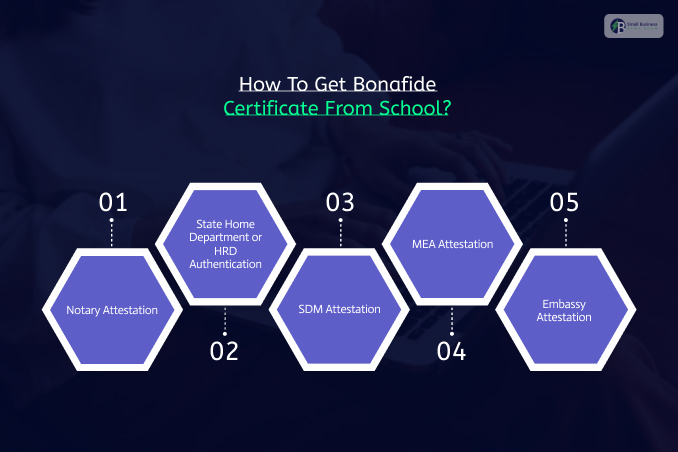
Sometimes, simply submitting your application for a bonafide certificate and getting the document isn’t enough.
Especially if you are planning to move or study abroad. To make it legally valid outside India, you need to get it attested.
While this sounds like a lot of legal jargon, the actual step-by-step process is quite straightforward:
Step 1: Notary Attestation
First, take your original certificate to a local notary public. The officer there will check your paper, sign it, and place an official stamp to kick-start the verification process.
Step 2: SDM Attestation
Next, you need to visit the Sub-Divisional Magistrate (SDM) office. Once again, an official will verify your document and add another signature and stamp.
Step 3: MEA Attestation
After local and state-level checks, your document proceeds to the central government.
The Ministry of External Affairs (MEA) reviews the prior stamps. Depending on your destination country, they will either grant a standard central attestation or issue an Apostille sticker (required for Hague Convention member countries).
For digital verification, citizens can track or initiate parts of this via the official National Portal of India eSanad (https://india.gov.in) platform.
Step 4: Embassy Attestation
Finally, you must submit the paper to the embassy of the country you are planning to visit.
They will place a special sticker, signature, and stamp on it, making it officially legal for international use.
A Quick And Easy Shortcut
If running around government offices sounds exhausting, you don’t have to do it alone.
You can easily hire professional attestation and apostille services in Chennai to handle all the heavy lifting for you.
Since they are experts in this field, they can complete your paperwork quickly and safely, offering reliable services across India.
What Guidelines Do We Need To Follow?
Writing a formal request might feel a bit intimidating, but structuring your letter is actually incredibly simple.
To make sure the administration office processes your request quickly, here is a breakdown of the essential details you need to include:
- The Date: Always start by putting the current date right at the top of your page.
- The Address: Next, direct your letter to the right person, usually your Principal or the Head of the Institution.
- The Subject Line: After that, add a short, clear line stating exactly what you need. For example, write something straightforward like “Request for Bonafide Certificate.”
- The Main Body: Inside the letter, introduce yourself clearly by sharing your full name, class, roll number, and the exact reason why you need the document.
- A Polite Request: Remember to always ask politely and use respectful phrasing, such as “Kindly issue me the certificate” or “I request you to provide…”
- The Sign-Off: Finally, wrap things up with a proper closing like “Thanking you” or “Yours sincerely,” followed by your signature and printed name.
By following this simple, professional structure, you ensure your application for bonafide certificate looks great and gets approved without any unnecessary delays!
Application For Bonafide Certificate: A Sample
If you are an employee needing this document for a passport application, corporate bank account, or visa processing, use this corporate bonafide certificate letter format for your HR department:
Date: [DD/MM/YYYY]
To,
The Human Resources Manager / Department Head,
[Company / Organisation Name],
[Branch/Office Address, City]
Subject: Application for Issuance of Employment Bonafide Certificate
Respected Sir/Madam,
I am writing to formally request an employment bonafide certificate. I am currently employed with [Company Name] as a [Your Designation/Job Title] in the [Your Department] department. My Employee Identification Number is [Your Employee ID].
I require this certificate to serve as official proof of my current employment status for [State your reason, e.g., processing a home loan application / completing personal passport verification / international visa processing].
Kindly issue the document on the official company letterhead at your earliest convenience. Please let me know if any further details or verification forms are required from my end.
Thank you for your time and prompt support.
Yours sincerely,
[Your Signature]
[Your Printed Name]
[Your Contact Number]s
What Are The Key Points You Need To Remember While Writing?
When writing a clear and effective application for bonafide certificate, you should keep these key rules in mind to avoid rejection:
- Stay Polite: Always use a respectful and formal tone throughout the letter.
- Be Clear: State the exact reason why you need the document in the subject line.
- Check Details: Double-check your name, roll number, and dates for accuracy.
- Keep It Brief: Avoid long, unnecessary stories and get straight to the point.
Proofread First: Look for typos or grammar mistakes before hitting submit.
Disclaimer: While this guide provides standard operational steps for obtaining and attesting documents in India, administrative guidelines and government requirements can change frequently.
Always verify the latest guidelines on official portals like the Ministry of External Affairs (MEA) (https://www.mea.gov.in/) before submitting sensitive paperwork