
Table Of Contents
- What Exactly Is A Corporation?
- The Good Stuff (The Advantages)
- · Your Personal Belongings Are Under Protection
- · Cool Tax Features
- · It Can Never Die
- · Licensed Shares Can Be Easily Exchanged
- · Big Money Can Come
- · Hiring Star Talent
- · Brand Prestige And Global Credibility
- The Tough Stuff (The Disadvantages)
- · The Double Tax Trap
- · A Mountain Of Paperwork
- · Strict Rules And Formalities
- · Losing Total Control
- · The Agency Problem And Short-Term Pressure
- How To Actually Form A Corporation In 4 Simple Steps?
- Is It The Right Move For You?
Corporation Advantages And Disadvantages You Cannot Afford To Ignore!
Are you trying to start a new business? The process can be super exciting. However, picking the right setup can feel like a maze. And there’s option
Thinking about starting a business? It is super exciting, but picking the right setup can feel like a maze. Let’s talk about a major option: the corporation.
First, the good news! The best part you can find is limited liability. This means your personal piggy bank and house are safe if the business gets sued.
Plus, you can raise money easily by selling stock, and the business lives on forever, even if you step down.
However, there is a flip side. You will face double taxation, meaning Uncle Sam taxes the business profits and your personal dividends.
Also, the paperwork is no joke. You have to deal with heavy regulations, constant meetings, and strict government rules.
Ultimately, it comes down to balancing these corporation advantages and disadvantages.
If you want to scale big, it is awesome. If you want a simple life, a different setup might be your best bet!
What Exactly Is A Corporation?
A corporation is a completely separate and invisible legal person. It can buy property, sign contracts, open bank accounts and even get sued, all on its own.
It sells little pieces of ownership called shares to raise cash. Moreover, the big bosses have something called a “fiduciary duty” because of this setup.
That is just a fancy way of saying they can legally put the investors’ financial interests first.
Moreover, their main goal is always to make the company grow and bring in returns for the shareholders.
The Good Stuff (The Advantages)

A corporation’s business structure can offer some huge benefits. Besides helping you to sleep better at night, it can even allow you to scale your business at much higher speed.
Amid the corporation advantages and disadvantage, the main attractions of incorporating, or starting a corporation, are as follows:
· Your Personal Belongings Are Under Protection
Besides providing you with limited liability in case of business debts or lawsuits, your personal assets such as home, car and savings are fully safe.
The fact that only business investments can be used in case of losses, is an advantage of limited liability.
· Cool Tax Features
Corporations are given tax incentives unique to them.
For instance, if a business makes a loss in the current year through operations, they can use past years as “carrybacks” or “carryforwards” to reduce taxes on profits.
Also, as sole employees are usually exempt from self-employment taxes, so are you.
· It Can Never Die
This feature of corporations is famous as perpetual existence.
Unlike simple partnerships, if an owner leaves, sells their shares, or passes away, the corporation remains alive, and operations continue seamlessly.
· Licensed Shares Can Be Easily Exchanged
Stock shares are easily bought or sold. This is an option for owners or new investors to part with or come in business without affecting the routine business operations.
· Big Money Can Come
Banks and venture capitalists support corporations. A properly structured corporate vehicle opens the door for you to obtain huge sums of cash from outside investors through financing.
· Hiring Star Talent
Issuing stock to them gives them a chance to become part-owners if they wish to do so. By offering shares or stock options, you can attract high-class managers and/or employees.
· Brand Prestige And Global Credibility
Beyond money and taxes, adding “Inc.” or “Corp.” to your business name carries significant psychological weight.
It instantly signals to major vendors, international clients, and traditional banks that your operation is stable, formal, and here for the long haul.
This prestige often opens doors to enterprise-level B2B contracts that are rarely awarded to sole proprietorships.
You May Also Love To Read: Startup Accounting Secrets: The VC Blueprint 90% Of Founders Fail To Use
The Tough Stuff (The Disadvantages)
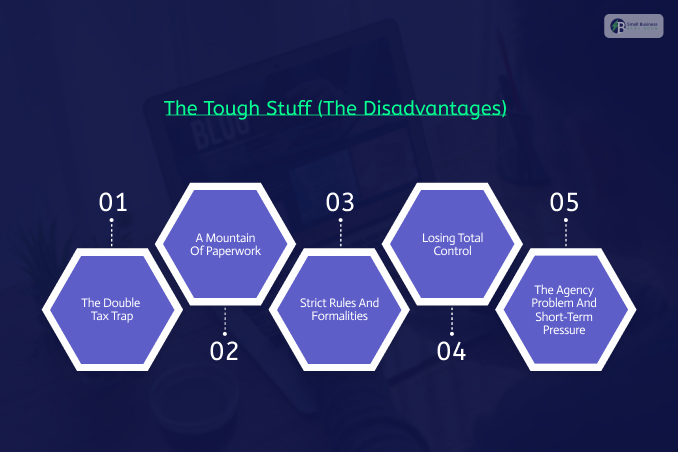
Of course, it is not all sunshine and roses. When you are planning to run a corporation, it means you might have to deal with a lot more rules, costs, and headaches than other business types.
Here are the main drawbacks you need to keep in mind:
· The Double Tax Trap
Firstly, this is a big bummer for C-corporations. The government taxes the corporation’s profits first at the corporate level.
Then, when you take your share of those profits home as a dividend, you have to pay the taxes again on your personal tax return.
· A Mountain Of Paperwork
Secondly, you need to get ready for endless forms. You have to keep incredibly detailed financial records, hold official board meetings, and file tons of reports every single year.
· Strict Rules And Formalities
You cannot just wing it. You must write official corporate bylaws, elect a board of directors, and keep up with strict legal steps.
Moreover, the government can dissolve your corporation if you get lazy with these rules.
· Losing Total Control
Lastly, once you start selling shares to raise money, you are no longer the sole boss.
A board of directors or activist investors can actually outvote you, and in some cases, founders even get pushed out of their own companies.
· The Agency Problem And Short-Term Pressure
As a corporation grows, a natural rift can form between the people who own the company (shareholders) and the people who run it (management).
This is famous as the “agency problem.” Managers might prioritize their own bonuses or short-term quarterly earnings to please Wall Street.
This can accidentally choke out vital, long-term research and development (R&D) that the company actually needs to survive a decade down the road.
How To Actually Form A Corporation In 4 Simple Steps?

It is worth noting that the process of incorporation is reasonably simple; once you carefully consider corporation advantages and disadvantages, you can make the right decision!
Below are the four steps necessary to form a corporation:
1. Selection of a unique name.
2. Election of a board of directors by the shareholders.
3. Filing of Articles of Incorporation with the relevant state authorities.
4. Development of corporate bylaws and the first stock issue.
Indeed, everything is relatively simple and transparent. Nonetheless, it is essential to remember that each state has its own fees and paperwork requirements for incorporating a business.
So, it is necessary to consult the relevant government websites (for example, the U.S. Small Business Administration).
Is It The Right Move For You?
At the end of the day, corporations are perfect for tech startups. High-risk ventures and big businesses that need millions of dollars from investors to scale up.
However, the heavy paperwork and extra taxes might not be worth the headache if you are running a small, local shop or a simple freelance business.
In those cases, a Limited Liability Company (LLC) or a simple partnership might fit your goals much better.
Moreover, you must always have a chat with a business attorney or a CPA before you make the final leap!
Disclaimer: This article is provided for educational and informational purposes only. Business structures and tax laws vary significantly by state and country. This content does not constitute formal legal, financial, or tax advice. Always consult with a licensed business attorney or a Certified Public Accountant (CPA) before finalizing your business structure.