
Table Of Contents
- What Is A Voyage Policy In Marine Insurance?
- Key Features Of A Marine Insurance Voyage Policy
- 1. Coverage For A Specific Journey
- 2. Protection Against Common Transit Risks
- 3. Flexible And Cost-Effective
- 4. Customisable For Specific Shipments
- 5. Clear Terms And Easy Claims
- Marine Insurance Voyage Policy: Inclusions
- Marine Insurance Voyage Policy: Exclusions
- How Indian Businesses Benefit From A Voyage Policy in Marine Insurance
- Real-World Examples With Data And Case Studies
- Regulatory References And Legal Framework
- Practical Comparison Table Of Marine Insurance Policies
- Frequently Asked Questions (FAQs)
What is Voyage Policy in Marine Insurance – A Complete Guide
Last Updated on: December 27th, 2025
A voyage policy in marine insurance covers a specific journey from one place to another. The insurer protects goods or cargo during that particular transit.
This type of policy starts when the journey begins and ends when the ship reaches its destination.
Businesses often choose a voyage policy for single shipments, especially when the route or timing is irregular. It offers security against risks faced during the specified journey.
Let us explore why a voyage policy is a smart choice for businesses shipping goods within India and abroad.
What Is A Voyage Policy In Marine Insurance?
A voyage policy is a specific type of marine insurance policy that covers cargo for a single, defined journey. You get coverage from the starting point to the destination, regardless of how long the trip takes.
This is different from a time policy, which covers cargo or vessels for a fixed duration instead of a single trip.
Every business requires a transportation solution to maintain its operations and sales.
However, without transportation assistance like insurance, you cannot be safe all the time. This is where voyage policy comes into play for marine trips.
Let’s say you are exporting a particular shipment from Mumbai to London. You have chosen the marine path, and here you can get a voyage police to ensure that the coverage/protection remains active for the entire trip.
From the moment you start to the moment you safely complete your shipment journey, you get complete coverage.
However, this is different from transit insurance, which considers all modes of transportation, including land, air, or sea.
Apart from that, it also covers multi-modal transport like trucks, ships, trains, and planes.
So, during your journey, you get complete coverage of the shipment with no risk. Therefore, Voyage policies are suitable for businesses that do not regularly ship to dedicated destinations.
Key Features Of A Marine Insurance Voyage Policy
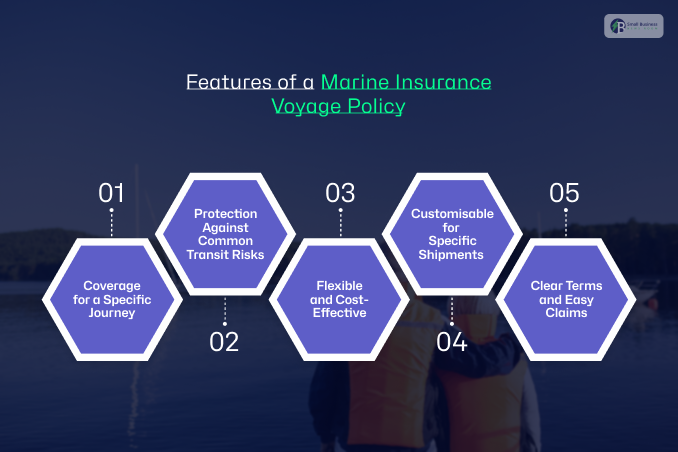
A marine insurance voyage policy is a kind of cargo insurance that insures the goods for one particular trip rather than a specified period of time.
The coverage is very particular to the individual shipment and terminates instantly on the cargo’s safe delivery to the specified location.
1. Coverage For A Specific Journey
You get coverage for one journey between two fixed points. The policy is clear about where the cargo starts and where it is supposed to end.
2. Protection Against Common Transit Risks
What are the common marine transit risks that come to your mind? Sinking?
Well, with voyage policy, you get protection against all common dangers like –
- Sinking
- Fire
- Collision
- Theft
- Natural calamities
While doing business, we all fear unexpected financial losses. Therefore, it is better to protect your operations to minimize financial risks.
3. Flexible And Cost-Effective
Businesses that do not ship goods frequently can find voyage policies cost-effective. You only pay for the coverage you need without committing to an annual or open policy.
4. Customisable For Specific Shipments
Every business has unique requirements. Voyage policies allow you to customise coverage based on the nature of your cargo, destination, and chosen route.
5. Clear Terms And Easy Claims
The policy clearly defines the start and end of coverage. If you need to make a claim, the process is generally simple because of well-defined terms.
Marine Insurance Voyage Policy: Inclusions
- Marine Perils: Loss or damage due to marine perils such as storms, rough seas, sinking, or collision.
- Fire and Explosion: Loss from fire, explosion, or jettisoning (throwing goods overboard to save the ship).
- Theft and Piracy: Theft or piracy during the voyage.
- Accidental Handling Damage: Accidental damage during loading and unloading, if specifically mentioned in the policy.
- General Average Loss: In emergency situations, a voluntary sacrifice is common on a ship journey. If, due to that, a general average loss occurs for all parties in a sea venture, you get complete protection.
Please note: Read your policy documents carefully, as coverage can vary between providers.
Marine Insurance Voyage Policy: Exclusions
A marine insurance voyage policy typically excludes all the losses that are preventable! These can arise from the inherent nature of the goods or be somewhat related to the political or war risks.
- Delay in Transit: Loss due to delay in transit that is not caused by an insured peril.
- Poor Packaging: Losses caused by inadequate or improper packaging.
- Intentional Acts or Negligence: Damage from intentional acts or negligence of the insured.
- Normal Wear and Tear: Normal wear and tear or loss of market value.
- Out-of-Scope Losses: Losses occurring before the commencement or after the completion of the defined voyage.
Please note: Obtaining a policy is not a difficult task these days, with numerous providers available across various genres.
However, you have to be sceptical about your choices. However, try to make a smart choice by aligning policy exclusions with your business requirements.
How Indian Businesses Benefit From A Voyage Policy in Marine Insurance
Businesses in India that ship goods occasionally or to varied destinations can benefit the most from a voyage policy under marine insurance.
If your business deals with exports, imports, or even inland transportation for valuable consignments, a voyage policy is necessary.
You can cover your goods for that specific journey without investing in a long-term, comprehensive policy unless needed.
Every business owner wants to control costs in their operations. When it comes to transportation, your shipment deserves special care.
From protecting cargoes to seasonal goods protection, voyage policies deal with it all more flexibly.
With Voyage Policy in Marine Insurance, you get more clarity on your investments in insurance while making smart choices. What else do you want?
Businesses may choose a voyage policy for coverage during the sea journey between two ports.
However, if the goods need protection while being transported to and from the ports (truck or train within the country), transit insurance offers additional coverage.
Also, you need to select the right insurance provider for professional services. Reputable insurance providers like TATA AIG offer a range of marine insurance solutions tailored for Indian businesses.
With the right partner, you can ensure smooth claims, clear policy terms, and reliable customer service.
Real-World Examples With Data And Case Studies
A textile exporter, who was sending his goods from Mumbai to Dubai, got a recovery of ₹3.5 lakh for the loss that had occurred because he had a voyage policy that covered the cyclone damage in the Arabian Sea.
As the loss was during the covered voyage, the insurer paid for it. In another case, an Indian computer hardware exporter, named XY Ltd.
They took a voyage policy for electronics shipped to Singapore.
A part of the cargo was damaged by the typhoon, and XY Ltd. was able to claim insurance for the losses as the event was covered under the terms of the voyage policy.
Regulatory References And Legal Framework
The legal framework and regulatory references for Indian marine insurance are controlled by the Marine Insurance Act of 1963.
This demarcates the basic terms for the voyage policies, such as the limits of coverage and the exclusions.
According to the Act, any unauthorised deviation from the prescribed voyage may result in policy cancellation (Section 48).
Besides, Indian marine insurance is subject to the rules and guidelines laid down by the Insurance Regulatory and Development Authority of India (IRDAI).
Marine insurance companies apply the recognised terms like Institute Cargo Clauses (ICC A/B/C) to express in detail the specific risks.
This insurance is provided under the voyage policies. The clauses cover marine perils, fire, theft, etc., in a uniform manner.
Practical Comparison Table Of Marine Insurance Policies
This table will help you understand all the differences among the Marine insurance policies based on the price.
| Policy Type | Coverage | Best For | Duration | Key Feature |
| Voyage Policy | Single specific voyage | Irregular shippers | Journey-based | Coverage from origin to destination |
| Time Policy | Fixed period | Regular exporters/importers | Time-based | Coverage for a set time period |
| Open Policy | Multiple shipments | High-volume exporters | Ongoing | Covers all shipments within the policy period |
Frequently Asked Questions (FAQs)
Not necessarеly, but it is still recommended very much for companies that are transporting irregular or one-time shipments so that they can get protection against the risks of transit.
Of course, it is the IRDAI that governs the marine insurance market in India by dictating the rules that will make it difficult for anyone to be dishonest.
This, thus ensures that the policies of the insurance companies and the settlements of the claims are carried out in a professional manner.
Usually, the papers such as invoices, bills of lading, packing lists, and shipment details are required to calculate the risk and give out the policy.
Read More: