
Table Of Contents
- Why Do We Need To Conduct In Today’s Competitive Market?
- What Are The Business Market Research Techniques That Can Help Your Business To Grow?
- Primary Research
- Secondary Research
- Qualitative Research
- Quantitative Research
- What Are The Common Market Research Methods?
- Interviews
- Focus Groups
- Public Data / Desk Research
- Purchased Data
- Field Trials
- Social Listening
- Competitor Benchmarking
- Mystery Shopping
- How To Choose A Market Research Method?
- What Is The Cost And Timeline For Each Type Of Research?
- What Are The Common Mistakes That You Must Avoid While Conducting Market Research Success?
From Surveys To Focus Groups: Exploring Diverse Market Research Methods
Imagine a scenario where a company spends $50 million on a new energy drink, which, unfortunately, fails to sell in the first six months. This is the case when a major corporation picks the wrong data.
However, this is just one example among many. Every year, a large number of companies suffer significant losses because they base their decisions on inaccurate research or on questions that don’t matter.
Bad research leads to worse results than no research at all. This is because it leads you to overlook the risks you will subsequently take.
Conversely, market research strategies can be a powerful decision-making tool if you employ the right ones. Thus, you mitigate your risks and increase your chances of success.
Whether you select a strategy is not only about seizing any data. It is about uncovering the right knowledge that propels your business.
This is especially important when validating small business ideas, launching a small manufacturing business,
Through this post, you will discover 11 major market research techniques. Additionally, you will identify the appropriate times for their application.
Lastly, we will provide you with an easy framework to choose the top method aligned with your objectives.
Why Do We Need To Conduct In Today’s Competitive Market?
Market research is essentially about understanding your customers and the industry you operate in.
Using different market research approaches, you can gather information that helps you develop better products and increase customer satisfaction with your brand.
Moreover, these findings enable you to attract quality leads and increase your sales.
Whether you are exploring different types of marketing strategies or evaluating credit card processing for small business solutions, research ensures you make informed decisions.
Its very difficult to filter out the real information in the busy world nowadays.
There is a ray of hope, though: an effective research process helps to cut out the noise so that you can target your specific audience.
Here are 9 reasons why these market research methods can revolutionize your growth:
- Know your world: Initially, you’ll know your audience and competitors in much greater detail. This gives you a competitive edge.
- Lower your risk: Testing your ideas ahead of time lets you avoid wasting money on the ones that don’t work.
- Hidden gems: You’re going to identify opportunities while, at the same time, steering clear of the threats that are coming.
- Check yourself: The questionnaire process is a good way to measure your strengths and weaknesses relative to others.
- Predict the future: Being on top of the game, you can detect the trends before they break onto the masses.
- Get inspired: High-quality data provides a solid foundation for a few fresh, winning ideas.
- Find your fit: You’ll learn exactly which group of people is most likely to buy from you.
- Focus on the customer: It keeps you focused on what people actually want and need.
- Measure success: Finally, you can compare your progress against industry standards to keep growing.
Now that you see why this matters, let’s dive into the specific techniques you can use.
What Are The Business Market Research Techniques That Can Help Your Business To Grow?
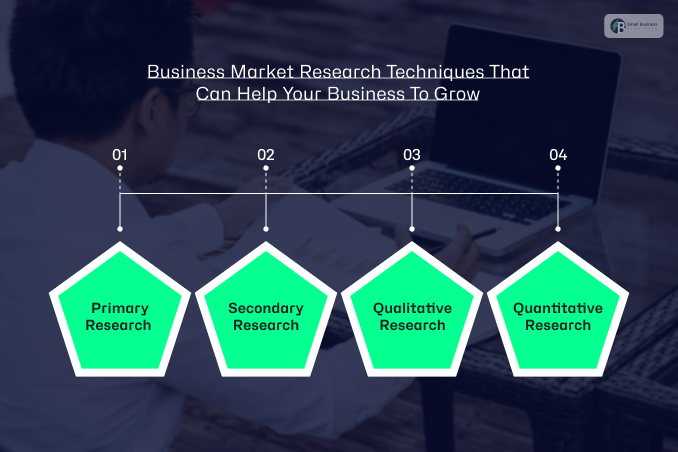
To grow your brand, you need the right tools. While digital tools are popular today, many successful companies still use traditional market research methods to get the best results.
To help you understand how it all works, let’s break these techniques down into simple categories.
This is particularly useful if you are planning how to register a company in the USA and want to understand your target market before officially launching.
First of all, it is helpful to understand the difference between primary and secondary research:
Primary Research
It is basically fieldwork. In fact, it means you are the one collecting the data. To get direct feedback from your customers, for example, you might conduct a focus group or mail out a questionnaire.
Secondary Research
You are utilizing other people’s work in this strategy. You study others’ data and analyses, for example, through workshops, research products, or online articles.
If you have limited funds or require speedy service, this is an ideal alternative.
After you choose a type, you’ll need to decide whether you want to focus on emotions or figures. This is the difference between qualitative and quantitative market research methods.
Qualitative Research
This is mostly why it involves interpreting the underlying causes, opinions, and motivations of your audience or visitors.
It records their emotions, experiences, and thoughts. This type is very appropriate for gaining insight into people’s motivations.
Quantitative Research
This is more concerned with the quantity aspect of things. It primarily uses factual information, numerical data, and percentages to uncover patterns.
Because it is highly structured, it is well-suited for validating your hypotheses with data.
You can develop a plan tailored to your specific objectives by combining elements from these methods.
What Are The Common Market Research Methods?
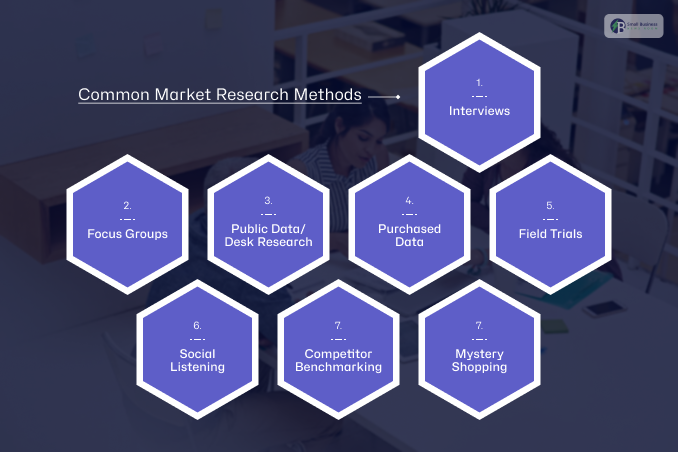
Are you trying to choose the right research methods for your brand? Here are some popular market research techniques explained in simple, easy English.
Interviews
Type: Primary market research
Interviews are detailed discussions between a customer and a company representative to gain in-depth views and experiences.
One can ask open-ended questions to uncover their needs or issues. It yields great insights but takes a lot of time, and it is difficult to quantify the information.
Timeline: 23 weeks
Budget: Low to Medium
Focus Groups
Type: Primary market research
Focus groups gather a small number of individuals at a time to discuss a product or service. The participants freely express their thoughts and reactions to the product during the session.
This allows you to learn different opinions all at once. However, planning the group and recruiting the right participants can be challenging.
Timeline: 24 weeks
Budget: Medium
Public Data / Desk Research
Type: Secondary market research
Desk research involves gathering information from sources such as industry reports, online scientific research, and government data to gain insight into the market.
It is a fast and inexpensive way to understand market trends and competitor information. However, the data may not always be up to date or precisely what you need.
Timeline: 12 weeks
Budget: Low
Purchased Data
Type: Secondary market research
Purchased data means buying ready-made research from market research companies. This way, you get deep, detailed insights without having to conduct the research yourself.
It can be a time-saver, but the data might not perfectly align with your goals, and it can be costly.
Timeline: 1 week
Budget: Medium to High
Field Trials
Type: Primary market research
Field trials let you test your product or campaign in real-world conditions before going all in.
It gives a good understanding of how customers will use the product in their everyday lives.
On the other hand, collecting enough valuable feedback can be quite expensive and time, consuming.
Timeline: 48 weeks
Budget: High
Social Listening
Type: Primary market research
Social listening involves monitoring customer conversations about your brand across social media and other online platforms.
It gives a real-time insight into people’s opinions, complaints, and trending topics.
The downside is that the feedback that you get online may not be representative of your whole audience.
Timeline: Ongoing
Budget: Low
Competitor Benchmarking
Type: Primary market research
Competitor benchmarking is the process of analyzing competitors’ pricing, products, and service offerings.
It allows you to discover market gaps and sharpen your strategy. Yet, at times, it can be quite challenging to get reliable competitor data.
Timeline: 23 weeks
Budget: Low to Medium
Mystery Shopping
Type: Primary market research
Mystery shopping involves a person pretending to be an ordinary customer to evaluate your business or a competitor’s service.
It gives you an idea of the customer experience from an authentic perspective. Nevertheless, you may find it costly to operate such a program.
Timeline: 24 weeks
Budget: Medium to High
How To Choose A Market Research Method?
First, you can achieve the best results by aligning your objectives with the appropriate strategy.
Don’t rush in; first, clarify what information you want to get. This part is very important because it ensures that your market research methods actually provide you with the answers you need.
Here is a brief guide that will help you decide which way to go:
- Would you like to discover “why” people behave the way they do? Then, qualitative research or focus groups are the right choices to get their narratives.
- Do you want to find out the market size? Consider quantitative research because it provides numerical data.
- If you are just starting to look into a trend, you may want to run exploratory research to find out what is available.
- Which of the following would probably provide you with the most up, to, date information on current market conditions? Generative research will give you the clearest picture.
- Do you want to figure out the exact reasons behind a sale? A/B testing is the right tool to test different ideas against each other.
- Do you have a limited budget, or are you pressed for time? Then consider doing a competitive analysis or social media listening.
In some situations, it is not a good idea to do everything by yourself. Getting professional help is necessary if a decision involves more than $ 100,000.
Moreover, experts are helpful if one is inexperienced in research design. If you want to use reliable stats to convince stakeholders, it is wise to hire a professional.
Applying the right market research techniques can significantly reduce your stress later on.
Moreover, it will help you avoid costly errors.
What Is The Cost And Timeline For Each Type Of Research?
Costs often vary based on the sample size, complexity, and geographic scope. The professional execution can typically help you deliver an ROI that’s 3-5x higher than with DIY approaches.
| Research Type | Timeline | Budget Range |
| Qualitative Research | 4-6 weeks | $15,000-$75,000 |
| Focus Groups | 3-5 weeks | $12,000-$40,000 |
| Quantitative Research | 2-4 weeks | $10,000-$50,000 |
| Competitive Analysis | 2-6 weeks | $5,000-$25,000 |
| Social Media Listening | Ongoing | $3,000-$15,000 |
What Are The Common Mistakes That You Must Avoid While Conducting Market Research Success?
Research is great, but it can easily lead you down the wrong path. If you aren’t careful, you might end up with “expensive lessons” instead of helpful insights. Here are five common traps to avoid:
First, don’t mix up your methods. If you want to know “why” people feel a certain way, a simple survey won’t cut it.
Likewise, don’t use small interviews to guess “how many” people will buy your product.
Second, watch your sample size. If you only talk to a few people who all think alike, your data won’t represent the real world.
Third, stay focused. It is easy to get buried in useless facts, so make sure you are only collecting data that actually helps you make a decision.
Fourth, don’t miss the subtext. If a moderator is untrained, they might miss the “hidden” feelings behind a participant’s answer.
Finally, don’t jump to conclusions. It’s tempting to see what you want to see, but always look for other explanations.
The real danger of DIY research is the false confidence it breeds. It’s scary to make a huge business move thinking you have the facts, only to realize later that your “science” was flawed.