Table Of Contents
- What Exactly Is Ethical Leadership?
- 4 Core Pillars Of Ethical Leadership
- 1. Integrity / Moral Scope
- 2. Transparency
- 3. Fairness
- 4. Accountability
- Why It Matters: The Internal And External Benefits
- Elevating The Employee Experience
- Winning The Trust Of Customers
- Key Leadership Theories That Support Ethics
- · Transformational Leadership
- · Servant Leadership
- · Stakeholder Theory
- Real-World Examples: Ethics In Action
- Hubert Joly – Best Buy CEO
- Dr. Wayne Frederick – 17th President of Howard University
- Overcoming Common Obstacles And Dilemmas
- 5 Practical Steps To Develop Your Ethical Leadership Skills
- 1. Know Thyself
- 2. Know The Theory Behind Ethical Decision Making
- 3. Create The “Speak-Up” Culture
- 4. Show Empathy And Compassion At The Workplace
- 5. Invest In Leadership Development
The One Management Secret That Completely Stops Employee Burnout!
In today’s world, companies are obsessed with increasing the bottom line, meeting targets, and accelerating growth.
However, without ethical leadership, a company will fail to consolidate its position in the marketplace.
Ethical leadership is no longer a bonus but a guarantee of success.
| Quick Summary: What Is Ethical Leadership? Ethical leadership involves influencing a group of people, for example, not through the corporate power the position brings. An ethical leader creates a fair, transparent environment, considers all interested parties, and fosters high employee engagement. |
What Exactly Is Ethical Leadership?
To truly grasp this concept, it helps to break it down. At its core, Ethical Leadership is about making decisions grounded in clear, positive moral principles.
It means setting an example so your team knows exactly what behavior is expected.
According to renowned business researchers Treviño, Brown, and Hartman, this leadership style requires balancing two distinct roles:
- The Moral Person: This is your internal character. It includes your personal integrity, empathy, and your own moral decision-making processes.
- The Moral Manager: This is your external action. It is your ability to shape how other people behave through transparent communication, holding teams accountable, and setting up reward systems that champion honesty.
Meanwhile, we must acknowledge that this discipline is not abstract. It requires daily practice.
It is not just about managing a crisis; it is about navigating the subtle, everyday moments when choices are not entirely clear-cut.
4 Core Pillars Of Ethical Leadership
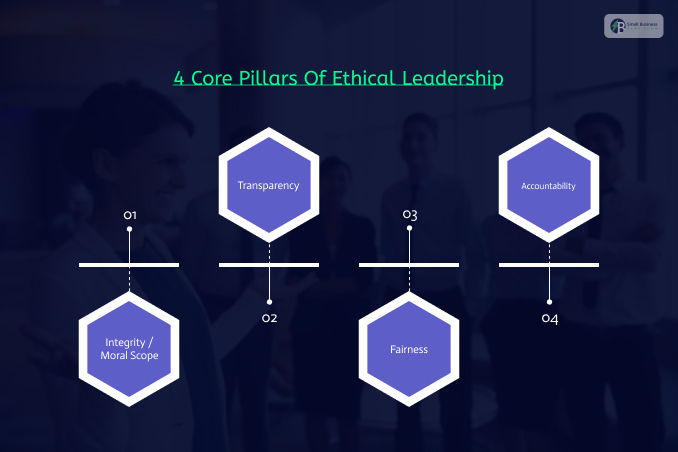
So what are the ethical leadership pillars that build the framework for a fair and prosperous workplace?
There are four basic elements, each essential to building the right corporate culture.
1. Integrity / Moral Scope
Integrity implies alignment between inner values and actions.
In addition, a person must have a moral scope that allows them to make decisions even when faced with dilemmas.
For example, choosing between two equally necessary but mutually exclusive events, such as product quality and speed of development.
2. Transparency
Transparency means honest, open communication with all stakeholders and visibility into operations at all levels.
This, in particular, excludes any “hidden” actions by companies that may disadvantage employees.
3. Fairness
Fair treatment of employees, the ability to resist bias, and the absence of discrimination are essential aspects of ethical leadership.
In addition, fairness is based on recognizing achievements and avoiding “backdoor” appointments.
4. Accountability
Accountability is an essential component of ethical leadership. This means not only admitting mistakes but also discussing them openly and working to fix them.
At the workplace, accountability is reflected in a fair assessment of employees, taking into account not only mistakes but also their subsequent implementation of solutions.
Why It Matters: The Internal And External Benefits
Choosing to implement Ethical Leadership brings massive strategic advantages to both the individuals inside your company and your broader brand identity.
| Focus Area | Core Benefits | Long-Term Impact |
| Internal (Your Team) | • Boosts employee morale and engagement• Reduces workplace stress and burnout• Skyrockets retention and team collaboration | Lower turnover costs, higher everyday productivity, and a safe, innovative work environment. |
| External (The Market) | • Builds a rock-solid brand reputation• Generates massive, organic customer loyalty• Attracts values-driven investors | Sustained financial success, protection from public scandals, and strong competitive advantages. |
Elevating The Employee Experience
When employees know they are working with honest and fair leadership, it stimulates their productivity and engagement.
People feel safe in sharing their ideas and even pointing out problems. With ethics, colleagues fear less disapproval when they do something wrong.
At the same time, a non-ethical workplace with threats and blackmail leads to lower staff retention, reduced productivity, and even burnout.
Winning The Trust Of Customers
Modern customers are highly demanding and ready to support companies that share their views.
Ethical leadership shows how the business cares about its employees, suppliers, and the environment.
Such a company builds customer loyalty, which ultimately translates into profitability.
Moreover, customers are likely to stand by the business when its ethical practices suffer.
Key Leadership Theories That Support Ethics
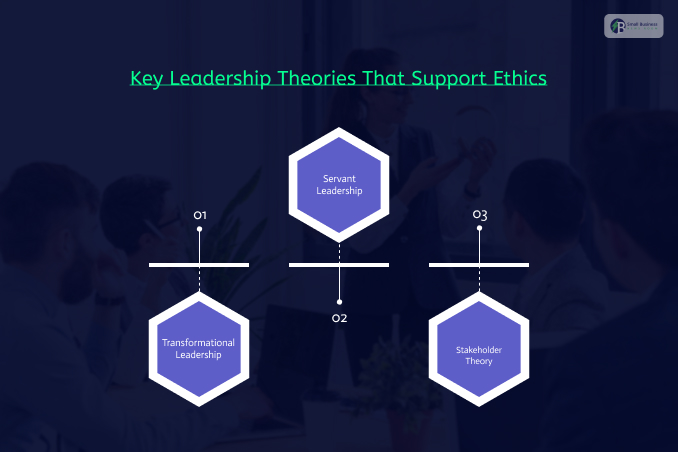
Ethical leadership does not exist in a vacuum. It is supported by several foundational management frameworks that help explain why it works so well.
· Transformational Leadership
This framework focuses on inspiring a shared vision and empowering individuals. Ethical leaders use this approach to serve as real-world role models.
This shows their teams how to make value-based choices every single day.
· Servant Leadership
Coined by Robert K. Greenleaf, servant leadership flips the traditional corporate pyramid upside down.
The leader’s primary goal is to serve the team by removing obstacles, providing emotional intelligence, and helping people grow both personally and professionally.
· Stakeholder Theory
For decades, businesses focused exclusively on satisfying shareholders (investors).
However, stakeholder theory proves that an ethical business must consider everyone impacted by its decisions.
This includes employees, customers, suppliers, the local community, and the environment.
Related Article For You: The Real Difference Between W-2 And 1099 Hiring
Real-World Examples: Ethics In Action
Companies cannot simply promise ethical leadership; they must demonstrate it.
Many ethical leaders have changed entire industries and become successful because of their policies.
Hubert Joly – Best Buy CEO
When Joly became CEO of Best Buy in 2012, the company was in crisis and had to make many cuts.
However, instead of laying off many workers, he invested in employee development and training and adhered to transparent policies.
This allowed him to increase the staff’s loyalty to the company, which subsequently had a positive impact on its growth.
Dr. Wayne Frederick – 17th President of Howard University
Dr. Frederick has developed many policies at Howard University that have made the institution more competitive and socially aware.
He has guided his leadership by ethics and incorporated community interests into the university’s work.
This brought in new donations and significantly raised the institution’s prestige.
Overcoming Common Obstacles And Dilemmas
Ethical leadership is not always easy, and companies often face dilemmas that require an answer. Some of the most common challenges include:
- The Myth Of Ethical Leadership
Many traditional CEOs believe that ethics is detrimental to business.
However, companies like Patagonia and Ben & Jerry’s have implemented ethical leadership and shown it can be profitable.
In addition, ethical leadership protects a company from expensive scandals and legal problems.
- Balancing Different Needs And Demands
While large corporations strive to meet the expectations of all stakeholders, it is often difficult to balance their sometimes incompatible interests.
To address this, ethical leadership must be based on long-term strategies rather than hasty decisions.
5 Practical Steps To Develop Your Ethical Leadership Skills
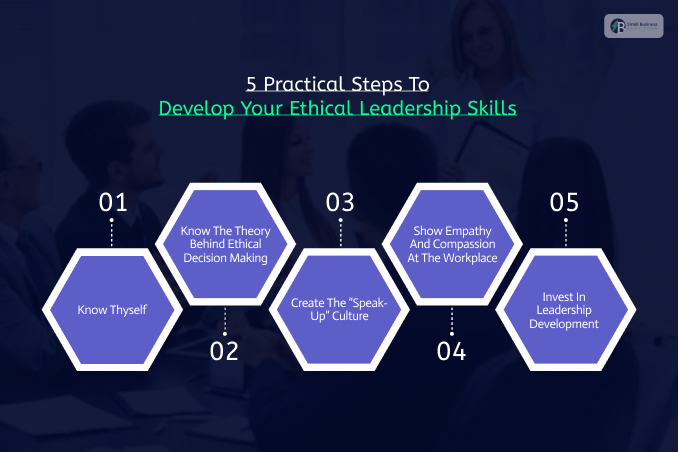
Ethical leadership is a continuous learning process. Here are a few tips for becoming a more ethical leader.
1. Know Thyself
A fundamental truth about leadership is that ethics begins with self-awareness. To do this, spend time analyzing your desires, thoughts, and behavior.
In addition, you should also understand what values you are guided by and how your subconscious reacts to certain situations.
Keeping a journal, reflecting, and meditating can help you with this.
2. Know The Theory Behind Ethical Decision Making
To make the right decision, it helps to use standard decision-making models, such as the Four-Component Model developed by molecular neurobiologist Jeffreys.
It can be used to solve any ethical dilemma and consists of four stages:
1. Recognition of the problem. Understanding that there is an ethical dilemma and the need to solve it.
2. Moral judgment. Choosing the most ethical solution based on personal values.
3. Moral motivation. Overcoming the temptation to choose a more comfortable but unethical option for personal gain.
4. Moral action. Bringing the decision to life.
3. Create The “Speak-Up” Culture
An ethical leader must create an environment where employees feel safe and secure expressing their opinions.
They should also encourage feedback and interaction between colleagues.
Moreover, it is essential to create conditions for full disclosure so employees can openly discuss any abuses and problems.
The leader must also show that he will take accountability for everything that happens in the team.
4. Show Empathy And Compassion At The Workplace
Empathy is an essential quality of an ethical leader. Understanding other people’s problems allows a manager to support employees and contribute to their well-being.
In addition, empathy encourages loyalty and devotion to the leader. By showing compassion, you not only help people but also inspire them to help you.
5. Invest In Leadership Development
To become a great leader, you need to invest time and effort. This includes receiving professional help and consulting with mentors.
Moreover, taking courses on ethical leadership can help you learn new skills and get ideas for implementation. One of the best ethical leadership training programs is the NXT-GEN Fellowship, designed for young change-makers who want to learn the fundamentals of leadership.