



Table Of Contents
Famous Entrepreneurs In India: An Analytical Overview Of Corporate Founders And Industrial Leadership
Have you ever wondered about starting a huge business empire from scratch?
It is a long, winding road that involves late nights full of hope and blind gambles, and a ton of setbacks along the way.
Today, India stands as one of the most dynamic markets in the world. It has evolved into a hotbed of innovation and ingenuity, thanks to a tiny group of incredibly important people, known as entrepreneurs.
If you’re considering embarking on your own entrepreneurial journey but are in need of the right inspiration, you’ve stumbled upon the perfect article on the blog.
Here, we aim to present a list of famous entrepreneurs in India.
We’ll also explore how they laid the groundwork, what went wrong early on, and the business strategies that led to dominance in their respective fields.
Legacy Industrialists: The Pioneers Of Modern Indian Business
Before we delve any further and look at the apps on your smartphone, we have to acknowledge and appreciate the bricklaying ancestors who built the infrastructure.
These legendary industrialists single-handedly created job opportunities, built roads, and opened avenues of finance that paved the way for today’s entrepreneurs.
And before the concept of venture capital even existed, these entrepreneurs defined what it takes to become one of India’s most famous entrepreneurs.
Ratan Tata & The Tata Group Legacies
When someone thinks of ethical business, the first name that comes to mind is Ratan Tata.
The patriarch of Tata Enterprises took charge of the business conglomerate in 1991 and became CEO of a company that has led Indian industry for decades.
Key Achievements
The most significant thing Ratan Tata did for his company was expand into new markets abroad.
He took it upon himself to acquire renowned international labels such as Jaguar Land Rover and Tetley Tea.
More recently, Ratan Tata launched the affordable car brand Tata Nano, making India not just a manufacturing powerhouse but also a market for mass consumption of such products.
Impact
His philosophy revolved around providing the highest standards of living possible, without compromising any of the core values.
A large portion of Tata’s earnings goes into trusts, channeling money back into society at large.
Mr. Tata goes to prove that a strong set of personal values does not undermine his status as one of the richest men in the world.
Dhirubhai Ambani & Mukesh Ambani: The Reliance Revolution
While Ratan Tata epitomizes the idealism of Indian business, Mukesh Ambani blends big bucks with belligerence.
From humble beginnings selling spices and textiles, Dhirubhai Ambani took Reliance from a tiny cotton ginning company to a global behemoth in petrochemicals.
Moreover, his son Mukesh later took the reins and leveraged them to launch India’s social media and entertainment revolution.
Key Achievements
In his efforts to dominate the telecom sector, Mukesh launched Reliance Jio and gifted millions of Indians with free data and calling services.
In addition, the company spent billions of rupees setting up a 4G network that spans the country.
Moreover, all the domestic competitors were forced to slash their tariffs, resulting in what many call India’s modern-day telecom revolution.
That pretty much sums up what makes these entrepreneurial families special.
Impact
The hallmark of Reliance’s business philosophy is vertical integration and complete end-to-end control. They don’t just enter a market; they strive to rule it.
The IT And Tech Emperors Of India
As the world entered the 21st century, India became famous for a new export: high-quality software engineering and famous entrepreneurs in India in that field.
The IT boom created a massive middle class and put Indian tech talent on the global map.
N.R. Narayana Murthy: The Father Of Indian IT
In 1981, N.R. Narayana Murthy and six friends sat in a small apartment and decided to start a software company called Infosys.
They started with just $250, mostly borrowed from Murthy’s wife, Sudha Murty.
Key Achievements
Murthy co-founded Infosys and built it into an international IT superstar. He created the “Global Delivery Model,” which split up software development work so it could be done across different time zones.
Moreover, as a result, global Western companies could outsource their tech problems to India and get them fixed overnight.
Impact
Infosys opened the floodgates for international investment in India. It proved that
Indian engineers could deliver world-class technical work, establishing the country as the definitive back-office of the global tech economy.
Today’s software pioneers often look back on Murthy as one of India’s most influential and famous entrepreneurs.
Sridhar Vembu: Bootstrapping A SaaS Empire
While most tech founders rush to venture capitalists for millions of dollars, Sridhar Vembu chose a completely different path.
He built Zoho Corporation, a cloud software company, without taking a single rupee of outside investment.
Key Achievements
Vembu built Zoho into a global competitor that can go head-to-head with giants like Microsoft and Salesforce.
He retains total control and does not answer to demanding Wall Street investors, since he bootstrapped the company.
Impact
Vembu pioneered a concept called “rural-first development.” Zoho sets up tech hubs in small villages, instead of opening massive offices in crowded cities like Bengaluru.
This allows local youth to secure high-paying tech jobs without abandoning their hometowns.
The Digital Unicorn Era: Modern Startup Disrupters
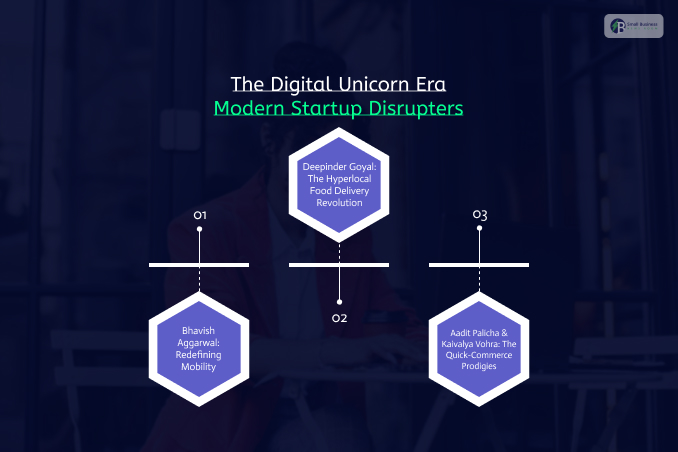
Today, India boasts over a hundred “unicorns”—startups valued at over $1 billion.
These famous entrepreneurs In India are using mobile apps to solve everyday problems like transportation, food, and grocery delivery.
Bhavish Aggarwal: Redefining Mobility
Getting a reliable taxi used to be a nightmare in Indian cities. Drivers would refuse to turn on meters, or they simply would not show up.
Bhavish Aggarwal saw this frustration and launched Ola Cabs to fix it.
Key Achievements
Aggarwal successfully fought off global giant Uber, keeping Ola a leading ride-hailing service in India.
Not content with just software, he later launched Ola Electric, building the world’s largest two-wheeler factory to manufacture electric scooters.
Market Value
Ola changed the way millions of Indians commute every day. They expanded into Tier-2 and Tier-3 towns.
This helped the company create steady livelihoods for hundreds of thousands of gig-economy drivers.
Deepinder Goyal: The Hyperlocal Food Delivery Revolution
Hungry but do not want to cook? Deepinder Goyal solved this problem by creating Zomato.
What started as a simple website to view scanned restaurant menus soon became a logistics titan.
Key Achievements
Goyal steered Zomato through fierce food-delivery wars, acquired its main rival Blinkit, and led the company to a massive, successful initial public offering (IPO) on the Indian stock market.
Market Value
Zomato did more than just deliver food; it created a massive hyperlocal logistics network.
It laid down the blueprint for how modern apps interact with physical neighborhoods, by integrating real-time tracking and digital payments.
Aadit Palicha & Kaivalya Vohra: The Quick-Commerce Prodigies
Think you need decades of experience to build a massive business? Think again.
Aadit Palicha and Kaivalya Vohra dropped out of Stanford University as teenagers to solve a simple problem: getting groceries delivered instantly.
Key Achievements
The duo founded Zepto, a startup that delivers groceries to your doorstep in under 10 minutes.
Despite heavy skepticism from older investors, they scaled the company into a billion-dollar unicorn while still in their early twenties.
Market Value
Zepto completely re-engineered urban logistics by using “dark stores”—hidden micro-warehouses optimized for lightning-fast packing.
As a result, they shifted consumer expectations nationwide, making 24-hour delivery timelines look obsolete.
Their rapid success has earned them a spot among India’s most talked-about and famous entrepreneurs.
Leading FFamous Entrepreneurs In India Who Are Shattering The Glass Ceiling
Indian women are breaking barriers and building the most profitable and fastest-growing businesses in the country.
These progressive leaders have proved that insights from deep industry knowledge beat corporate gatekeeping every time
Falguni Nayar: Omnichannel Beauty Queen
The shopping culture for cosmetics in India used to be very low-key. Local stores had a meager selection, while malls offered little variety.
Falguni Nayar, a former investment banker, decided to change the game at 50 by launching her company, Nykaa.
Key Features
Falguni Nayar turned her online beauty portal into a public limited company, making her India’s richest self-made female billionaire and an inspiration to many for pursuing a business career at any age.
The strategic leader understood the power of an “omnichannel” approach, allowing customers to shop online and experience the same at physical stores.
She created Nykaa stores where customers could sample products before buying online.
Kiran Mazumdar Shaw: India’s Biotech Queen
Biotechnology was an alien subject in India in the late 1970s. Kiran Mazumdar Shaw faced numerous rejections from banks and landlords while launching her bio-pharma company from her garage.
However, the tenacity shown by the serial entrepreneur paid off when she made India’s largest publicly listed biopharmaceutical company.
Key Features
Biocon, her brainchild, is currently known for its low-cost production of life-saving drugs for people across 120+ countries.
Mazumdar Shaw’s deep-down cost insights enabled her to make the most of every resource while manufacturing complex generic drugs.
The strategic genius reduced the price of insulin and other essential medicines by nearly half, making it affordable for millions of people and revolutionizing the pharma sector.
Her legacy will always live on in India as one of the famous female entrepreneurs who made India proud globally.
Why Are These Indian Women So Successful? (What Unifying Traits Do They Have?)
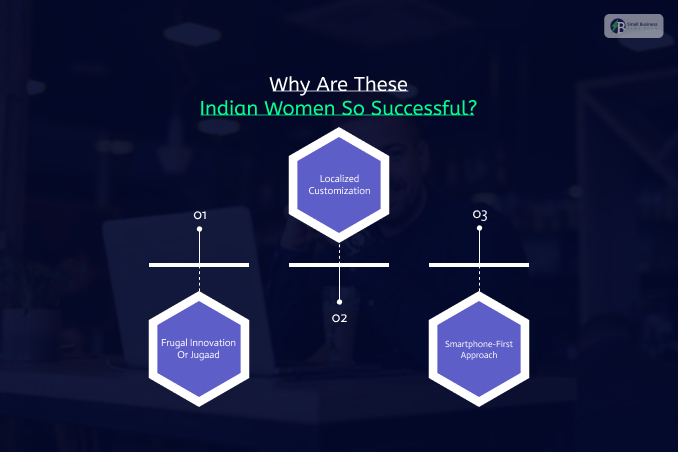
While every entrepreneur has a different approach to business, a few strategies every successful woman leader shares help them stand out from the rest.
Frugal Innovation Or Jugaad
Indian businesswomen excel at creating great products or services with fewer resources.
Their jugaad, or frugal innovation, allows them to build entire ecosystems with one-tenth of the effort and money it takes in the developed world.
Localized Customization
Most women entrepreneurs have mastered the art of localized customization, unlike their male counterparts.
They understand that building an application and releasing it worldwide will not be effective because regional conditions vary.
Everything from language to internet stability is taken care of by these smart businesswomen to give their product or service an edge over the competition.
Smartphone-First Approach
Internet users in India are more inclined to use smartphones over personal computers.
Indian women entrepreneurs know that developing applications using mobile-first technology is the new way of doing business.
Government Schemes And Funding For Female Entrepreneurs In India
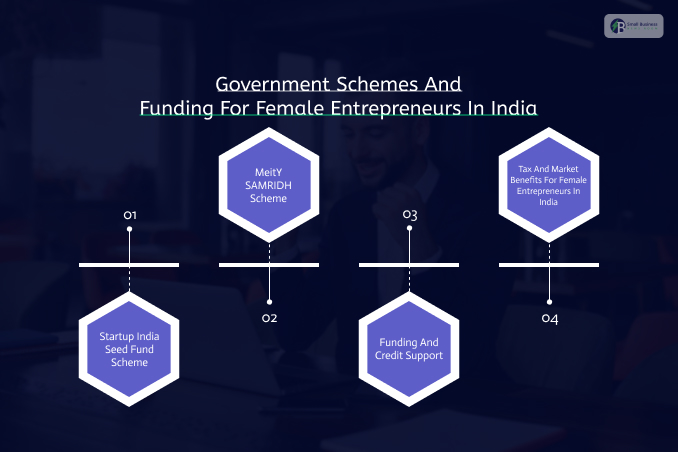
India’s business-friendly government policies attract talented individuals willing to test their skills in the competitive world.
Starting a business in India is comparatively easier for foreign and local entrepreneurs because of the support and funding available from government agencies.
The government’s main objective is to ensure that entrepreneurs with viable proposals receive sufficient assistance to make their business dreams come true.
Here are the top financial support schemes for female entrepreneurs in India:
Startup India Seed Fund Scheme
Firstly, this is the best network for women entrepreneurs seeking funding to establish and scale their business ideas.
The scheme allows new-age startups to access up to ₹50 lakh to build their prototype and take their concept to market.
MeitY SAMRIDH Scheme
The primary aim of this digital empowerment scheme is to foster gender inclusiveness in India’s technology ecosystem.
Moreover, female entrepreneurs can apply for ₹40 lakh to accelerate their software and tech-based startups on a global platform and receive mentorship support.
Funding And Credit Support
Women entrepreneurs do not have to put their personal assets at risk when applying for a business loan.
Schemes such as Pradhan Mantri Mudra Yojana offer collateral-free credit facilities up to ₹20 lakh for women-led small businesses.
Moreover, female entrepreneurs can also apply for bank loans of up to ₹5 crore with CGTMSE as a special guarantor.
Tax And Market Benefits For Female Entrepreneurs In India
Here are the best tax benefits female entrepreneurs in India can leverage:
Three-Year Tax Holiday For Startups
DPIIT-recognized startups must utilize this 100% tax exemption on profits for the first three years of their inception to reinvest in the business’s expansion.
80% Rebate On Patent Fees
Female entrepreneurs must claim the 80% discount on legal costs levied while filing patents to protect their intellectual property at a lower cost.
Access To GeM Portal For New Startups
New-age women entrepreneurs can sell their products and services to government departments and ministries through GeM without following the conventional corporate sales process.
Read Also:


