Table Of Contents
Why 90% Of Food Startups Fail (And 7 Brilliant Food Business Ideas That Actually Make Money)
Starting a business in the modern world means creating a successful digital kitchen.
Today, customers expect to order food with the touch of a button and track their meals in real time.
Luckily, modern technological advances can help meet these growing expectations by enabling the creation of a custom food-ordering application. The app can be built by simply describing the idea in detail in natural language.
An innovative meal-prepping subscription service is one option for such a business.
Dozens of great ideas for a food-related company would be perfect for a modern digital kitchen.
The high expenses involved in a meal subscription business can cut into final profit significantly, but an online scheduling system will ensure the kitchen remains productive at all times.
As a result, a modern approach to a traditional business will yield exceptional profits with little to no stress for the owner.
What Is A Food Business?
A food business involves producing, packing, storing, and selling meals, ranging from small-scale home bakeries to large-scale industrial enterprises.
Because safety is so important, in India, for instance, owners must maintain high-quality standards to keep customers safe and healthy under FSSAI guidelines.
For anyone searching for the best food business ideas, it is crucial to ensure the best supply chain management.
It helps them find the best suppliers of quality products that appeal to their clients’ taste buds. Moreover, modern technology helps manage inventory as efficiently as possible.
Still, it is vital to prioritize food safety regulations since only spotless kitchens can guarantee customer trust and a great reputation.
How Can You Start A Food Business?
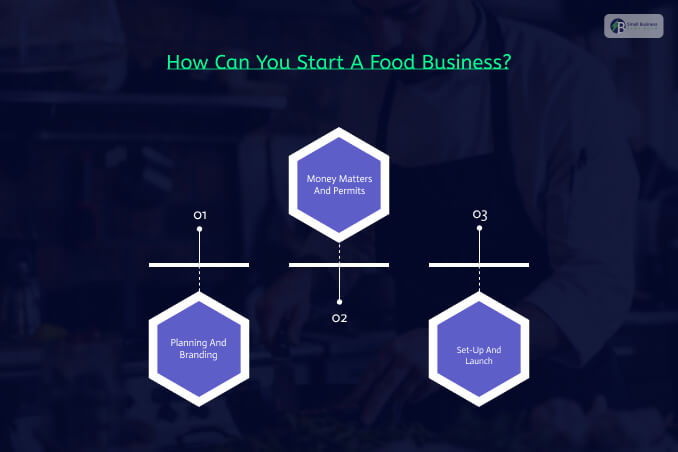
If you are planning to start your own food business venture, you need to have a clear idea of the steps that will help you make your venture profitable.
Therefore, focus not only on financial planning but also on the rules imposed by health authorities to ensure customer safety.
When venturing into food-related business plans about food, it is crucial to go through the following steps:
1. Planning And Branding
Research your target market and identify potential competitors using the 4C’s analysis approach, which includes Customer, Consumer, Channel, and Context.
In this step, entrepreneurs should formulate their target audience and unique selling proposition (USP), such as healthy options.
They should also identify the best restaurant format, such as a cloud kitchen, food truck, or café, and develop the right menu before designing their logos, packaging, menus, and employee uniforms.
2. Money Matters And Permits
In this phase, develop a detailed business plan that includes operational plans, a menu, and profit forecasts for the next three years.
It is essential to consider alternative sources of funding, such as personal savings, and the requirements for commercial loans.
Applicants for business loans must ensure that they meet the banks’ requirements.
Therefore, entrepreneurs can complete legal registration as an LLP or proprietorship and open a current account with the bank.
Apart from licenses, FSSAI, and GST registration, other permits from local authorities are needed during this phase.
3. Set-Up And Launch
This phase involves identifying and securing the best location for your restaurant while considering the investment analysis.
Acquire the required equipment to fit the restaurant’s interior design.
Hiring is also crucial at this stage, as entrepreneurs need employees to support operations.
Test concepts by introducing samples to consumers before using them in the restaurant.
Marketing should also start by creating buzz around the restaurant using social media platforms such as Instagram and WhatsApp, as well as food delivery companies.
Top Food Business Ideas In India You Can Start In 2026
India’s food services market is growing rapidly and is estimated to be worth $1.2 trillion by 2025.
Spurred on by urbanization, changing lifestyles, and disposable incomes, consumer behaviour is rapidly shifting towards digital, upscale, and convenience-driven options.
You also need to align your passion with modern technology. This way, you can build a profitable business around any of these food business ideas in India.
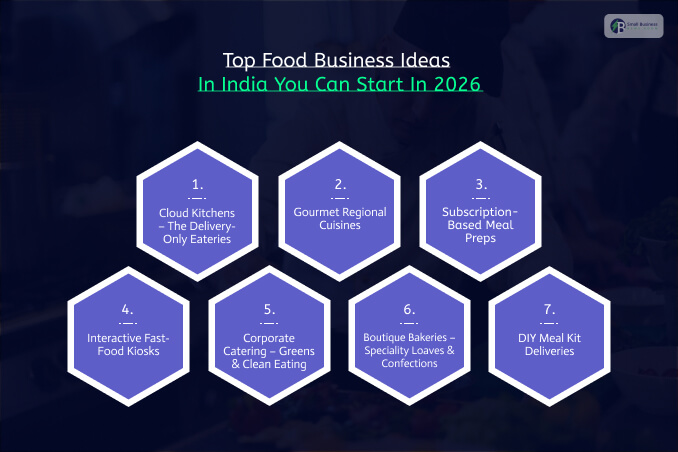
We’ve listed out 7 great food business ideas for entrepreneurs looking to build their own restaurant ventures in 2025.
1. Cloud Kitchens – The Delivery-Only Eateries
Cloud kitchens let you fulfil food orders without the need for dine-in infrastructure.
Powered by India’s booming online food delivery ecosystem, the cloud kitchen industry has grown rapidly – and is estimated to be worth $2.92 billion today.
• Startup Economics And Margins
This method of outsourcing food production has proven to be highly capital efficient.
Compared to traditional dine-in bistros that require a minimum investment of ₹20+ Lakhs, cloud kitchens can be started with as low as ₹3-7 Lakhs.
Well-run independent cloud kitchens can achieve profit margins of up to 25% in the current competitive environment.
• The Dependency Obstacle
By relying heavily on aggregator platforms, most cloud kitchen owners are left with razor-thin margins of 15-30% due to steep commissions.
However, independent website owners using online billing platforms can build their own direct-to-consumer ordering infrastructure and retain full control of consumer data.
2. Gourmet Regional Cuisines
Indian consumers are always on the hunt for authentic regional specialities.
By focusing on lesser-known micro-regional cuisines like Chettinad, Naga, and Malvani, you can build a niche among serious foodies.
• Startup Economics And Margins
By starting up as a speciality restaurant or pop-up kitchen, you’ll need a capital investment of ₹5-10 Lakhs.
With value-priced regional delicacies on the menu, you could earn profit margins of 20-30%.
• The Sourcing Puzzle
Sourcing high-quality organic produce from these target regions may present some logistical challenges.
However, by emphasizing the connection to the local roots on social media, you can gain tremendous goodwill with foodie customers.
3. Subscription-Based Meal Preps
As the health and fitness craze sweeps the country, more professionals are seeking customized meal plans.
You can build a highly scalable subscription-based business by preparing and delivering calorie-controlled meals to residential customers or corporates.
• Startup Economics And Margins
You can kickstart this venture from your home or a small commercial kitchen with an investment of ₹2-5 Lakhs.
With minimal wastage from fixed menu planning, you can expect profit margins of 20-25%.
• The Retention Battle
As customers get bored of the same meals, you’ll need to rotate the weekly menu and allow plan customization via WhatsApp or other messengers.
4. Interactive Fast-Food Kiosks
Fast-food kiosks let you serve a single food item or a range of savoury-sweet dishes in a quick-commerce setup. By setting up small retail counters near metro stations, tech parks, and colleges, you can maximize foot traffic and offer highly convenient small meals.
• Startup Economics And Margins
A small fast-food kiosk can be started at a cost of ₹4-8 Lakhs. With minimal wastage and quick turnover, the most well-run kiosks enjoy profit margins of 25-35%
• The Location Challenge
While prime locations offer excellent traffic, they also come with steep rental costs.
Therefore, it’s advisable to either negotiate a profit-sharing agreement with a landlord or invest in mobile street vendors instead.
5. Corporate Catering – Greens & Clean Eating
As more businesses value employee welfare, many are turning to healthy catering options.
You can build a sustainable B2B business with stable margins by supplying fresh greens, whole-grain meals, and preservative-free snacks to corporate offices.
• Startup Economics And Margins
A small corporate catering kitchen can be started with a capital investment of ₹6-12 Lakhs. With healthy bulk discounts, you can enjoy steady profit margins of 15-22%.
• The Volume Hurdle
As large corporate chains require extensive compliance testing, you may find it necessary to get certified FSSAI documents and commercial insurance.
In exchange, you’ll find more businesses willing to sign long-term contracts for healthy meal supplies.
6. Boutique Bakeries – Speciality Loaves & Confections
Premium sourdoughs, vegan-friendly pastries, and sugar-free cakes have become mainstream as modern Indian consumers look to baked goods as both a snack and a dessert option.
By specializing in small-batch premium baking and selling directly to consumers, you can build a profitable home-based business.
• Startup Economics And Margins
With minimal equipment, you can start a home bakery for as low as ₹1 Lakh.
Meanwhile, a commercial micro-bakery requires an investment of ₹5-8 Lakhs. With the right branding, you can expect profit margins of 30-40% with these value-added speciality items.
• The Shelf-Life Risk
Unsold stock can lead to devastating losses, because bread and pastries are perishable. Therefore, with an online pre-order system, you bake only what’s been sold online.
7. DIY Meal Kit Deliveries
Meal kits offer a middle-ground between home-cooked meals and restaurant dining.
Meal kit providers let the consumer experience restaurant-quality food in the comfort of their own kitchen by delivering prepped ingredients along with chef-style recipes.
• Startup Economics And Margins
Since this business is all about optimized inventory, you’ll need an investment of ₹4-7 Lakhs to start.
You can leverage the bulk discounts on ingredients and sell them at a premium. This way, you can see profit margins of 18-25%
• The Cold-Chain Puzzle
To keep the ingredients fresh, it’s vital to use hyperlocal delivery partners with reliable cold-chain storage.
You have to ensure ingredient quality. This way, you can boost consumer trust and maximize repeat sales.
Essential Compliance Checklist For Food Founders
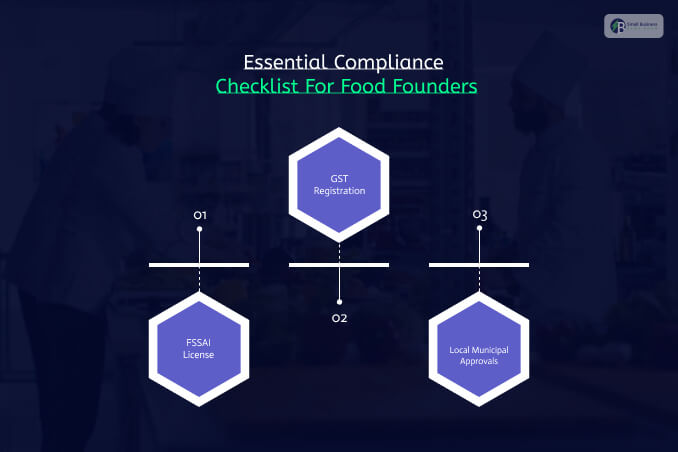
No matter which concept you pick, operating legally and safely is vital for protecting your customers and your wallet.
1. FSSAI License
The Food Safety and Standards Authority of India registration is absolutely non-negotiable.
This license ensures your kitchen follows strict cleanliness and food-handling standards.
2. GST Registration
GST registration is mandatory once your business hits local revenue thresholds, ensuring smooth financial operations with supply chain vendors.
3. Local Municipal Approvals
Secure a Trade License and a No-Objection Certificate (NOC) from your local fire department to keep your physical kitchen safe and fully compliant.
How Can You Choose The Food Business Idea?
If you are planning to start a business in the food industry, you may have to choose from various food business ideas, and that is not an easy task.
You need to find the one that balances your culinary passion with practical market realities.
So, if you are wondering how to choose one, I have the cheat sheet for you!
First, look closely at your local neighborhood. You can check what food options are missing, whether that is healthy office lunches or authentic regional dishes.
This helps you find an open gap in the market rather than fighting in an oversaturated space.
After that, you can also evaluate your personal lifestyle and finances. A cloud kitchen demands less upfront capital and lets you focus strictly on cooking.
On the other hand, a physical food kiosk requires high-traffic locations but gives you instant face-to-face branding.
Now, to pick the perfect path, focus on these critical areas:
- Market Gap: Research your neighborhood to find missing food options, like healthy lunches.
- Capital vs. Format: Pick a cloud kitchen to save money, or a food truck for high visibility.
- Legal Safety: Ensure your setup easily complies with strict local FSSAI health rules.
- Concept Testing: Run small soft trials with friends to test recipes before spending heavily.
Disclaimer: This article is for informational purposes only and does not constitute professional financial, legal, or investment advice. Startup costs, profit margins, and local regulations (like FSSAI guidelines) can vary based on your specific location and business choices. Always consult with a certified financial advisor and local legal experts before launching your business or applying for commercial loans.