
Table Of Contents
- What Is CHRA?
- Who Needs A CHRA?
- The New Risks Of Ignoring The Law
- When CHRA Must Be Conducted?
- Mandatory Triggers Under USECHH Regulations
- Critical Compliance Mistakes To Avoid
- Mistake #1: One-And-Done Mentality
- Mistake #2: Ignoring Contractor Chemicals
- Mistake #3: Using Outdated Assessments
- Mistake #4: Relying Only On Safety Data Sheets
- Mistake #5: Using Non-Registered Assessors
- How To Ensure Legal Compliance: Your Action Checklist
- 1. Check Your Assessor
- 2. Keep Records
- 3. Monitor Air Quality
- 4. Train Your Team
- 5. Fix Problems
- CHRA Cost Vs. Consequences: The Business Case
- Why Choose Biochem Laboratories For CHRA?
How To Comply With Malaysia’s Chemical Health Risk Assessment Requirements (Without Getting Fined Rm500,000)
Last Updated on: July 9th, 2026
In Malaysia, it is necessary to keep your workplace. It is not just some good practice anymore!
You must conduct a Chemical Health Risk Assessment (CHRA) if your business uses any sort of chemicals.
This has to be done no matter you started a new firm or bought a shelf company, with the help of local specialists like those from BridgeWest Malaysia
This is like a formal checkup. This way, you ensure your team is well protected.
Many business owners do not realize that rules have become strict. Furthermore, if you fail to comply, you can be fined RM500,000 or even jailed. So, this falls under the latest laws.
You cannot afford to ignore this. This is equally important!
Moreover, staying compliant is the only way to protect your workers and your bank account, whether you run a large factory or a small workshop.
Here is everything you need to know about chemical safety compliance and how to get it right the first time.
What Is CHRA?
A Chemical Health Risk Assessment (CHRA) is a formal checkup for workplace safety. In Malaysia, it is required by the USECHH Regulations 2000.
BioChem Laboratories, based in Penang, has been helping businesses stay compliant since 1977.
Who Needs A CHRA?
Almost every business does. Especially if your team handles chemicals, you must comply. Also, this includes:
| Manufacturing & Labs | Handling solvents, acids, or reagents. |
| Workshops & Food Plants | Using paints, coatings, or disinfectants. |
| Offices | Even common cleaning chemicals can trigger the law if their Safety Data Sheet (SDS) shows a health hazard. |
The New Risks Of Ignoring The Law
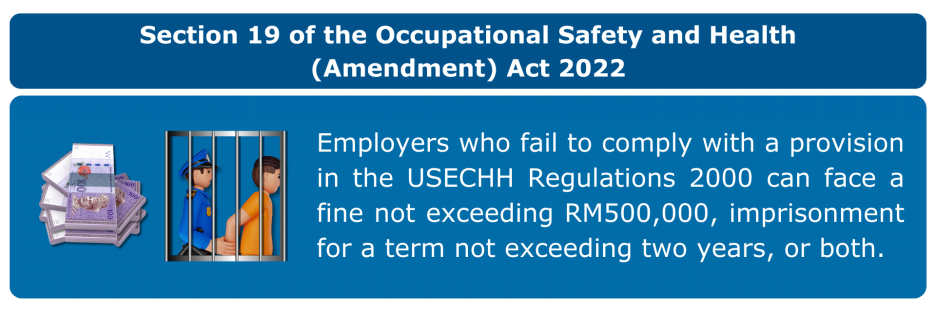
The 2022 Amendment Act changed the game. Before, a fine was RM50,000. Now, it has jumped to RM500,000 plus possible jail time.
Moreover, DOSH is now inspecting twice as often. Also, recently, companies in Johor and Penang faced massive fines and total shutdowns.
So, Chemical safety compliance is no longer optional, and it is essential for survival. Hence, let’s take a look at what all these are about.
When CHRA Must Be Conducted?
Now, it is really necessary to understand WHEN you must conduct a chemical health risk assessment. Moreover, it is critical to maintain chemical safety compliance and avoid penalties.
Mandatory Triggers Under USECHH Regulations
So, here are the triggers that you must check out!
| Initial Assessment | When Circumstances Change | Periodic Reviews | Post-Incident Requirements |
| Before workers begin chemical tasks | New chemicals introduced/substituted | Minimum every 2 years (baseline) | Immediately after exposure incidents |
| Introducing new chemicals to the site | Changes to work processes or procedures | Annually for high-risk operations | Following near-miss events |
| Before contractors use chemicals | New equipment affecting handling | When DOSH inspectors request updates | If workers report health symptoms |
| Establishing new production processes | Modifications to ventilation/controls | After significant production increases | After the elevated air monitoring results |
| Changes in work duration or frequency | |||
| After workplace chemical incidents |
Critical Compliance Mistakes To Avoid
To ensure your chemical safety compliance stays airtight, watch out for these common pitfalls:
Mistake #1: One-And-Done Mentality
Firstly, many businesses conduct CHRA once and forget it. However, the 2-year periodic review is not optional. It’s a legal requirement even if nothing has changed.
Mistake #2: Ignoring Contractor Chemicals
Secondly, facility owners are legally responsible for the chemicals used by contractors on-site. Therefore, your CHRA must include contractor activities.
Mistake #3: Using Outdated Assessments
Moreover, CHRA reports older than 2 years are legally invalid. Consequently, DOSH inspectors will issue immediate non-compliance notices.
Mistake #4: Relying Only On Safety Data Sheets
Furthermore, they don’t replace CHRA, while SDSs are required inputs. This is because the assessment must evaluate YOUR specific workplace conditions.
Mistake #5: Using Non-Registered Assessors
Lastly, only DOSH-registered competent persons can legally conduct CHRA. As a result, using unregistered consultants makes your assessment invalid, regardless of quality.
How To Ensure Legal Compliance: Your Action Checklist
Staying compliant with chemical safety compliance rules requires more than just a one-time report. You must follow these five steps to stay safe and legal:
1. Check Your Assessor
Only a DOSH-registered competent person can legally perform a CHRA. Thus, you must always verify their registration number on the official DOSH website.
2. Keep Records
You can also keep your CHRA report, chemical register, and Safety Data Sheets (SDS) ready. Inspectors expect to see these immediately.
3. Monitor Air Quality
You must conduct air monitoring if your CHRA shows a high risk. Moreover, you can use laboratories accredited to ISO/IEC 17025 to ensure results are valid.
4. Train Your Team
You must teach workers about chemical hazards and how to use PPE. So, you have to keep signed attendance lists as proof.
5. Fix Problems
Moreover, Act on the report’s recommendations. DOSH inspectors will specifically check if you have completed the required “Action Priority” (AP) tasks.
CHRA Cost Vs. Consequences: The Business Case
Fine payments cost significantly more than setting aside money for a Chemical Health Risk Assessment.
Firstly, a small business usually pays fees of RM3,000 to RM6,000 for a professional review.
On the other hand, more complex or larger locations can expect charges ranging from RM15,000 to RM30,000.
So, think about how much it costs to break the rules. A single offense might result in a penalty of RM500,000, along with imprisonment.
Moreover, facing legal bills could come along with halted production. Also, operations might freeze overnight when DOSH steps in.
Consequently, these can possibly cost you the right to run your business or ship goods abroad.
Furthermore, fines are not the only consequence; your name takes a hit, too. Workers might file claims, which result in soaring insurance costs overnight.
Reputation damage sticks around long after payments are made.
Ultimately, fines shrink when risks are managed well. A secure workplace guards tomorrow, not just today.
Why Choose Biochem Laboratories For CHRA?
BioChem Laboratories Sdn Bhd, an ISO/IEC 17025:2017 accredited testing laboratory established in 1977. They are headquartered in Penang.
They can offer you integrated Chemical Health Risk Assessment and chemical exposure monitoring services across Malaysia.
Moreover, BioChem’s DOSH-registered assessors provide industry-specific expertise backed by SAMM-accredited laboratory capabilities, with nearly five decades of experience serving Malaysian industries.
So, as a Ministry of Health Panel Laboratory and MPOB-approved facility, BioChem delivers comprehensive compliance solutions, including
- A free pre-assessment consultation,
- 24-hour quotation turnaround,
- A typical 10-14-day completion,
- Implementation support,
- And, A 2-year renewal reminder system with transparent pricing and no hidden fees.
Furthermore, one of BioChem Laboratories’ clients, Tan Boon Huat, HSE Director at an electronics manufacturer in Penang, shared,
“Working with BioChem meant that a single professional provider managed our entire CHRA process, from assessment to air monitoring and laboratory analysis. Their team was responsive and quick to act, and their 47 years of experience were clearly reflected in how efficiently they understood the risks associated with our electronics manufacturing operations.”
Read Also: