Table Of Contents
- What Is Venture Meaning In Business?
- Financial Risk & Liability Warning
- Characteristics Of A Business Venture
- Pursues An Entrepreneurial Venture
- Helps In Executing A Good Idea Or A Business Plan
- De-Risking With An MVP (Minimum Viable Product):
- Involves More Than Just One Partner
- Solves A Problem Or Satisfies A Market
- Works In Every Industry Or Sector
- Examples Of A Business Venture
- Business Venture vs. A Start-Up
- The Bottom Line
What Is A Business Venture? (And Why It Is NOT A Startup)
Last Updated on: July 30th, 2026
Organizations or individuals may start up a brand new enterprise or a business activity to satisfy the needs of the market, serve a purpose, or solve a problem.
They may even launch a business venture to begin, develop, and operate a flourishing institution that supports those specific objectives and gives out profits. A lot of you may ask about venture meaning in business, while some may think both business venture and startups are the same. However, they are not.
In this article, we shall discuss the details of venture meaning in business and its characteristics. We shall also highlight the examples of a business venture and compare the same with a startup.
So, without any more delay, let us get started.
What Is Venture Meaning In Business?

“Venture meaning in business,” or a business venture, is a new business or a business activity that entrepreneurs or institutions launch that involves the potential for risk or a return. The entrepreneur, founder, or owner assumes the risk to satisfy all the particular clients for a return on investment.
Some entities may also start a business venture without even having a business structure. However, having a structure is important if the operations of the business venture become tough because of expansion, profitability, or any other additional investments. All the successful entrepreneurs would have to have the skills of problem-solving, communication, passion, risk-taking, innovation, and organization.
Financial Risk & Liability Warning
Launching a business venture carries inherent financial risks, including the potential loss of your invested capital.
Before registering an entity, committing funds, or signing legal contracts, consult a certified financial adviser or corporate attorney to evaluate your specific situation.
To protect your personal assets from business liabilities, it is critical to select the right legal structure as your operations grow:
- Sole Proprietorship: Easiest to form, but leaves your personal assets completely exposed to business debts.
- Partnership: Ideal for two or more co-owners, requiring a clear, legally binding partnership agreement.
- Limited Liability Company (LLC): Creates a protective legal wall that separates and safeguards your personal savings and property from business lawsuits or losses.
Characteristics Of A Business Venture
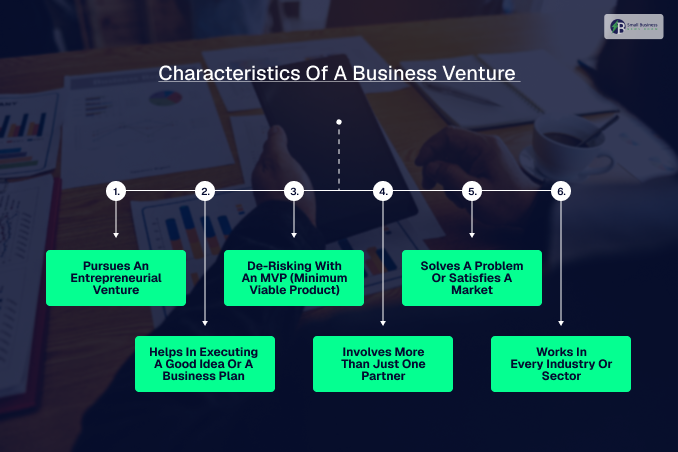
A business venture has certain characteristics that differentiate it from all of the other investments. These characteristics may include:
Pursues An Entrepreneurial Venture
A business venture is a corporate undertaking as it has an element of reward and risk. The entrepreneur, the founder, or the investor may expose all of their resources to the risk of the venture to receive the rewards. For instance, they may also risk their money, labor, and time to undertake all such activities.
If they are successful, they may be able to achieve all if their objectives and earn a profit. Individuals or entities that are undertaking a business venture may learn about its risks and take the necessary measures to avoid or reduce its exposure.
Helps In Executing A Good Idea Or A Business Plan
A business plan or a good idea may help entrepreneurs avoid or reduce the risks. For instance, entrepreneurs or founders may ensure that they, in fact, have a great idea by determining the data and facts that support the initiative or the undertaking. They can easily find a market gap that they can fill, or find out ways in which they may be able to make their offerings unique.
A business plan may also have all the important information that prepares the business venture for success. For example, it may detail the funding of the business venture, their marketing approach, the human resource considerations, and their value proposition. When businesses evaluate all these areas, it can help eliminate some of the risks of the business venture.
De-Risking With An MVP (Minimum Viable Product):
Modern entrepreneurs do not just guess. They build a bare-minimum version of their product or service first.
By launching an MVP to a small test group, you can collect real-world user feedback and validate market demand before spending large amounts of money on inventory or development.
Involves More Than Just One Partner
An entity or an individual may start a business venture. The individual or the entity would then have to assume all the work and the risks to take the venture on the path to success. Based on the needs of the business venture and the preferences of the founder, they can just hire some employees who can help with the everyday activities of the venture.
Some business ventures also have partners who share the risks of the business venture. These parties may also collaborate to complete the tasks and pursue the objectives of the organization. While the partners may be able to contribute more effort, they may also hire staff who would help undertake the activities of the entity.
Solves A Problem Or Satisfies A Market
A business venture may offer goods or services that may help to satisfy the needs of the market or solve problems. Clients would pay money for these offerings to the ventures. To decide upon the price of these offerings, the entrepreneur may add up the cost of the inputs, the overheads, and production for each unit to the expected profit for each item.
Works In Every Industry Or Sector
A business venture may operate in any industry or sector. For instance, the enterprise may operate in health care, education, or even in the manufacturing sector. Entrepreneurs may start businesses in a given area that they have an understanding of. This helps them leverage their expertise to achieve the objectives of the organization.
Examples Of A Business Venture
When you go through the examples of a business venture, it may help you have a clear understanding of the concept. These ideas may also inspire you when you are considering which business ventures you would want to begin with.
The following are some of the popular examples of a business venture:
Low-to-Medium Capital (Service-Based Ventures)
- Home Inspection Company – Providing structural assessments for real estate buyers.
- Website Development Enterprise – Building custom digital platforms for local businesses.
- Freelance Writing & Content Agency – Creating marketing copy and technical documentation.
- Digital Design & Graphic Agency – Providing branding and visual assets.
Medium Capital (Consumer & Product-Focused Ventures)
- Gymnasium or Fitness Studio – Offering localized health and wellness services.
- Car Detailing Shop – Providing premium automotive cleaning and restoration.
- Vending Machine Route – Managing automated retail points in high-traffic hubs.
High Capital (Enterprise & Asset-Driven Ventures)
- Real Estate Development Company – Acquiring land and constructing properties.
- Recruitment & Staffing Agency – Sourcing corporate talent for major employers.
- Investment Company – Managing and deploying capital into financial markets.
Business Venture vs. A Start-Up
While the terms are often used interchangeably, traditional business ventures and startups operate on entirely different business models, funding paths, and growth trajectories.
Understanding these structural differences is critical before deciding how to launch your new enterprise.
The comparison table below outlines the core metrics that set these two business structures apart:
| Feature | Traditional Business Venture | Tech Startup |
| Growth Goal | Steady, predictable growth aimed at long-term, local stability. | Hyper-growth aimed at scaling rapidly to dominate a massive market. |
| Funding Source | Funded via bootstrapping, personal savings, grants and loans. | Heavily reliant on Venture Capital (VC) and angel investor equity. |
| Founder Control | Lenders demand repayment but surrender 100% operational control. | Investors demand company shares, board seats, and decision-making power. |
| Business Model | Relies on proven, existing business models (e.g., a local gym). | Built around highly disruptive, novel, or unproven technology. |
The Bottom Line
A business venture is a calculated, targeted initiative designed to solve a consumer problem or satisfy a market need in a sustainable way.
While ventures carry a higher inherent operational risk than passive investments, they reward founders with complete long-term operational autonomy and predictable revenue models.
If you are ready to transition from planning to execution, follow this quick 3-step checklist to de-risk your launch:
- Validate with data: Conduct localised market surveys or launch a simple Minimum Viable Product (MVP) to verify that real customers are willing to pay for your solution.
- Protect your assets: Do not operate exposed. File legal incorporation documents for an LLC or Partnership to shield your personal savings.
- Secure structured capital: Build a 12-month cash-flow forecast before approaching local banks or grant committees for non-dilutive funding.