
Table Of Contents
- What Are The Real Estate Professional Status Requirements?
- A. The "Most of Your Time" Rule
- B. The 750-Hour Rule
- C. The Spouse Strategy
- How To Get Real Estate Professional Status?
- 1. Reach The 750-Hour Level:
- 2. Follow The "More than Half" Rule:
- 3. Take Ownership:
- 4. Participate "Materially":
- What Are The Benefits Of A Real Estate Professional Status?
- A. Use Losses To Lower Your Taxes
- B. Keep More Cash In Your Pocket
- C. Faster Tax Cuts
- D. Skip Extra Investment Taxes
- What Activities Qualify For Real Estate Professional Status?
- A. Maintain A Log Every Day
- B. Do Real Things
- C. Be Honest
- D. Do Not Throw Away Anything
- Real Estate Professional Tax Status: Participation Tests
- What Are The Common Pitfalls That You Can Avoid As A Real Estate Professional?
- A. Forgetting The "Grouping" Rule
- B. Counting The Wrong Tasks
- C. Trusting Your Tax Pro Too Much
How To Get Real Estate Professional Status: A Simple Guide
It can be frustrating to navigate IRS tax laws, especially when trying to determine whether one qualifies as a real estate professional.
In fact, this status is like a “golden ticket” for real estate owners.
That is because it allows you to use your rental losses to reduce the taxes on your regular income or on pay from another business.
Most investors end up with losses they can’t use for a while, but becoming a pro is one way to keep more money.
This article will explain, in simple terms, what the IRS expects.
We will tell you the best ways of fulfilling these requirements and remaining in their good graces so that you can benefit from those large tax breaks!
What Are The Real Estate Professional Status Requirements?
How you spend your time is what really gets you recognized as a real estate professional in the first place. The IRS is interested in seeing that you’re not just dabbling, but really a pro.
Here are the two main requirements you need to fulfill:
A. The “Most of Your Time” Rule
More than half of your total work hours for the year must be in real estate.
So, if you have another job, you need to make sure you are spending even more time on your properties than you are at that office.
B. The 750-Hour Rule
You have to put in at least 750 hours a year into your real estate business.
Also, you need to own at least 5% of the business for these hours to count. Just being a regular employee somewhere doesn’t cut it.
Here’s why it is a bit difficult to meet these requirements
In theory, this should be quite simple. However, when you look at it from a practical point of view, it is really a time-consuming task.
You can consider that 750 hours amount to 15 hours every week for an entire year. If you have a full-time 9-to-5 job, finding another 15 hours a week may be quite challenging!
C. The Spouse Strategy
In case you are a married couple, there is a way out for you. However, you cannot combine your hours to reach that 750-hour goal!
However, you can use your spouse’s time to demonstrate that you are “materially involved” in the business.
The IRS basically sets the bar super high to ensure only the serious players get the best tax breaks.
When you show that you’re willing to do the work, then you get the chance to use your rental losses to reduce your other taxes.
How To Get Real Estate Professional Status?

Getting a real estate professional status is not just about having a couple of houses. It is about convincing the IRS that real estate is your main occupation.
If you want to take advantage of those huge tax write-offs, you will have to stick to a particular plan.
Here is what you need to do:
1. Reach The 750-Hour Level:
You have to spend a minimum of 750 hours in the year on activities related to your real estate business.
In other words, you are getting your hands dirty, dealing with tenants, overseeing construction, or looking for new properties.
2. Follow The “More than Half” Rule:
This is the complicated part. You must allocate more time to real estate than to any other job.
For example, if you have a 40-hour office job, you should technically spend 41 hours per week in real estate to qualify.
3. Take Ownership:
If you are merely an employee at a real estate company and you do not own at least 5% of the company, your work hours typically will not count toward your status.
You have to “have some skin in the game.”
4. Participate “Materially”:
You cannot just give a property manager all the responsibilities. You have to prove that you are making important decisions and still involved in the day-to-day running of things.
To sum up, it’s all about where you invest your time and efforts. If you can demonstrate to the IRS that real estate is what you mainly focus on, then you are set!
What Are The Benefits Of A Real Estate Professional Status?
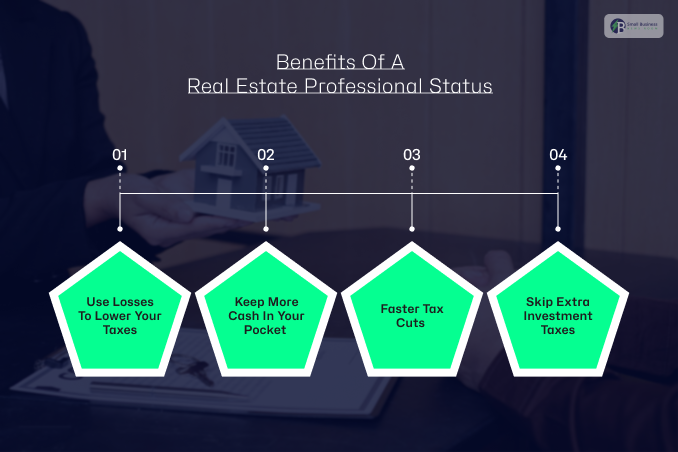
The overall idea of qualifying for real estate professional status mainly comes with some amazing perks that can easily save you tons of money!
A. Use Losses To Lower Your Taxes
First off, you get to skip those annoying “passive loss” rules. These rules hold most landlords back.
Moreover, this means that your rental property loses money on paper! So, you can use those losses immediately to cancel out the taxes on your regular paycheck.
B. Keep More Cash In Your Pocket
Secondly, this status seriously boosts your daily cash flow. You will have way more cash sitting in your bank account.
This is because you are not handing over as much of your hard-earned money to the IRS. Moreover, this makes it much easier to buy more properties.
C. Faster Tax Cuts
Additionally, you can use “cost segregation” to speed up your tax deductions. Basically, you break your building into smaller parts that “age” faster.
For a professional, these big, early tax cuts can be used to cancel out your active income, which is huge.
D. Skip Extra Investment Taxes
Finally, you get to avoid the extra 3.8% Net Investment Income Tax. Usually, the government takes an extra cut of rental profits.
However, your rental money counts as business income, since you are a professional. This simple switch keeps that money in your pocket!
Also Check: Melanie From Craigscottcapital: How She Made An Impact On The Finance Sector!
What Activities Qualify For Real Estate Professional Status?

Proving your status as a real estate professional to the IRS mainly comes down to providing evidence.
Even if you actually do the work, if you cannot support it with proper documentation, those tax concessions will be denied. Here’s a guide to being on the safe side:
A. Maintain A Log Every Day
It is more effective to keep a record of your hours as you go. Don’t leave it until tax time to try to remember what you did half a year ago! Note down the date, the duration of your work, and the exact property you were working on.
B. Do Real Things
The IRS counts things like negotiating leases, fixing leaks, or managing tenants.
On the other hand, they typically disregard activities that “investors” engage in, such as reviewing bank statements or having strategy discussions over coffee.
C. Be Honest
Do not fudge your hours or make all your tasks appear identical. In one well-known case, a plaintiff told the court they spent 40 hours “watching paint dry.”
The court did not believe it, and they immediately lost their status.
D. Do Not Throw Away Anything
Hold on to your emails, receipts, and calendar invites. These little pieces of paper confirm that your log is genuine.
Note that it is up to you to provide the evidence. It may seem like a hassle, but keeping excellent records is the only way to safeguard your large tax savings!
Real Estate Professional Tax Status: Participation Tests
How do some people pay way less in taxes while owning property? Well, it usually comes down to something called real estate professional status.
Basically, if the IRS sees you as a pro, you can get some pretty sweet tax breaks. These are the most regular things that landlords do not get!
In general, the IRS considers rental income passive income. This means that if your rental loses money, you can usually use those losses only to offset other rental profits.
However, when you qualify for this special status, those very losses become the non-passive ones.
This is huge. Reason? Well, because you can then use those losses. These can help you to offset your regular job’s income.
However, if you qualify for this special status, then those losses become non-passive.
This is actually huge since you can then use those losses to offset your regular job’s income, like your W-2 pay. Additionally, you might even skip a 3.8% extra tax on your profits.
So, how do you qualify? You just have to pass three main tests:
- The Half-Time Test: More than half of your total working hours for the year must be in real estate (building, managing, or buying).
- The 750-Hour Test: You need to put in at least 750 hours a year into your real estate business.
- The Participation Test: You have to show you are actually involved. Usually, this means working at least 500 hours on your properties or doing most of the work yourself.
Because these perks are so good, the IRS keeps a close eye on them. Make sure you keep a detailed log or calendar of everything you do. It’s the best way to protect your status!
What Are The Common Pitfalls That You Can Avoid As A Real Estate Professional?
Even if you are doing the work, it is easy to trip up on the fine print. Many people miss out on becoming real estate professionals simply because they have made a few basic mistakes.
Here are some things that you need to watch out for:
A. Forgetting The “Grouping” Rule
Do not just assume that the IRS sees all your rentals as one big business. You have to officially report them to the IRS on your tax return.
This way, you can easily combine your hours across multiple properties.
So, if you forget this election, they will look at each house separately. This is exactly what making almost impossible to hit your hour goals.
B. Counting The Wrong Tasks
Remember that investor work does not count. It might feel like a lot of work when you decide to spend hours scrolling through Zillow.
Or maybe when you are looking at bank investments or attending seminars.
However, the IRS considers these passive activities. They focus your log on operational tasks such as:
- Fixing toilets,
- Talking to tenants,
- Supervising contractors.
C. Trusting Your Tax Pro Too Much
Just because your accountant signs your return, that does not mean you are safe. Let’s say if the IRS audits you, they will not care if your tax pro said it was okay!
They want to see your records. So yes! You are the one responsible for the ultimate proof. In short? You have to stay proactive. You can set up a solid system that can keep your tax breaks safe. All you have to do is understand these traps now!
Additional Resource: Discover Smarter Property Investments with Invest1now.com Real Estate