


Table Of Contents
- What Is Post Event Survey Questions?
- Why Post-Event Survey Questions Are Crucial?
- 1. Measure Event Success Objectively
- 2. Identify Strengths and Weaknesses
- 3. Enhance Attendee Experience
- 4. Support ROI Measurement
- 5. Facilitate Future Event Planning
- Key Types of Post-Event Survey Questions
- 1. Quantitative Questions
- 2. Qualitative Questions
- 3. Demographic and Engagement Questions
- Importance Of Post Event Survey Questions
Why Is It Important To Ask Post-Event Survey Questions? What Purpose Do They Serve? [2026 Complete Guide]
Last Updated on: February 10th, 2026
One has to be joking if one claims that planning an event is an easy job. There is nothing simple or easy about planning an event.
If you are a professional event planner, you would know how difficult it is to put everything into place.
Planning an event demands a tremendous amount of money, time, and a team of experts. However, your job will not end once the event is over.
In 2026, events are no longer just about gathering people they are data-rich opportunities to understand attendee behavior, satisfaction, and future engagement.
From corporate conferences and trade shows to online webinars and hybrid events, post-event surveys have become an essential tool for measuring success and driving continuous improvement.
This guide explains why it’s important to ask post-event survey questions, what purpose they serve, and how event organizers can maximize their value in a fast-evolving events landscape.
What Is Post Event Survey Questions?
An event is a way of communicating with the masses, and just like every other communication process, events, too, need feedback.
Without feedback, the organizers would not be able to understand the areas where they need to work more or where they have excelled.
The survey is one such way of receiving feedback from a huge number of people at the same time.
It is not humanely possible for anyone to individually receive feedback from each of the attendees of the event.
Therefore, surveys are the best ways in which the organizers can easily receive feedback from all the guests while not having to spend a lot of money or effort.
A post event survey takes the opinions of the event attendees about every single aspect of the event. This can be the food, the management, the location, the content, and many other things.
From the attendees to the sponsors to the staff, the post event survey is directed to anyone that was present or took part in the event.
The aim here is to collect the exact input so that the planners get the opportunity to run better events in the future and rectify their mistakes.
Event planners use post event surveys extensively to analyze the events, identify the areas that need improvement, and, most necessarily, hear about what the attendees have in mind about the event. While you get positive or negative feedback, they are extremely helpful in planning future events.
Why Post-Event Survey Questions Are Crucial?
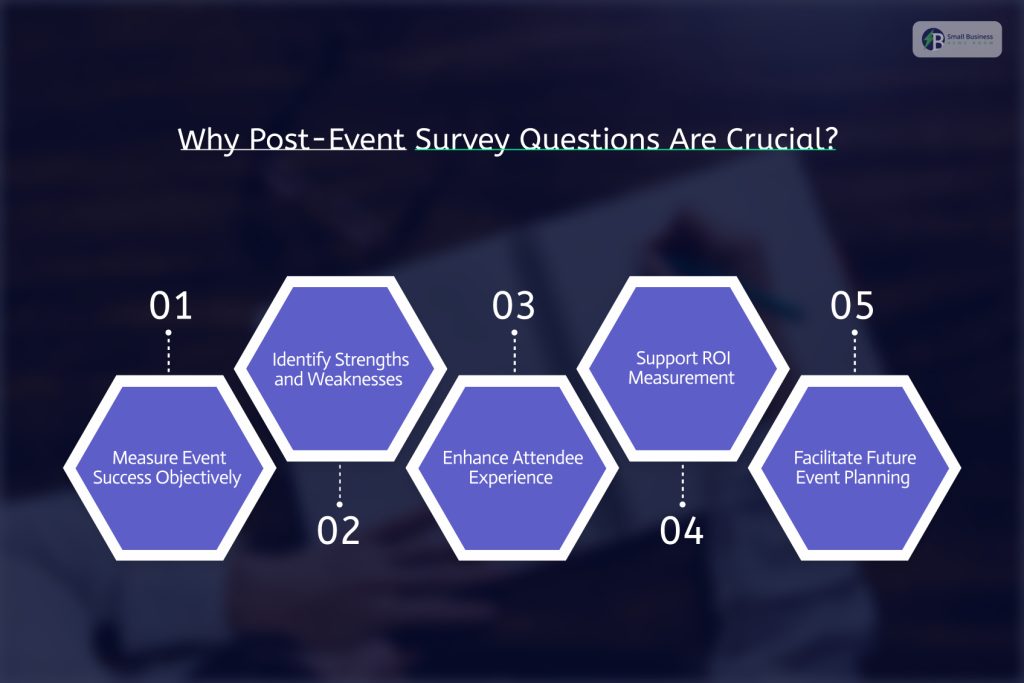
Post-event surveys are more than just feedback forms. They are a strategic tool with several key benefits.
1. Measure Event Success Objectively
While attendance and ticket sales provide quantitative metrics, surveys offer qualitative insights about:
- Attendee satisfaction
- Speaker effectiveness
- Session relevance
This information allows organizers to assess whether the event met its objectives.
2. Identify Strengths and Weaknesses
Survey responses highlight what worked well and what didn’t, enabling:
- Replication of successful elements in future events
- Corrective measures for weak areas
- Data-driven decision-making for planning
For example, if multiple respondents cite session timing issues, organizers can adjust schedules for the next event.
3. Enhance Attendee Experience
Attendees feel valued when their opinions are solicited. Asking relevant post-event survey questions:
- Shows appreciation for their participation
- Builds trust and loyalty
- Encourages repeat attendance
In hybrid events, surveys can also gauge virtual attendee experience, ensuring inclusivity and accessibility.
4. Support ROI Measurement
Event organizers increasingly need to justify budgets and ROI. Post-event survey data helps in:
- Linking attendee satisfaction to revenue or engagement
- Understanding lead quality from networking sessions
- Measuring sponsor satisfaction through targeted questions
In 2026, AI analytics tools can combine survey data with CRM and marketing automation to quantify event ROI accurately.
5. Facilitate Future Event Planning
Surveys provide actionable insights for long-term event strategy:
- Popular topics for future conferences
- Preferred session formats (panels, workshops, keynotes)
- Technology preferences for hybrid or virtual delivery
This ensures events evolve with audience expectations, increasing retention, and engagement over time.
Key Types of Post-Event Survey Questions
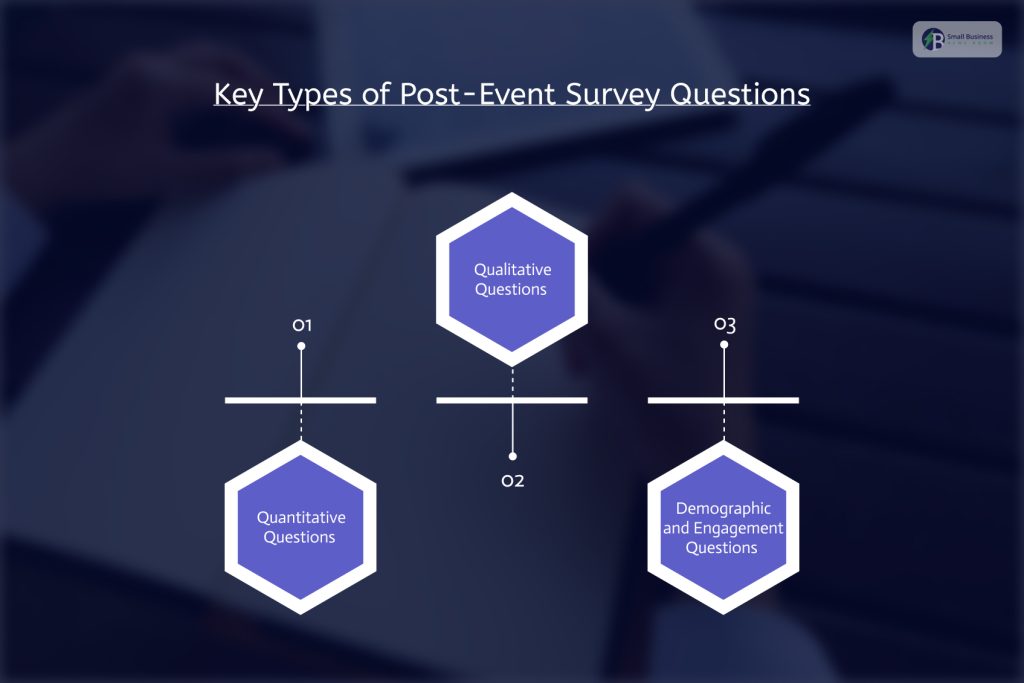
Effective surveys balance quantitative and qualitative questions:
1. Quantitative Questions
- Rating scales (1–5 or 1–10) on satisfaction, organization, speakers
- Multiple-choice questions about favorite sessions or content
- Net Promoter Score (NPS) to measure likelihood of recommendation
Example:
On a scale of 1–10, how would you rate the keynote session?
2. Qualitative Questions
- Open-ended feedback
- Suggestions for improvement
- Personal experience stories
Example:
What is one thing we could improve for our next event?
3. Demographic and Engagement Questions
- Role or industry of attendee
- First-time attendee vs. repeat attendee
- Level of engagement (networking, Q&A participation)
These insights help segment feedback and tailor future events to audience needs.
Importance Of Post Event Survey Questions
Whether you hosted a virtual event, a seminar, or the Oscars, getting feedback from the attendees, the participants, and even the stakeholders is very important. This would help you fix your mistakes and plan an even better event the next time.
Although you may gather the statistics without even surveying the participants, like the ROI of the event or the rate of sign-up, quantitative data has a lot of restrictions.
It may not help you understand how you need to enhance your future events or the reason behind the performance of the event.
The post-event survey questions assist the planners to:
1. Build Trust
By asking the audience for their feedback, the planners show them that their opinion matters. This makes the audience feel valued and appreciated.
2. Eliminate Guesses
Getting immediate feedback may help the companies clearly understand if the event was a success or not.
3. Estimate The Growth Of The Event
The post-event survey would help the planners assess how much the event may grow in the future.
4. Improve The Future Events
The insights of the guests help the planners correct any mistakes and organize the event even more skillfully.
5. Get Insights About The Experience Of The Participants
Post event survey questions are designed in a way that may help the planners get clear insights on what was the overall audience experience of the event.
The Strategic Purpose of Post-Event Surveys in 2026
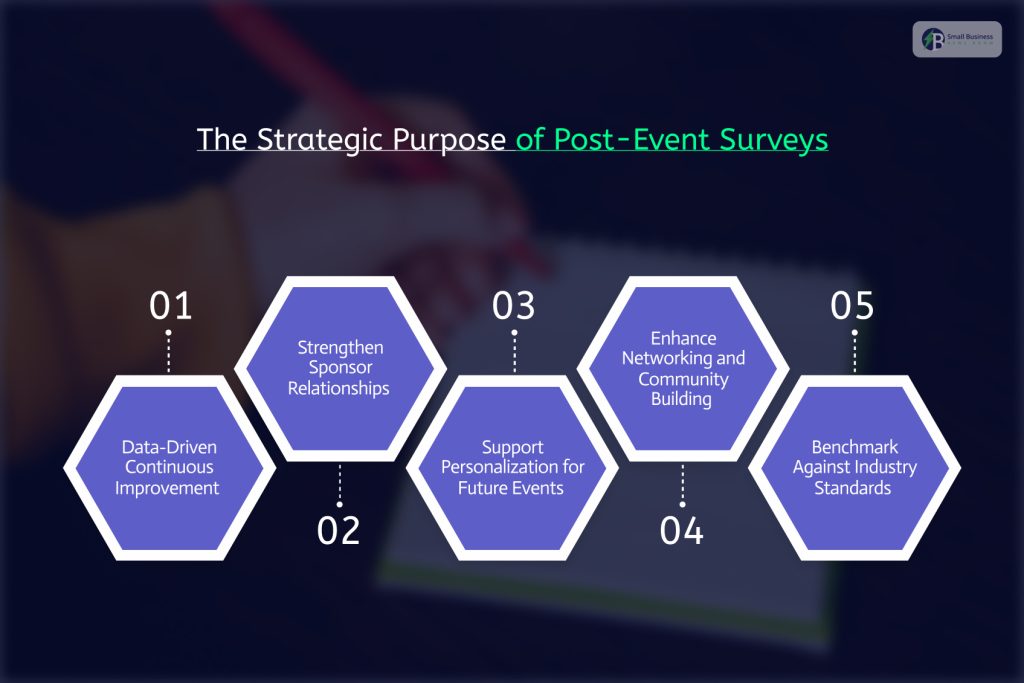
There are certain strategic purposes of having post-event surveys in 2026.
1. Data-Driven Continuous Improvement
Post-event surveys provide real-time insights that feed into iterative event improvements. Organizers can:
- Adjust marketing strategies
- Refine content selection
- Enhance attendee engagement
2. Strengthen Sponsor Relationships
Sponsors want measurable outcomes. Survey questions targeted at sponsor visibility, booth experience, or session ROI can:
- Demonstrate value
- Improve sponsorship retention
- Optimize pricing and partnership structures
3. Support Personalization for Future Events
Survey responses allow organizers to personalize future communications:
- Targeted session recommendations
- Customized event invitations
- Personalized follow-ups based on attendee feedback
AI-driven survey analysis in 2026 can predict attendee preferences and improve event personalization at scale.
4. Enhance Networking and Community Building
Post-event surveys can include questions about:
- Networking satisfaction
- Collaboration opportunities
- Interest in community or industry groups
This helps build long-term professional communities, extending engagement beyond the event itself.
5. Benchmark Against Industry Standards
Survey data helps compare:
- Your event’s satisfaction metrics against competitors
- Engagement levels relative to industry averages
- Content relevance versus similar events
Benchmarking supports strategic planning and market positioning.
Types Of Post Event Survey Questions To Ask The Audience
Here are the types of questions that you may ask the audience for detailed feedback:
- Open-ended questions may help the audience give detailed answers and expanded opinions.
- Close-ended answers where they may only have to give one-word answers.
- Simple yes or no questions.
- Scalable questions that the audience would answer on a scale of 1 to 10 about their experience of the event.
- Nominal or multiple-choice questions.
FAQs
Here are a few questions and queries on the topic of post event survey questions that others have asked that you might think helpful for you.
1. How can I ensure higher survey response rates?
- Keep surveys short
- Use multiple channels (email, app, SMS)
- Offer incentives or exclusive content
2. Can AI help analyze post-event survey responses?
Absolutely. AI can detect trends, sentiment, and predictive insights, helping organizers make data-driven decisions faster and more accurately.
3. Can post-event surveys be used for hybrid and virtual events?
Yes. In 2026, surveys are essential for hybrid and virtual events to measure both in-person and online attendee experiences, including technology performance, session engagement, and networking effectiveness.
4. What types of questions get the most actionable feedback?
Questions that combine rating scales (quantitative) and open-ended prompts (qualitative) tend to yield the most actionable insights. Examples include:
- Rate your satisfaction with the event content (1–10).
- What improvements would make the next event better?
5. How long should a post-event survey be?
Keep surveys short and focused, ideally 5–10 questions. Longer surveys reduce completion rates, while concise surveys maintain engagement and higher-quality responses.
6. Should post-event surveys include questions about sponsors and exhibitors?
Yes. Asking about sponsor visibility, booth interactions, and product relevance provides insights to improve sponsor ROI and helps in negotiating future partnerships.
7. Is it better to make post-event surveys anonymous or trackable?
Both approaches have benefits:
- Anonymous surveys encourage honesty.
- Trackable surveys allow segmentation by attendee type, helping tailor future events and communications.
8. How can survey feedback improve attendee retention?
By acting on feedback:
- Fix recurring issues
- Personalize future events
- Show attendees their opinions matter This builds loyalty and encourages repeat attendance.
9. Can AI or analytics tools enhance post-event survey analysis?
Absolutely. AI can:
- Identify trends across large datasets
- Analyze sentiment in open-ended responses
- Predict areas of improvement for future events This helps organizers make data-driven decisions quickly.
- How often should survey results be reviewed and acted upon?
Survey results should be reviewed immediately after the event for urgent issues and then revisited quarterly or annually for strategic improvements and benchmarking.
11. Can post-event surveys help justify event budgets?
Yes. Surveys provide quantitative and qualitative evidence of attendee satisfaction, engagement, and ROI, which supports budget approvals and sponsorship negotiations.
The Bottom Line
Conducting an event is a huge responsibility. There is no way that this is a man’s job. As a planner, you would need a whole team of employees, volunteers, sponsors, staff, and many other participants to successfully conduct an event.
The post-event survey questions play an equally important part in the entire event-conducting process.
Without the feedback of the attendees or anyone associated with the event, it is not possible for you to evaluate the success of the event or know which areas need correction to plan better events in the future.
Continue Reading:


