
Table Of Contents
- Why Journaling Matters In Business (The ROI)
- 1. Decision-Making Improves
- 2. Stress Is Lowered
- 3. Records Progress
- 4. Encourages Original Thinking
- Core Journaling Techniques For Professionals
- The Bullet Method (For Rapid Organization)
- The Morning Pages (For Brain Dumping)
- The Post-Mortem Journal (For Continuous Improvement)
- The 5-Minute Gratitude Journal (For Resilience)
- How To Build A Frictionless Journaling Routine
- Keep It Accessible
- Anchor The Habit
- Set Minimalist Goals
- Choosing Your Tools: Digital Apps vs. Analog Paper
- A. The Case for Analog (Paper Journals)
- B. The Case for Digital (Apps & Software)
- C. The Executive Security Check
- The 7-Day Journaling Kickstart Plan
- 30 Journaling Prompts For Business Clarity
- When Journaling Doesn't Work
Journaling Techniques: The 5-Minute Brain Habit Successful CEOs Use Everyday!
Journaling means writing your thoughts, feelings, and daily events on paper or using a digital app.
Rather than keeping all your thoughts in your head, you express your ideas in words to better understand them.
In the corporate world, people are employing journaling techniques to clear the mental clutter, monitor progress, and reduce job stress.
Journaling is a tool that helps you organize your thoughts so you are better positioned to make decisions.
By incorporating these habits, a person in a professional role can guide the team with clarity and purpose.
Why Journaling Matters In Business (The ROI)

Most people regard jotting down notes in a diary as nothing more than a leisurely pastime. However, it can significantly multiply your career prospects. Dedicating just a few minutes to penning your reflections can completely transform your work behavior. Here are reasons why it is worthwhile:
1. Decision-Making Improves
Writing will give you time to organize your thoughts that are going in different directions.
Therefore, you can easily detect logical inconsistencies and unconscious biases that could lead to costly mistakes.
2. Stress Is Lowered
Physically writing out one’s concerns reduces the stress one feels.
Hence, this simple act keeps one calm and is one of the factors that prevent one from experiencing intense burnout at one’s job.
3. Records Progress
This is a great way of keeping a permanent record of your career path. In fact, the journaling of business successes and failures has become a source of many lessons.
4. Encourages Original Thinking
An empty page is like a blank canvas that you can freely play with without fear of making a mess.
Also, discovering new ways of journaling opens up avenues for coming up with innovative business ideas when you’ve hit a creative block.
Core Journaling Techniques For Professionals
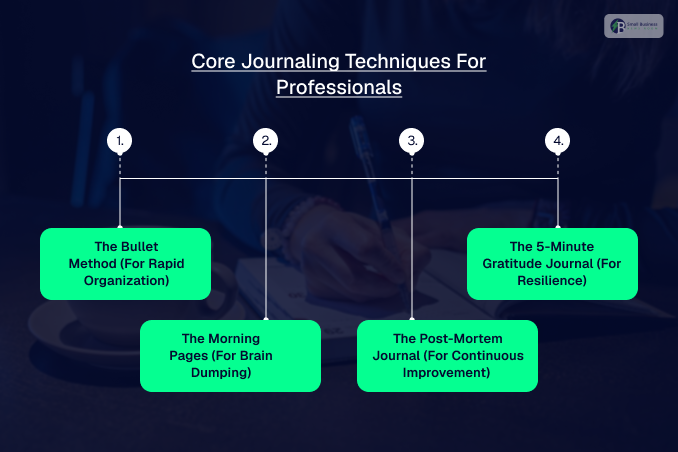
Using the right system makes a huge difference when you are busy. Here are four simple ways to use journaling techniques to stay ahead at work.
These methods are especially effective for knowledge workers, founders, and managers handling high cognitive workloads.
However, they may not fully replace the structured planning systems required in highly regulated roles such as finance or healthcare.
The Bullet Method (For Rapid Organization)
What it is: You write short, bulleted notes instead of long sentences. You use simple symbols to track tasks, quick notes, and meetings.
- Tasks (•)
- Events (○)
- Notes (-)
Business Use: This works perfectly on extra busy days. When your phone keeps ringing, you do not have time for long paragraphs.
Instead, this fast method helps you organize your heavy workload in seconds.
It keeps your mind clear so you can focus on major tasks and reduces decision fatigue across the day.
The Morning Pages (For Brain Dumping)
What it is: You write three pages of your exact thoughts first thing in the morning. You do not edit yourself. You just let the words flow onto the paper.
Business Use: This routine clears all your morning worries from your head before you check your email.
By putting your anxiety on paper, you enter the boardroom feeling calm. Research by James Pennebaker shows that expressive writing can significantly improve mental clarity and reduce stress over time.
It is a great daily tool for reducing work stress and improving focus.
The Post-Mortem Journal (For Continuous Improvement)
What it is: You review a specific business project or tough choice right after it happens. You take notes on what actually took place during the process.
- What went right?
- What broke?
- What will I change next time?
Business Use: This practice reveals what worked well and what failed. Instead of repeating old mistakes, you learn how to improve your future business strategy. Over time, it helps identify repeat errors across projects and turns stressful work problems into structured lessons for your career.
The 5-Minute Gratitude Journal (For Resilience)
What it is: You write down three small wins and three things you are thankful for each day. It takes very little time but brings huge rewards.
Business Use: This habit trains your brain to notice positive career progress.
Research by Robert Emmons highlights how gratitude practices can improve resilience and long-term well-being.
When a business crisis happens, it is easy to lose motivation.
However, focusing on small daily wins keeps your morale high so you can face tough challenges with a stronger, more stable mindset.
How To Build A Frictionless Journaling Routine

Building a journaling habit is not about motivation. It is about removing resistance. The easier it feels to start, the more likely you are to stay consistent, even on your busiest days.
Keep It Accessible
Choose tools you will actually use daily. A premium notebook works if you enjoy writing by hand.
While digital options like Notion or Day One make it easier to stay consistent across devices.
The goal is simple: remove any barrier between you and the act of writing.
Anchor The Habit
Tie journaling to something that already happens without fail, your morning coffee, commute, or final inbox check.
Behavioral research popularized by James Clear shows that habits stick better when attached to existing routines.
Set Minimalist Goals
Keep the entry small enough that you cannot skip it. Two minutes or one paragraph is enough to build momentum.
Over time, consistency compounds into clarity, making journaling a reliable system rather than an occasional effort.
Choosing Your Tools: Digital Apps vs. Analog Paper
The tool you decide on will influence how regularly you journal.
The point isn’t to find the “perfect” system, but one that makes it easy, removes any barriers, and fits your natural workday flow.
A. The Case for Analog (Paper Journals)
Benefits: No digital distractions, the ability to touch the pages, and writing by hand strengthens memory through physical movement.
Research on the brain shows that handwriting enhances memory encoding more than typing.
Best for: Thinking deeply, writing morning pages, and coming up with ideas at a creative level while away from screens when uninterrupted thought is most important.
B. The Case for Digital (Apps & Software)
Benefits: Easily find words by searching text, switch between different devices as your files are stored in the cloud, and get help with remembering by automatic date assignments.
Digital tools facilitate revisiting past thoughts and tracking behavioral tendencies over time.
Top Tools: High-end-looking apps for journaling with strong security, like Day One, or customizable digital spaces such as Notion and Obsidian that encourage structured, connected thinking.
C. The Executive Security Check
Journaling your work choices, client information, or company strategy will mean you have security as one of your top priorities.
If digital journaling, turning on password protection, or biometric locks should be the standard, and sensitive information should never be kept in an unsecured platform.
On the other hand, paper journals should be kept in a private, secure location where no one can access them without your consent.
The 7-Day Journaling Kickstart Plan
Starting can be the most difficult part. Instead of overthinking the whole process, here is a straightforward 7-day plan to help you get started without any pressure.
- Day 1, 2: Get familiar with a bullet journal system for managing tasks, appointments, and jotting down brief notes
- Day 3, 4: Experiment with morning pages as a way to clear your mind before work
- Day 5: Reflect on a recent decision or task with a post-mortem write-up
- Day 6: Change your mentality with a 5-minute gratitude journal
- Day 7: Mix the methods and figure out which one was the most useful
After a week, you will not only get the concept of journaling, but you will also have a methodology that will suit your way of working.
30 Journaling Prompts For Business Clarity
Sometimes, the hardest part is knowing what to write. Use these prompts to think more clearly, make better decisions, and stay focused on what truly matters.
Decision-Making & Strategy
1. What decision am I currently avoiding, and why?
2. What is the worst-case scenario, and can I handle it?
3. What does the best possible outcome look like?
4. Am I making this choice based on data or emotion?
5. What would I advise someone else in this situation?
Productivity & Focus
6. What is the one task that will make today successful?
7. What is currently wasting most of my time?
8. Where am I overcomplicating things?
9. What can I eliminate, automate, or delegate?
10. What does a “high-impact” day look like today?
Self-Awareness & Growth
11. What mistake taught me the most recently?
12. What pattern keeps repeating in my work?
13. Where do I hesitate the most, and why?
14. What skill do I need to improve right now?
15. What feedback have I been ignoring?
Stress & Mental Clarity
16. What is currently causing me the most stress?
17. Is this problem within my control?
18. What can I let go of today?
19. What would make me feel lighter right now?
20. What is one small win I can create today?
Leadership & Communication
21. Did I communicate clearly today? If not, where did I fall short?
22. How did I handle conflict or disagreement?
23. What does my team need from me right now?
24. Am I listening enough or just reacting?
25. What kind of leader was I today?
Reflection & Long-Term Thinking
26. What worked well this week that I should repeat?
27. What did not work, and why?
28. What am I building long-term with my current actions?
29. If I continue like this for 6 months, where will I end up?
30. What is one thing I will do differently tomorrow?
When Journaling Doesn’t Work
Journaling has its advantages, but it is not a perfect solution in all cases. Understanding its limitations will help you to use it efficiently.
- In case you do not have much time, a quick voice note can be more effective than writing
- When journaling results in overthinking, make a change to write short bullet points only
- Everyone faces stress and burnout from time to time; therefore, journaling alone will not be enough. It is necessary to get professional help as well
When done well, journaling helps you to figure things out. On the other hand, if done badly, it is simply another chore. Since we are talking about changing habits, keeping it natural, focused, and suited to your requirements matters most.