
Table Of Contents
The Hidden Threat In Insurance Portfolios That Could Trigger The Next Market Crash
Last Updated on: September 11th, 2026
Investors and regulators are increasingly interested in identifying characteristics of entities that contribute to financial stability.
A growing body of financial literature explores how interconnectedness drives institutional selling behavior during unexpected liquidation shocks.
This includes foundational studies from the National Bureau of Economic Research (NBER) and the Journal of Financial Economics.
In times of stress, other non-banking institutions, such as insurance companies, sell assets.
These companies are subject to risk-based capital requirements. Moreover, these are linked to the broader financial system through their investments in specific asset types.
Insurance companies don’t need to fail to spread risk throughout the system for a negative impact to occur. It may suffice for them to “fire-sale” assets.
Empirical research confirms that insurers’ trading behavior during stress can impact prices and cause spillovers to other market players.
The Concept Of Asset Liquidation And Portfolio Summary
Asset liquidation is the process of selling an asset and converting it into cash.
The company can then use the proceeds to pay off debts, distribute remaining assets, and more.
This can be a voluntary process or forced through bankruptcy. The risk of liquidation is the possibility that a company cannot meet its obligations. As a result, it may have to sell assets or file for bankruptcy.
On the other hand, portfolio similarity measures how similar the holdings are between multiple funds and portfolios.
For instance, let’s say there are two insurers who have identical portfolios. These portfolios would have a cosine similarity of one.
On the other hand, if the insurers have different portfolios, then they will have a cosine similarity of zero.
Regulators can use portfolio similarity and related measures to predict when companies are likely to sell their assets altogether.
This can be a strong solution during periods of market stress.
Real-World Context: A classic structural example of this vulnerability occurred during the 2008 financial crisis with the collapse of AIG.
While its core insurance business was stable, its highly correlated systemic exposure to non-traditional financial instruments triggered a massive liquidity crisis that required federal intervention.
Methodology
This paper examines whether insurers with more similar portfolios are more likely to sell the assets they share.
We calculate the cosine similarity of a pair of insurers’ holdings. For this purpose, we will use 2002-2014 data from the National Association of Insurance Commissioners.
The cosine similarity is bounded between zero and one: a similarity of 1 indicates identical portfolios, while a similarity of 0 means completely different portfolios.
We calculate the year-end similarities of each pair across broad asset classes and granular issuers.
We demonstrate that portfolio similarity is related to insurer characteristics. These characteristics include
- Joint size,
- Portfolio composition, and
- Similarity in business lines.
We also show that our measure can accurately predict the frequency. This also includes the amount of sales the company has made with similar portfolios. We construct a measure for joint sales using information from insurer trades.
This measure is the dot product of vectors of quarterly net sales at the asset-class and security-issuer levels.
We find an inverse relationship between a pair’s portfolio similarity and their quarterly joint sales in the following year.
High-Risk vs. Low-Risk Assets
The overlap between insurers’ portfolios may stem from liability-matching needs, risk-seeking behavior, or both.
We decompose each insurer’s portfolio into high-risk and low-risk assets based on their likelihood of affecting prices due to liquidity and credit quality.
We calculate portfolio similarity across high-risk and low-risk assets. We then regress these similarities on liability similarity to identify the expected and unexpected portions.
High-risk portfolio similarity drives the largest increases in joint sales.
Especially in concentrated holdings like high-yield corporate bonds, collateralized debt obligations (CDOs), and volatile tech-sector equities.
Conversely, expected portfolio similarity across low-risk, highly liquid assets like US Treasury bonds and AAA-rated sovereign debt remains stable.
This proves that the dangerous systemic cascading effect is primarily driven by risk-taking behavior conducted within the boundaries of standard asset-liability management.
Price Impact
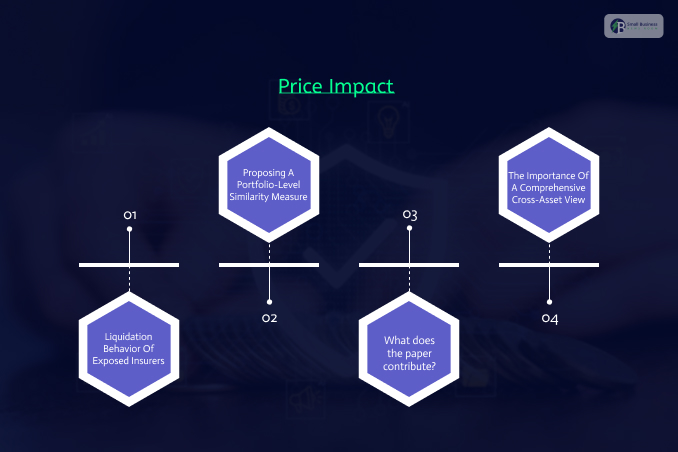
We examine the change in the value of a pair’s corporate bond holdings. This aims to determine if joint selling by exposed insurers due to these shocks has a price effect.
We calculate the average change in each pair’s portfolio yield spread between the quarters before and after the shocks.
We find that greater portfolio similarity increases yield spreads in pairs’ joint corporate bond portfolios more for exposed than unexposed pairs.
Liquidation Behavior Of Exposed Insurers
Exposed insurers tend to sell more corporate debt and liquid assets like equity, mutual funds, and US government bonds.
Thus, overlaps in insurers’ holdings could lead to joint sales that may depress asset values under certain conditions.
Proposing A Portfolio-Level Similarity Measure
We propose a portfolio-level similarity measure. It computes and compares each insurer’s average portfolio with those of other insurers in our sample.
This measure helps identify institutions that may contribute to financial instability through their divestment behavior.
It accurately predicts how much an insurer will sell in common with others, even after adjusting for size.
Our measure is a valuable portfolio overlap tool for regulators monitoring potential systemic risk contributions from specific institutions.
Regulators are mainly concerned with corporate and sovereign bond markets where insurers play a significant role.
Our findings could help regulators identify and monitor joint insurers’ investments in these markets. This is where their divesting behavior can amplify systemic risk.
What does the paper contribute?
This paper contributes to the growing literature on institutional investors’ herding effects on asset allocation and liquidity.
Moreover, prior studies have focused on corporate bonds. Meanwhile, we propose a measure of commonality in portfolio holdings that encompasses an insurer’s entire portfolio.
The Importance Of A Comprehensive Cross-Asset View
This distinction is crucial as the sale of fixed-income securities (e.g., mortgage-backed securities) can spread risk among joint holders (Merrill et al., 2013).
Insurers can strategically trade between asset classes to mitigate the impact of price changes. Our measure provides a comprehensive view of the relationship between portfolio similarity and expected sales.
Key Regulatory Takeaways
Financial authorities must shift from static balance-sheet reviews to dynamic network tracking to translate these academic findings into actionable macroprudential policy.
Oversight bodies can anticipate market friction points before a crisis unfolds by focusing on asset co-movement patterns.
Implementing this comprehensive framework involves three immediate structural adjustments:
- Proactive Monitoring: Regulators should mandate quarterly cosine similarity reporting for the top 50 domestic insurance providers.
- Stress Testing Updates: Incorporate “joint sales vectors” into annual liquidity stress testing models to simulate synchronized sell-offs.
Cross-Sector Tracking: Use this metric to identify hidden bridges between traditional insurance asset managers and private shadow banking entities.
Read Also: