
Table Of Contents
- What Is A Part-Time Job?
- How Many Hours Is Considered A Part-Time Job?
- The Magic 30-Hour Number: How Government Laws Affect Part-Time Schedules
- What Is The Difference Between Full-Time Hours Vs Part-Time Hours?
- How Does Part-Time Work In Different Industries?
- 1. Retail Gigs
- 2. Hospitality & Food Service
- 3. Healthcare Roles
- 4. Education & Tutoring
- 5. Remote & Freelance Gigs
- Advantages And Disadvantages: Part-Time Jobs
- How Can You Find Good Part-Time Jobs?
- Part-Time Work: How Does The Payroll And Tax Considerations Work?
- · Income Taxes:
- · FICA Taxes (Social Security & Medicare):
- · Unemployment Insurance:
How Many Hours Is Part Time Really? The Sneaky 29-Hour Capping Trick Employers Use To Dodge Your Benefits!
Most people out there want to take a peek at part-time job positions so they can get some income without compromising much of their personal lives.
However, it can be quite confusing sometimes: exactly how many hours is part time?
Sometimes, it just feels as though the regulations change so much that it gets really hard to find out whether your part-time job, which you can get to work the way you want, will even pay the bills.
Well, in this blog, we will explore:
- The average part-time hours people work,
- The main advantages,
- How these jobs compare with full-time work,
- The problems one can encounter as a part-time worker.
Moreover, we offer handy tips to help you find a flexible work option that fits your lifestyle.
Let’s dive right into these points.
What Is A Part-Time Job?

A part-time job is about working fewer hours than a full-time job. We can see part-time roles as much less demanding than those of full-time workers. The latter usually clock in 40 hours or more per week.
Rules may differ depending on the company or where you live.
That is one reason the question “How many hours is part time?” remains popular.
In reality, a part-time job typically involves working about 35 to 39 hours a week.
Furthermore, the lighter work schedules for these jobs give you incredible freedom to manage school, family, or hobbies.
Different types of these adaptable jobs can be found from local businesses and hospitals to homework opportunities.
The key point of a part-time job is an adjustable schedule that allows for short daily shifts or just working weekends! You can be as flexible with your schedule as you want your life to be!
How Many Hours Is Considered A Part-Time Job?
When you are looking for a part-time or a freelance job, you will be surprised to learn that there is no one-size-fits-all worktime schedule.
Hours of part-time work vary widely from one workplace to another, so you will get answers that vary a lot from one place to the next!
This is primarily due to the fact that your week’s working hours will be largely determined by three main areas :
- The labor laws of your country
- The specific company rules of your manager
- The nature of your work
Therefore, an arrangement may be considered very short compared to an office, while the same arrangement might look quite different in the context of work in a restaurant.
Thankfully, there are just a few basic guidelines you can turn to to understand the issue and be clear about it!
The Magic 30-Hour Number: How Government Laws Affect Part-Time Schedules

When it comes to figuring out exactly “how many hours is part time” in the eyes of the government, the magic number in the United States is 30 hours a week.
Under a major healthcare law called the Affordable Care Act (ACA), any business with 50 or more full-time workers is considered a large employer.
Consequently, if you cross that 30-hour mark, the law officially labels you as full-time, and the company must offer you health insurance or face massive IRS fines!
To keep things compliant and accurate, bosses use two main ways to track hours:
- The Monthly Match:
- They look at your hours every single month.
- If you hit 30 hours a week (or 130 hours a month), you get health perks for that month.
- The Look-Back Review:
- They average out your hours over a longer timeframe, like a full year.
- This is perfect for seasonal jobs, ensuring a busy month doesn’t accidentally disrupt your insurance status.
What Is The Difference Between Full-Time Hours Vs Part-Time Hours?
It is super helpful to look at the raw numbers side by side to visualize everything easily.
Thus, comparing these two paths directly is the fastest way to figure out exactly part-time hours vs full-time working hours.
Now, full-time roles usually demand a set 40-hour week. Whereas part-time jobs offer a lot more breathing room.
However, the exact cutoff point can vary by location, because different government agencies have their own rules.
Therefore, we put together this quick, simple breakdown below to show you exactly how different countries and laws categorize these working hours!
| Employment Type | Weekly Work Hours | Key Details & Government Rules |
| Full-Time | 40+ hours | In the US, the Fair Labor Standards Act requires extra overtime pay if you work more than this. |
| Part-Time | Under 30 to 35 hours | The US Bureau of Labor Statistics views anything under 35 hours as part-time. |
| European Union | Under 30 hours | European rules officially classify anyone working fewer than 30 hours as part-time. |
How Does Part-Time Work In Different Industries?
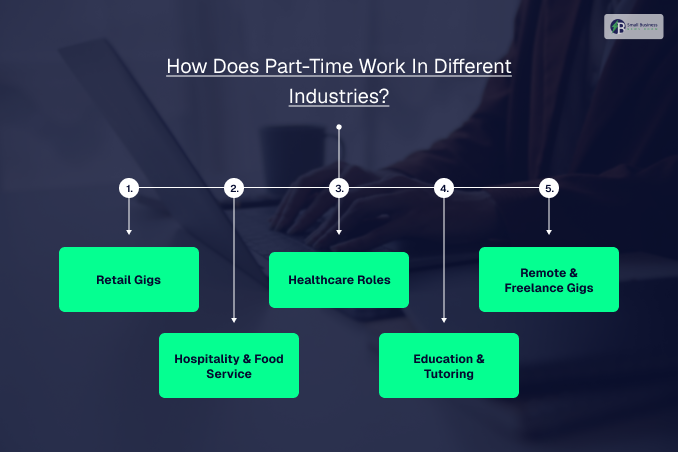
The number of hours you will put in can change quite a bit depending on the field you choose.
Because every business has different busy times, your weekly routine will largely depend on the industry.
So, what do these shifts look like in real life?
To give you a clear picture, here is a breakdown of typical hours across a few popular fields, backed by career insights from platforms like Coursera Career Guides:
1. Retail Gigs
Usually, retail associates work between 20 and 30 hours per week. However, because stores stay open late, your hours will likely be spread across mornings, late evenings, and weekends.
2. Hospitality & Food Service
Restaurants, bars, and hotels typically offer flexible roles ranging from 10 to 30 hours a week.
In this industry, you will mostly work during peak times, such as busy dinner rushes, weekends, and holidays.
3. Healthcare Roles
For nurses, caregivers, and medical assistants, part-time work often means working 20 to 30 hours per week.
Interestingly, instead of working every day, you might just cover two long 12-hour shifts.
4. Education & Tutoring
This is one of the most flexible fields, typically requiring only 5 to 20 hours per week.
Consequently, your schedule depends entirely on how many students you have and when they need help.
5. Remote & Freelance Gigs
If you are doing freelance writing, customer support, or virtual assistant work, your time is highly customizable.
Many remote workers log anywhere from 10 to 20 hours a week, often choosing exactly when they want to log on.
The biggest takeaway here is that while a flexible schedule always means staying under the 40-hour mark, the exact answer to “how many hours is part time?” depends on your specific industry!
Also Check: Arcarrierpoint Net: Best For Free Study Materials, Admit Cards, And The Latest Govt Job Notifications!
Advantages And Disadvantages: Part-Time Jobs
Honestly, deciding “how many hours is part time” right for your budget and lifestyle comes down to balancing the perks against the downsides.
Therefore, we put together a simple, honest breakdown of the pros and cons of flexible schedules based on workplace studies from global workforce experts like TCWGlobal:
| The Good Stuff (Benefits) | The Tough Stuff (Challenges) |
| Amazing Flexibility: You can easily plan work around school, kids, or hobbies. | Smaller Paychecks: Fewer hours automatically mean less total take-home pay each month. |
| Better Work-Life Balance: More free time means less stress and zero burnout. | Fewer Job Perks: Health insurance, paid time off, and retirement matching are rarely included. |
| Super Sharp Focus: Working shorter shifts helps you stay productive and energized. | Shifting Schedules: Hours can drop during slow seasons, making your income unpredictable. |
How Can You Find Good Part-Time Jobs?
When you are trying to find a flexible job, you need a bit of strategy. However, it can be easier for you if you know where to look!
Before you apply, your first step is deciding “how many hours is part time” right for your routine so you can filter your searches perfectly.
Therefore, we put together a simple guide that shows exactly how to spot the best flexible openings to save you time.
Based on modern career insights from job matching platforms like Indeed Career Advice, here is a handy breakdown of the best ways to land your next gig:
| Where to Look | How It Works | Quick Pro-Tip for Success |
| Big Job Boards | Platforms like Indeed, Glassdoor, and LinkedIn Jobs host thousands of listings. | Type “part-time” or “flexible hours” into the filters to instantly filter out full-time roles. |
| Seventhway Premium | A specialized portal for exclusive, high-quality part-time roles. | Keep your profile fully up to date here to get matched with premium, flexible employers. |
| Company Pages | Many local shops, offices, and restaurants post openings directly on their own websites. | Head straight to the “Careers” or “Join Our Team” section of companies you already love. |
| Staffing Agencies | Recruiting firms match workers with businesses needing temporary or flexible help. | This is perfect if you want to test out a job before committing long-term. |
| Your Network | Simply telling friends, family, or former coworkers that you are open for work. | Word-of-mouth is still one of the fastest ways to uncover hidden, unadvertised jobs! |
You May Also Like: Is Flexjobs Legit? The Ultimate Behind-The-Scenes Review For Remote Job Seekers In 2026
Part-Time Work: How Does The Payroll And Tax Considerations Work?
When it comes to taxes, the government treats the part-time and full-time paychecks exactly the same.
No matter how many hours are part-time for you! Whether you work 10 hours or 35 hours a week, tax law still applies to every dollar you earn.
Therefore, your employer is required by law to handle your taxes automatically. Here is a simple breakdown of what gets taken out of your paycheck and why:
· Income Taxes:
The company must withhold federal income tax based on your earnings.
Moreover, state and local taxes are also withheld depending on where you physically perform the work.
· FICA Taxes (Social Security & Medicare):
These taxes apply to every single worker, regardless of how short your weekly shift is.
Moreover, your boss matches your FICA contributions dollar-for-dollar to fund your future retirement benefits.
· Unemployment Insurance:
Employers must pay into federal and state unemployment funds for part-time staff.
Consequently, this keeps you protected and allows you to claim benefits if you lose your job through no fault of your own.