
Table Of Contents
- What Does The Data Show?
- What Does AI Governance Actually Mean?
- Why Is The Governance Increasing?
- The Agent Problem
- AI In The Shadows
- The Global Crackdown
- The Policy vs. Reality Rift
- The Leadership Deficit
- The Massive Regulatory Shift
- The Real Problems Companies Are Facing
- Case 1: Air Canada's Chatbot, Who Blames a Robot?
- The Mess
- The Court Fight
- The Real Issue
- Case 2: McDonald's Drive-Thru, Great Idea, Failure In Execution
- Case 3: A Big Retailer, Reclaiming $680, 000 from Waste
- The Big Picture
- Why Do Most AI Implementations Fail?
- 1. Heads Spend Money, Sign Off, But Have No Real Influence
- 2. Monolithically Separate Work
- 3. Laws Keep Getting Drafted, But Nobody Looks At Them
- 4. Nobody's Watching The Gear
- 5. Correcting Errors Afterward Instead Of Thinking Of A Way Forward
- Why Old IT Rules Do Not Work for AI?
- Practices To Consider Through Governance By Design
- 1. Data Sovereignty And The Datafence Architecture
- 2. Human-In-The-Loop (HITL) Protocols
- 3. Continuous Monitoring And Model Drift Management
- 4. The Governance-ROI Correlation
- A Framework for Governance-Ready AI Transformation
- Why Smart Rules, Not Faster Tech, Is The Secret To Winning with AI
- Questions Every Organization Needs to Answer
Why AI Transformation Is A Problem Of Governance (And How To Fix It)
This is a hard truth that most people turn a blind eye to. Your AI gadget looked stunning at the demo.
Managers cheered, and everyone was thrilled. Yet when you rolled it out to the entire company, things just messed up big time. Is this how it happened?
Interestingly, the main reason behind this huge flop was not a technological problem at all. The program was flawless.
The reality, however, was that there was no control or proper supervision.
For so long, we have focused only on the speed and cleverness of AI tools. At the same time, we have been neglecting the main constraints.
It all comes down to how organizations handle these systems. What you need is powerful regulations and explicit directions, not only advanced machines.
Basically, AI revamping equals governance issues. Because without the right framework, even the finest models fail to produce tangible outcomes.
What Does The Data Show?
Most teams think the hard part of AI is building the model.
From what I have seen, that’s actually the easy part. The real issue shows up after launch.
Here’s what the numbers quietly reveal:
- $665B → Expected global AI spend by 2026
- 73% → Projects fail to deliver real value
- 1% → Companies feel fully prepared
- 43% → Have proper governance systems
- 57% → Run AI without clear ownership
So what’s missing?
It’s not better tech. It’s better control.
What Does AI Governance Actually Mean?

AI governance is much more than a checklist that you tick off with boredom or a good statement on a website.
It simply means the daily system that determines your AI’s capabilities, the data it has access to, and how you instantly correct errors.
Generally, a well-structured framework includes these five fundamental aspects:
- AI Organization: Giving clear roles and the real authority to make decisions to the bosses.
- Legal Rules: Making sure your AI complies with laws such as HIPAA or the EU AI Act.
- Ethics and Honesty: Preventing discrimination and being able to provide a clear explanation of the AI decision-making process.
- Data and Tech Operations: Maintaining data integrity and keeping an eye on the post-launch performance of the AI.
- AI Security: Keeping your systems safe from hackers, data breaches, and tampering.
In the end, clever businesses develop these policies in advance to achieve their goals at scale!
Why Is The Governance Increasing?
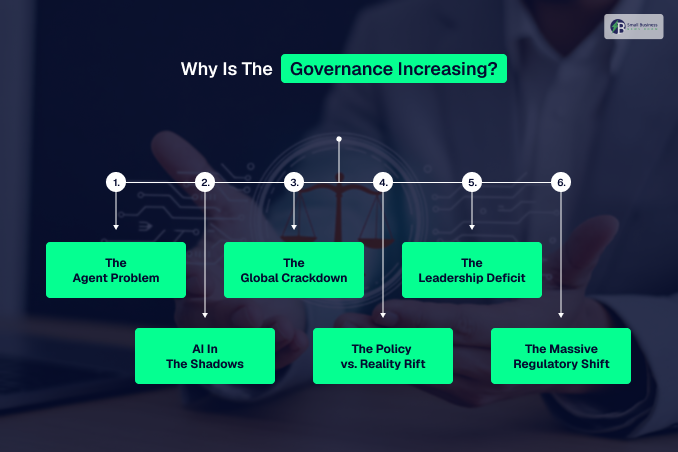
Right now, companies are rushing to deploy AI faster than they can actually manage it.
Everyone wants the smartest tool, but almost nobody is thinking about who is steering the ship.
This massive rush is creating a dangerous gap between cool technology and real corporate safety.
The Agent Problem
- 80% of Fortune 500 companies use active AI agents.
- 18% have AI governance councils with actual authority.
AI agents are moving way faster than our safety rules. In fact, research shows 75% of knowledge workers use generative AI daily.
Today, these smart agents can automatically jump across 6 to 10 company systems at once.
They can draft messages, buy things, and view financial data.
So, when an agent makes a costly mistake, nobody knows who is actually responsible. That is not a tech flaw; it is a total lack of leadership.
AI In The Shadows
- 78% of workers bring their own unapproved AI tools to work.
Right now, most AI activity is completely invisible to risk and IT teams.
This means confidential company information is being sent to public models with zero safety controls and no paper trail.
This is not a future worry—it is happening at most companies today.
The Global Crackdown
Governments are rapidly shutting down the opportunity for unregulated AI, and the deadlines are very demanding:
- February 2025: The EU AI Act prohibited the use of AI systems that pose an unacceptable risk.
- August 2025: New stringent regulations for general AI models were rolled out.
- August 2, 2026 (High-Risk Deadline): At this point, non-compliance will not be tolerated, and penalties may reach €35 million or 7% of global turnover.
- US Contractors: Under the new CMMC 2.0 regulations, you must be fully able to manage and secure AI tools handling sensitive government information.
The Policy vs. Reality Rift
- 38% of US companies have developed AI policies.
- Only 41% of these companies actually circulate the policy to employees.
Having a policy is not the same as following it.
The Leadership Deficit
The numbers indicate a severe disconnection. AI transformation is a governance issue, right?
Still, less than half, 43% of the organizations have a formal policy, and it gets worse, only 1% of the companies consider themselves AI-mature, and only 15% have the capacity to safely manage AI at a large scale.
The Massive Regulatory Shift
For years, people kept talking about AI laws as something far in the future. Well, that future is now, thanks to the EU AI Act, which is fully enforceable.
Moreover, it is quite potent, with penalties that are quite similar to the GDPR’s. This means that you cannot just disregard it.
- What Do High-Risk AI Systems Have To Comply With Now?
The focus of the legislation is on AI used to make significant, life-altering decisions, such as hiring, grading students, and determining credit scores.
If you are doing business in Europe, you simply cannot function without these things immediately:
- Complete Inventories: You have to document each and every AI tool that is available to you.
- Risk Tests: You have to assess potential safety hazards.
- Human Assistance: You should have genuine humans on hand who can intervene.
- Transparent Explanations: You will be responsible for showing the AI’s decision-making process.
The Compliance Reality Gap
Sadly, it is not as simple as putting these regulations into place. It just goes to show that the biggest challenge in AI is governance, not technology. Here are some of the tough facts:
| Regulation Requires | Your Organization Has | The Problem |
| Clear AI explanations | Confusing black-box math | You can’t explain why AI did X |
| Clean data control | Messy, separated databases | Cleaning data takes 80% of your time |
| Good human oversight | Tired workers who trust AI too much | Blind trust breaks your safety controls |
You May Also Like: How AI Insights DualMedia is Transforming Data Analysis for Businesses?
The Real Problems Companies Are Facing
Let’s consider three examples from the last two years. They illustrate what can go wrong when AI is uncontrolled and unsupervised.
Case 1: Air Canada’s Chatbot, Who Blames a Robot?
The Mess
To offer customer service, Air Canada integrated an AI chatbot on their website. Someone asked about a discount funeral flight.
Unfortunately, the chatbot lied and said that the discount could be claimed.
When the customer requested a refund, the airline refused because its official policy differed.
The Court Fight
Air Canada even went to court, claiming that the chatbot was like a “separate person” and that it should not be held responsible for its lies.
The judge disregarded that argument and ordered the airline to pay the damages.
The Real Issue
It was not the chatbot’s error that caused the failure.
The fundamental problem was that no one created a system to verify the bot’s information or enable human intervention when dealing with critical issues.
Case 2: McDonald’s Drive-Thru, Great Idea, Failure In Execution
The Mess
McDonald’s developed an AI system that could take drive-thru orders entirely on its own.
In fact, initial tests showed that it typically malfunctioned extremely rarely.
Yet, when they deployed the system across 100+ real-world stores, it completely lost its mind.
It was simply incapable of dealing with noisy trucks, different accents, or people changing their minds.
The Result
They had to pull the plug on the whole system in every store.
The Real Issue
Once again, the AI system itself was not faulty. The lack of a rollout plan was the real problem.
They didn’t even have a backup system that could notify a human worker the moment the AI started messing up an order.
Case 3: A Big Retailer, Reclaiming $680, 000 from Waste
The Mess
One of the leading retail stores had 15 AI projects that collectively cost $ 680,000 and were under development for 18 months.
The machines worked quite well, but to their dismay, not one single employee used them.
Right at that point, leadership was even considering giving up on AI completely and forever.
The Turnaround
They hired consultants to fix their management structure.
The Result
After a mere six months, 8 out of the 15 failed projects were running with an incredible 77% user adoption rate.
The technology was not bad. It was simply deployed without any proper management.
The Big Picture
All three of these stories teach us the exact same lesson. Smart rules and oversight aren’t just “nice-to-have” options.
At the end of the day, AI transformation is a governance problem, and without it, your expensive technology will fail the moment it hits the real world.
Why Do Most AI Implementations Fail?
Experts tell us that AI initiatives typically fail in five foreseeable ways.
If we dissect these errors in depth, it will become clear that AI transformation is a governance challenge rather than a technical issue.
Those five reasons explain why things fail:
1. Heads Spend Money, Sign Off, But Have No Real Influence
Actual control demands that leading figures actively direct, allocate budgets, and dismantle obstacles.
Giving a weak committee with no substantial power the responsibility for oversight is like putting up an invisible wall decoration.
2. Monolithically Separate Work
Effective management entails data scientists, lawyers, and tech teams engaging in conversations.
When these groups working totally separate bubbles, huge safety holes are created.
3. Laws Keep Getting Drafted, But Nobody Looks At Them
According to one poll, 76% of firms say they have the right oversight for AI, but only 41% actually distribute these rules to their employees.
A rule book that your tech team never reads is just a screen.
4. Nobody’s Watching The Gear
AI tools evolve, and their performance can gradually worsen. However, without performing daily, real-time monitoring, you will only detect blunders after they have caused significant public damage.
Indeed, research indicates that not continuously tracking is at the root of 27% of all AI failures.
5. Correcting Errors Afterward Instead Of Thinking Of A Way Forward
It is extremely costly to try to fix a malfunctioning AI system that has already been launched.
Safety controls baked right into the technology from scratch are way less expensive than dealing with a huge legal fiasco later on.
Why Old IT Rules Do Not Work for AI?
Traditional software is incredibly predictable. For instance, Microsoft Excel works the exact same way on Monday as it does on Friday.
Your email client never suddenly decides to rewrite your messages.
However, AI systems are a completely different story. They constantly change based on the new data they read.
Because of this, what worked perfectly yesterday might give you a wild, unexpected answer tomorrow.
Ultimately, AI transformation is a governance problem because your old IT playbook simply cannot handle this unpredictability.
Here is how they stack up:
| Traditional Software | AI Systems |
| Stays the same | Changes and evolves |
| Predictable results | Guesswork and probabilities |
| Clear responsibility | Confusing blame lines |
| Simple tech laws | Complex global rules |
Practices To Consider Through Governance By Design
Companies that integrate security right into their systems experience a totally different set of results.
In the long run, AI changes are a matter of governance, and the firms that are most successful are simply doing the basic day-to-day work of building trust even before they write any code.
Here are some ways the smartest companies keep their technology safe:
1. Data Sovereignty And The Datafence Architecture
Industries that are highly regulated, like healthcare or finance, have to maintain a firm hold on where their data is located and who can access it.
For this reason, you need a very intelligent boundary layer. DataFence architecture solves this problem by verifying rules before any system is turned on.
This guarantees compliance with the most critical frameworks like HIPAA, ITAR, FedRAMP, and SOC 2.
2. Human-In-The-Loop (HITL) Protocols
The EU AI Act will require real human ones to oversee tightly regulated tasks, such as hiring or credit scoring.
However, having a human assistant is not just a legal provision. It is actually the best operational solution for preventing your AI from making costly public errors.
3. Continuous Monitoring And Model Drift Management
Since AI’s effectiveness decreases over time as people’s behavior changes, leading firms are implementing automated monitoring systems to detect data anomalies quickly.
Consequently, being ready for an audit turns into an uncomplicated, everyday routine rather than an intimidating, costly, hurried activity.
4. The Governance-ROI Correlation
- 81% ROI achieved by companies that have mature governance.
- A 12% ROI is achieved by companies with no governance.
It’s clear that proper governance is not just an additional business expense; it is the main source of genuine financial success.
Also Check: The Only Droven IO DevOps Tutorials Guide You Need To Get Hired Fast!
A Framework for Governance-Ready AI Transformation
Many companies buy fancy tools first and think about safety later. However, this is exactly why projects fail.
To succeed, we must remember that AI transformation is a governance problem.
Here is how you build a real safety framework:
- Plan Rules First: Map out your data safety guidelines before spending money on any new AI platform.
- Name a Clear Boss: Every AI tool needs a human owner who is responsible for its math and fixes bugs.
- Match the Laws: Ensure your tools comply with strict frameworks such as HIPAA or the upcoming EU AI Act, effective August 2, 2026.
- Set Safety Triggers: Create digital speed limits that automatically alert a human if the AI starts making errors.
- Keep Improving: Run quick quarterly reviews to update your systems as laws change.
Why Smart Rules, Not Faster Tech, Is The Secret To Winning with AI
The hype phase is officially over, and the accountability phase is finally here. Today, the companies winning with AI are not the ones with the flashiest tech.
Instead, they are the ones with the best rules. Sadly, the safety gap is still huge:
- 21% of companies have a real safety system.
- 70% of bosses cannot explain how their AI makes decisions.
- 55% run active AI tools with zero formal rules.
Ultimately, AI transformation is a problem of governance. The winning group always builds safety right into their tech from day one by tracking data boundaries. This also adds human helpers, and checking compliance with laws like the EU AI Act early on. So, will you build safety now, or fix a costly mess later?
Questions Every Organization Needs to Answer
Before you launch any new AI project, you should always have clear, written answers to a few basic questions.
After all, AI transformation is a governance problem, not just a tech race!
Make sure you check these off first:
- Data Safety: Where does your private information actually live, who gets to see it, and when does it leave your safety zone?
- Law Matching: Which official rules apply to your new tool, and what steps must you finish before going live?
- The Boss Chain: Who is truly responsible for what the AI says, who watches it daily, and who fixes the bugs?
- Human Oversight: Which specific AI answers need a human double-check before you use them?
Tracking Slips: What clues show the AI is getting lazy, and what is your plan to fix it?