
Table Of Contents
- What Exactly Is Employee Retention?
- The Brutal Financial Reality Of High Turnover
- Why Do Good Employees Pack Their Bags?
- 1. Feeling Stuck
- 2. Burnout
- 3. Poor Management
- 4. Lack Of Recognition
- The Psychology Behind Retaining Talent
- Maslow's Hierarchy Of Needs
- Herzberg's Motivation-Hygiene Theory
- 5 Actionable Strategies To Supercharge Retention
- Real-World Case Studies
- How Microsoft Does It
- How Walmart Does It
The Real Reason Your Best Employees Are Quitting (And How To Stop It Right Now)
Just picture this: You wake up on a Monday morning, and your phone buzzes. It’s an email, and it’s from your dream software engineer.
Or perhaps your graphic designer. Or maybe your star sales manager. When you open it up, your heart sinks. It’s their two-week notice.
Now your stomach twists into knots as you picture the endless hours of posting jobs, sifting through hundreds of disorganized resumes, interviewing dozens of desperate candidates, and then training a new employee for months.
Does this resonate with you? If it does, you’re not alone. Retention has become one of the hardest problems in modern business.
Recent statistics suggest that 56% of workers plan to look for a new job, and 80% are confident they’ll find one faster than before.
Modern-day managers understand the value of employee retention, but many believe it’s a lost cause.
They think if they pay a decent wage, workers will stick around. After all, aren’t high salaries the fundamental pillar of any successful organization? Statistics say otherwise.
And that’s what we’re going to discuss today.
In this guide, we’ll analyze the psychology of employee retention, discuss the staggering costs of retaining talent, and share our best strategies to keep the brightest minds where they belong for years to come.
What Exactly Is Employee Retention?
Employee retention, in simple terms, refers to an organization’s efforts to keep its workforce on the job longer.
It refers to the collective strategies, policies, and everyday actions an employer takes to reduce voluntary quits.
Imagine your company as a bucket, while your employees are the water that fills it. If this bucket has a few holes drilled in it, the water will simply fall out, no matter how much you pour in.
Similarly, if you have a poor corporate culture, toxic management, or an unsuitable compensation policy, your best workers will seek opportunities elsewhere.
This means that instead of focusing on plugging up the holes, you should devote all your efforts to ensuring that no water falls out of the bucket.
We’ll discuss these strategies later on. Let’s now turn our attention to the staggering turnover costs
The Brutal Financial Reality Of High Turnover
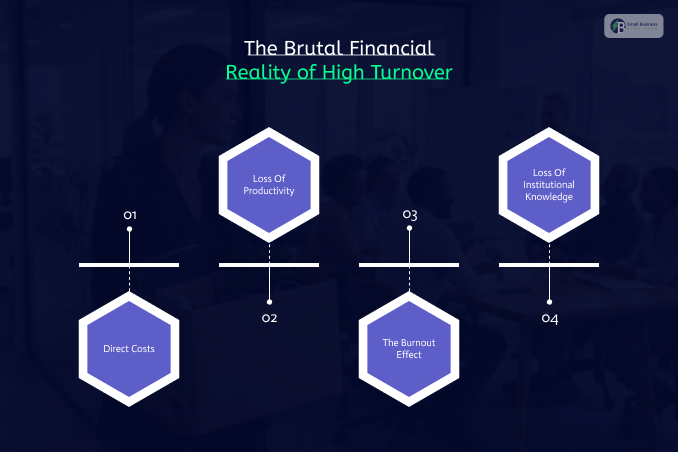
Any manager worth their salt knows that turnover is one of the most expensive and underappreciated costs any business faces. But just how expensive is it?
According to the Society of Human Resource Management, replacing an employee can cost three to four times their annual salary. Let’s separate what constitutes for this number:
- Direct Costs
These include all expenses involved in finding a new worker, from advertising the job opening to conducting background checks or hiring a third-party agency to do it for you. These numbers can be incredibly large.
- Loss Of Productivity
An empty post on the organizational chart can severely damage productivity, as a vital role goes unfilled.
- The Burnout Effect
Once you have a vacancy, remaining workers take on more responsibility, which may prompt them to quit.
New employees require additional training, which takes time to bring them up to speed.
- Loss Of Institutional Knowledge
The more experienced workers tend to know your company better than anyone else.
If you don’t replace them, you lose that knowledge when they quit, which adds to turnover costs.
Why Do Good Employees Pack Their Bags?
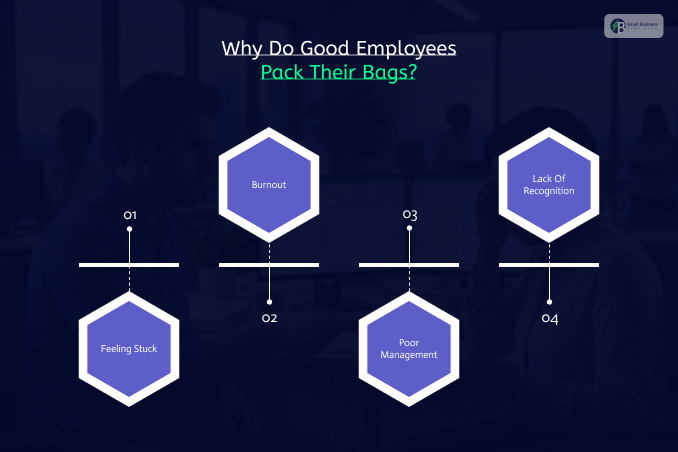
If you want to fix a leaking bucket, you first need to find every crack. Similarly, if workers decide to quit early, you have to identify why.
Here are the most common retention problems that lead to unnecessary turnover.
1. Feeling Stuck
Nobody wants to work in the same place for the majority of their life.
If an employee feels they have stagnated in their position and there are no opportunities for growth, they’ll likely look for a new job.
It’s important that you give your best workers the freedom to choose a better path.
2. Burnout
Many companies fail miserably, simply because they overwork their employees.
Unrealistic expectations and discouraging flexible schedules lead to serious employee burnout, which accounts for a large percentage of worker quits.
In fact, an overwhelming majority (95%) of HR professionals cite employee burnout as the leading cause of loss of quality personnel.
3. Poor Management
Managers and leaders have the greatest influence on an employee’s day-to-day experience.
If they fail in their duties, it could lead to a mass exodus of workers. Micromanagement, poor communication, and disrespect are some of the reasons workers leave their jobs.
Also, remember that most workers will quit a poor manager to pursue another position at a company that values transparent, communicative management.
4. Lack Of Recognition
People want to be appreciated for their hard work, and if they don’t feel it, they’ll go somewhere they feel it.
If leadership displays blatant disregard towards employees’ achievements, it would hurt workers’ productivity, leading to a retention crisis
The Psychology Behind Retaining Talent
There are many ways to examine human psychology and apply the principles to your staff, thus increasing retention in the process.
We’ve compiled a list of the most influential theories in modern behavioral psychology.
Maslow’s Hierarchy Of Needs
Maslow theorized that people will only strive to achieve higher-level goals if their fundamental needs are met.
This means that if your employees don’t feel safe or like they belong, they won’t achieve their full potential.
You must meet certain criteria to increase employee retention.
- Provide monetary compensation: Paying a decent wage is one of the most fundamental ways to show employees you care about their well-being. While some environments rely strictly on transactional leadership to manage performance through rewards, true retention goes deeper.
- Promote growth and accomplishment: Belonging to a company with opportunities for advancement instills a sense of personal growth in a worker. This, in turn, increases retention
- Motivate and incentivize: People feel best when their efforts are rewarded. This motivates harder work, leading to more productivity. In short, motivation begets motivation.
Herzberg’s Motivation-Hygiene Theory
This theory complements the previous one by differentiating between:
- Motivators (things that make an employee want to stay at a company)
- Hygiene factors (things that make a worker want to leave).
In short, you must fulfill these basic wants if you want to keep your most important asset.
5 Actionable Strategies To Supercharge Retention

Now that we understand the statistics and the psychology behind it, it’s time to put on our action hats and identify what employers can do to improve retention.
- Prioritize The Wellbeing Of Your Employees
Not everyone gets the chance to enjoy work-life balance. If your workers suffer, it reflects in their output.
Studies show that 83% of employees have difficulty, or even an impossible time, reaching their well-being goals, and they hold their organizations accountable.
Invest in your mental health, and you won’t regret it.
You will also improve retention, since employees will feel you have their backs.
- Offer Flex Scheduling
Flexibility is crucial to improving retention. 89% of HR professionals reported higher retention after introducing flex scheduling.
Workers need this balance to prevent job burnout, so trust your team to manage their schedules.
- Open Up Mobility Opportunities
The next time you have a vacant leadership or management position, explore internal options before posting a job ad. Always consider your options within reach for any vacancy.
Increasing internal mobility ensures retention, as well as employee productivity, as they grow alongside career ladder.
According to LinkedIn, organizations that use internal mobility see longer employment periods than the ones that don’t.
Offer clear opportunities and invest in the skills required for them. This will ensure that your workforce doesn’t go looking elsewhere
- Show Recognition
Recognition drives retention. Say you’ve already invested in a decent paycheck, yet employees are still seeking other options.
This may reflect inadequate recognition of their effort.
According to Gallup’s research, employees who feel their employers recognize them are 45% less likely to quit within two years.
Recognition is one of the easiest ways to make someone feel appreciated. You can do this through regular shout-outs or rewards.
However, do it consistently to reflect a steady upward trend.
- Listen To Your Employees
The biggest reason for employee dissatisfaction is feeling unheard and ignored.
In fact, 86% of employees think their company doesn’t listen to them fairly.
Schedule regular one-to-one meetings within your team and ask what they think about important company issues.
Use feedback tools to gather information you can turn into concrete, meaningful changes.
This makes employees feel their opinions genuinely matter within leadership and makes them more likely to stay with your company.
Real-World Case Studies
Microsoft and Walmart are two great examples of companies that use many of the discussed strategies for retention.
How Microsoft Does It
Microsoft uses a method that lets employees grow and evolve within the company.
They do this by promoting internal mobility, which allows workers to reach higher within their respective career branches
They also invest into vertical and horizontal movement of a worker, which allows them to not only climb up a ladder of power, but reach other.
These are equally important fields of the organization. This prevents stagnation within jobs, which is also one of the prime reasons why people leave
How Walmart Does It
Walmart invests significant resources in providing educational funding to its employees.
This lets them pursue personal and professional goals while maintaining a steady income.
Moreover, this improves retention. It’s a clever way to inspire people to come to your workplace and do an excellent job.