Table Of Contents
Ultimate Guide To 9954 HSN Code: Construction Services, Sub-Codes & GST Tax Rates Explained
If you are a contractor, builder, or a business owner, it can be areally tough job to figure out the right GST rate. It might feel like a headache.
You know you need to find the right code and percentage. However, the rules seem to change in a constant manner.
However, it is technically a Service Accounting Code (SAC 9954) because works contracts count as a service under GST.
In this guide, let’s break down the exact GST rates for these contracts. We’ll look at recent rule changes.
We’ll also make sure you never pick the wrong code on your invoices again.
At A Glance: Quick Summary
Before we dive into the details, here is a quick cheat sheet to keep you on the right track:
| Question | Answer |
|---|---|
| Correct Code | SAC 9954 |
| HSN or SAC? | SAC (Works contract is treated as a service, not goods) |
| Standard GST Rate | 18% (9% CGST + 9% SGST) in most cases |
| Legal Definition | Section 2(119) of the CGST Act, 2017 |
| Input Tax Credit (ITC) | Often blocked for own-use construction under Section 17(5)(c) |
Works Contract HSN Code / SAC Code: What It Actually Is
When creating an invoice, it is common to look for a 9954 HSN code. However, there is a technical catch.
Under the Indian GST regime, HSN (Harmonized System of Nomenclature) defines goods numbers and whereas SAC (Service Accounting Code) numbers defines services.
This is because a works contract, legally categorized as a service, uses an SAC code.
While many billing software and businesses casually label it as the 9954 hsn code, technically, it is SAC 9954 (Construction Services). This particular heading encompasses:
- Building residential and commercial properties
- Industrial and civil engineering construction
- Repairs, renovations, alterations, and maintenance on existing structures
Now, this technicality may seem inconsequential. However, the application of a goods HSN code instead of the appropriate SAC code on your invoice
This could lead to major data mismatches when submitting your GST return and refund.
Consequently, it is one of the most common documentation errors in the construction sector.
What Exactly Counts As A “Works Contract” Under GST?
A works contract under Section 2(119) of the CGST Act 2017 is a contract for carrying out work of construction, fabrication, completion, fitting out, finishing, or any similar kind in relation to an immovable property.
The contract must satisfy two conditions:
1. It Must Relate To An Immovable Property.
The immovable property is defined as land and anything connected or attached to it.
For example, building a warehouse would fall under a works contract, whereas repainting your delivery truck would not, as it is movable property.
2. A Contract Must Consist Of Goods And Services.
If a contract was simply about providing labor and the client about all materials, it might not work as a contract.
Schedule II of the CGST Act officially deems it a supply of service, because a works contract involves both goods and labor on immovable property
Who Needs To Know This?
If you belong to any of the following groups, you need to master SAC 9954for your daily operations. It is highly important:
- Civil and building contractors managing structural projects
- Builders and real estate developers handling commercial or residential properties
- Interior fit-out and renovation contractors transforming office or home spaces
- Government contractors working on public infrastructure projects
- GST consultants and accountants who want to ensure error-free client filing
- Businesses receiving invoices who need to double-check their vendors’ codes before claiming Input Tax Credit (ITC)
What is the Standard GST Rate on a Works Contract?
In most cases, works contract services fall under SAC 9954 and are taxed at 18% GST (9% CGST + 9% SGST).
This standard rate comes from CBIC Notification No. 11/2017-Central Tax (Rate).
However, you cannot just apply 18% to everything blindly. The final rate depends heavily on the nature of the work, who is receiving the service, and the specific type of project.
Here is a quick breakdown of how different projects are taxed:
| Type of Works Contract | Typical GST Rate | Important Notes |
|---|---|---|
| General Construction (Residential, commercial, industrial, and standard government works) | 18% | This is the standard rate under SAC 9954 for most normal cases. |
| Earthwork & Government Subs (Predominantly earthwork for Government, related subcontractor services, and offshore oil/gas E&P) | 18% with ITC | These specific categories were moved up to 18% from the older 12% bracket. |
| Residential Real Estate / Affordable Housing (Supply by a promoter or developer) | 1% or 5% without ITC | Do not apply this to a regular contractor’s invoice. This has very specific developer conditions. |
| Specified Pure Labor Contracts | Exempt (or separate treatment) | Only applies when the contractor supplies absolutely zero material. |
| Pure Labor for a Single Residential Unit (Private, non-government) | Exempt | Must be a genuine pure labor service, not a mixed supply. |
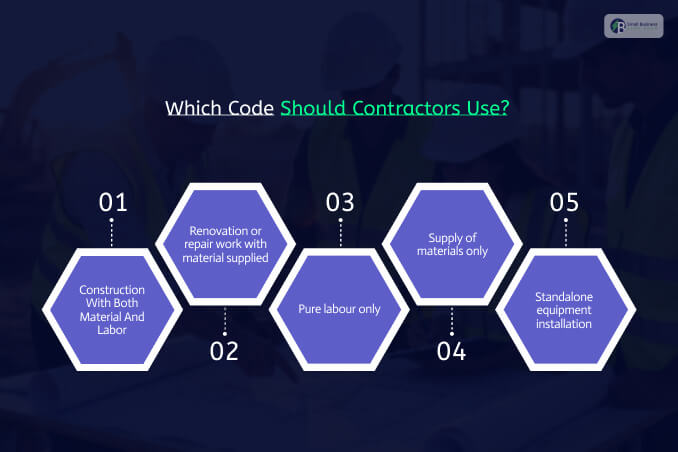
Which Code Should Contractors Use?
Choosing between a goods code and a service code is often where many businesses make inadvertent errors.
As such, if you casually type the 9954 HSN code into your accounting software, ensure that it is processing it as a service code.
To ensure that your books are perfectly clean, here’s a quick guide to using the below classifications:
- Construction with both material and labor: SAC 9954. This is the classic works contract scenario.
- Renovation or repair work with material supplied: SAC 9954 (specifically under relevant sub-codes like 995419).
- Pure labour only (no material at all): Do not use the works contract classification. You must use a separate service SAC meant for pure labor.
- Supply of materials only (no installation): Do not use SAC 9954. Use the actual goods HSN code for cement, steel, or whatever material you are selling.
- Standalone equipment installation (like an AC or machinery): If it is not part of a massive, ongoing building construction project, use SAC 9987 instead of 9954.
SAC 9954 Sub-Codes: Which One Applies to You?
While you may be happy with being able to simply type the broad “9954” code into your billing software, utilising precise sub-codes will make your GST filings more defensible in case of a tax audit.
Furthermore, if your aggregate business turnover was above ₹5 crore in the preceding financial year, reporting the 6-digit code is a mandatory requirement.
Here are the specific sub-codes taken from the CBIC’s Scheme of Classification of Services:
- 995411 – Construction of single- or multi-storied residential buildings
- 995412 – Other residential buildings (hostels, old age homes, shelters)
- 995413 – Industrial buildings (workshops, factories, warehouses)
- 995414 – Commercial buildings (offices, malls, hotels, restaurants, airports)
- 995415 – Other non-residential buildings (schools, hospitals, courts, religious places)
- 995419 – Repair, alteration, renovation, or maintenance of any building types above
- 995421 – Infrastructure works (highways, streets, roads, railways, runways, bridges)
- 995422 – Waterworks (harbours, dams, water mains, irrigation systems)
- 995424 – Local pipelines and cables (sewage, electricity, communication cables)
- 995433 – Site preparation (excavating and earthmoving services)
- 995441 – Installation and erection of prefabricated buildings
- 995451 – Pile driving and foundation services
- 995461 – Electrical installation (wiring, fire alarms, burglar alarms)
- 995473 – Painting services for building completion
- 995474 – Floor and wall tiling services
Works Contract vs. Labour Contract vs. Pure Supply
To avoid compliance issues, you must know exactly which category your contract falls under:
- Works Contract: Both materials and labour are supplied for an immovable property. (Classified under SAC 9954).
- Pure Labour Contract: Only workforce is provided; zero materials are transferred. (Classified under a different service SAC).
- Pure Supply of Goods: Materials are delivered to the site, but no installation or construction service is provided. (Classified under the relevant goods HSN code, not SAC 9954).
Real-World Example Calculation
Let’s look at how this works in practice. Now, imagine a contractor is hired to renovate a commercial office building.
They supply both the materials and the labor. The materials often include tiles, cement, and electrical fittings.
| Total contract value | ₹10,00,000 |
| Classification | Works contract (involves immovable property + material transfer) |
| SAC Code | 9954 (Specifically sub-code 995419 for renovation) |
| GST Rate | 18% |
| GST Payable | ₹10,00,000 x 18% = ₹1,80,000 |
The Cost of Getting It Wrong: If the contractor casually listed a goods HSN code instead of the 9954 HSN code (SAC 9954) on this ₹10,00,000 invoice, it would trigger a massive data mismatch during the GSTR-1 reconciliation.
Meanwhile, any GST refund claims tied to this transaction would be frozen, likely resulting in a tax scrutiny notice.
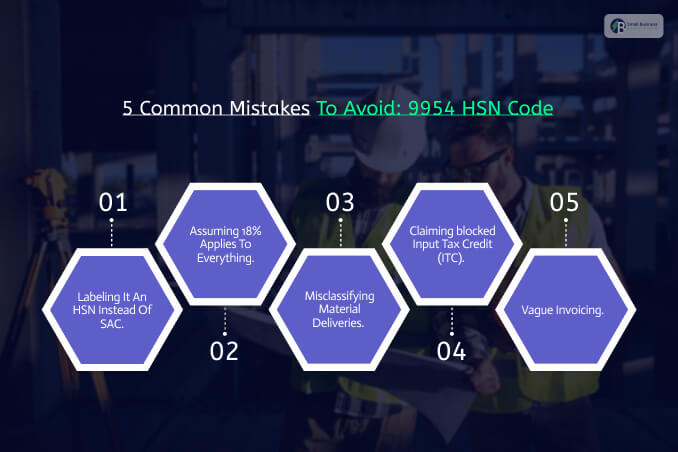
5 Common Mistakes To Avoid: 9954 HSN Code
One must never overlook the finer details of the law. Even seasoned professionals run into issues and compliance problems.
Here are some of the most common slip-ups that could land your business in the middle of the sea:
1. Labeling It An HSN Instead Of SAC.
Make sure your accounting software recognizes 9954 as a service code. This way, the filings match government databases perfectly.
2. Assuming 18% Applies To Everything.
Always verify whether your project falls under an exempt category like a private, pure-labor residential build.
3. Misclassifying Material Deliveries.
Do not use SAC 9954 (use the specific material’s HSN code) if you are simply dropping off steel or cement without installing it.
4. Claiming blocked Input Tax Credit (ITC).
Under Section 17(5)(c) of the CGST Act, you cannot claim ITC if you are constructing an immovable property for your own business use (unless it is for plant and machinery).
5. Vague Invoicing.
Avoid writing just “9954” if your turnover requires 6-digit precision. Break it down into the exact sub-code (like 995473 for painting) to stay completely audit-ready.
Lastly, always double-check your project categories against the latest CBIC notifications before hitting “generate” on your invoice software.
Read Also: