
Table Of Contents
- Why Startups Need A Different Approach To Moving?
- Hire Commercial Experts To Avoid Delays
- How Startups Can Handle Office Moves: Comprehensive Business Relocation Strategy
- Create A Timeline
- Assign A Moving Coordinator
- Map Out Major Milestones
- Reduce Unnecessary Clutter
- Focus On IT Infrastructure
- Backup All Information Systems
- Label All Hardware And Connecting Cables
- Book Reliable Internet Service Providers
- Break The Process Into Stages
- Shift Essential Departments First
- Avoid Congestion At The Office
- Notify Clients, Suppliers, And Partners
- Plan Communication And Logistics Efficiently
- Post The Office Floor Plan Online
- Set Guidelines For Packing Personal Possessions
- Consider Working From Home
- Review Practical Lessons From Real-World Case Studies: Danone
- Complete the Necessary Set Up at The New Office
- Ensure Smooth Transitions
- Create a Help Desk
- Celebrate The Achievement
How Startups Can Handle Office Moves Without Losing Thousands!
So, how startups can handle office moves?
Relocating a fast-growing business is a major milestone; however, it shouldn’t disrupt daily operations.
Moving heavy equipment, network infrastructure, and staff requires experienced professionals.
New offices must remain productive throughout the transfer process while meeting tight timelines.
A startup company must ensure a smooth transition while minimizing transit time and maintaining customer relations.
By optimizing their logistics strategy and designating qualified personnel, organizations can avoid downtime during a commercial relocation.
Well-planned procedures help firms protect valuable assets and quickly resume key functions.
Why Startups Need A Different Approach To Moving?

Unlike traditional corporations, startups does not have the luxury of taking their time with a relocation.
These firms operate under a much tighter schedule as their organizational processes remain fluid in their early years.
Each wasted hour on a disorganized relocation hurts both the firm’s growth and reputation.
In fact, businesses must develop a more specialized strategy to ensure that their moving budget aligns with their financial goals.
According to a recent Market.biz survey, 76% of organizations identify reducing relocation costs as one of their main reasons for physically transferring.
At the same time, 59% of these firms aim to move to a smaller office by 18%-25%.
Nevertheless, these benefits remain unfounded if firms fail to account for the high expenses of a poorly managed transfer.
Most young firms attempt to save money by cutting costs during the relocation. Some organizations move smaller items in staff vehicles and ask employees to help with the process.
This bottom-up approach usually results in broken computers, misplaced documents, and demoralized workers. In most cases, these mistakes occur when a firm fails to delegate authority correctly.
By contrast, an optimized relocation process helps maintain the firm’s productivity and minimizes downtime. It also prevents additional expenses down the line.
Hire Commercial Experts To Avoid Delays
Many startups try to reduce relocation costs by doing as much work themselves. However, this strategy can backfire because the process is complex.
For instance, a firm will incur huge expenditures by hiring a commercial expert to move delicate servers or heavy conference tables.
At the same time, a startup company will be unable to resume key operations for several weeks if its employees break monitors during the transfer.
When organizations hire professional commercial movers, they can be confident that their valuable assets will be handled by skilled workers.
Companies such as Better Life Moving offer a transparent flat-rate pricing system that helps protect clients’ moving budgets.
Their commercial relocation experts use 24-hour overnight moving services to ensure no disruption to the client’s daily operations.
Moreover, the reputable firm also insures every client’s belongings using a Certificate of Insurance to satisfy a landlord’s requirements.
Their cutting-edge fleet comes with real-time GPS tracking systems to guarantee the security of clients’ valuable startup equipment.
In addition, professional commercial movers allow the firm to focus on its core activities.
This helps in reducing the risk of personal injury and damage to expensive equipment,
This way, an organization can grow steadily despite the disruptions caused by the relocation.
How Startups Can Handle Office Moves: Comprehensive Business Relocation Strategy
A successful business relocation requires careful planning, strong leadership, and minimized operational downtime. Let’s take a look at how startups can handle office moves!
Create A Timeline
A successful business relocation requires extensive planning that should begin at least three to four months before the transfer date.
Create the timeline at least a year before the current office lease expires to avoid last-minute expenses.
Moreover, a well-distributed moving schedule reduces stress and keeps the workers focused.
Assign A Moving Coordinator
Every firm should identify one highly motivated worker who will spearhead the relocation process.
Give the most qualified candidate the title of Moving Coordinator. This individual should be the central point of contact for all utility providers, landlords, and movers.
The role requires excellent organizational skills to ensure that everyone meets the set timelines.
Ideally, an experienced professional should handle this position to avoid any avoidable expenditures.
Map Out Major Milestones
The organization’s leadership should develop a comprehensive plan that contains every critical step involved in the relocation.
Clearly identify all phases and allocate adequate time for completion.
Break the timeline into weekly targets and share it with the firm’s staff to maintain a high level of accountability.
Reduce Unnecessary Clutter
Before relocating, the startup should walk through its current office space and identify items that can be discarded.
For instance, a firm might want to throw away old office furniture or broken computers.
In most cases, a pre-relocation cleanup helps in reducing labor and transportation costs.
Focus On IT Infrastructure
A startup company cannot afford to waste time setting up modems and networking gear during a relocation.
Technology and communications should be the firm’s highest priority during a move.
This rule applies to all organizations that rely on digital tools to remain productive.
Backup All Information Systems
Back up the company’s servers, files, and databases in the cloud before disconnecting any device.
Ideally, test every system to ensure the transferred data is free from corruption.
This step is vital in protecting the firm against data loss, especially if the new setup is not ready.
Label All Hardware And Connecting Cables
Label all wires, monitors, and other devices by department and staff member.
Mark every computer with the employee’s name. This process is crucial because it saves time during setup at the new office.
Book Reliable Internet Service Providers
Firms should contact their preferred web hosting providers and internet service providers (ISPs) well in advance.
The relocation process should not halt an organization’s digital operations.
Consequently, workers should set up the new office’s network infrastructure before the moving van arrives.
Break The Process Into Stages
Companies should avoid relocating every department at once. Startups need to maintain a minimal presence at the old location to remain reachable by customers.
Shift Essential Departments First
The organization should relocate as few employees as possible while ensuring daily operations run smoothly.
For instance, a firm can leave non-essential staff at the current office while moving the support team first.
Alternatively, the essential workers can stay in the initial office until the new location nears completion.
Either way, this approach allows the firm to keep responding to customers’ needs seamlessly.
Avoid Congestion At The Office
Whenever possible, companies should use weekends to handle heavy lifting during a relocation.
This measure spares employees the stress of working in a noisy and busy office. It also minimizes delays caused by rush-hour traffic jams.
Notify Clients, Suppliers, And Partners
Inform suppliers, clients, and business partners of the new address well in advance.
The company should update its digital directories and email signature to show the new information.
In addition, the firm might consider hiring a reliable virtual assistant to handle phone calls from these stakeholders.
Plan Communication And Logistics Efficiently
A business relocation affects the day-to-day operations of every employee at the firm.
Therefore, it is vital for every organization to communicate the changes to its staff clearly.
Post The Office Floor Plan Online
The firm should post the new office’s digital layout to help workers understand where every department will be located.
This way, the employees will know which amenities to expect when they arrive at the new location. The layout should be shared with the staff well ahead of time.
Set Guidelines For Packing Personal Possessions
The company should provide guidelines on how its employees should pack their personal items.
Workers should be provided with hard-plastic storage boxes or other reliable packing materials.
In addition, they should be encouraged to take home any valuable personal effects or sensitive documents during the relocation week.
Consider Working From Home
Firms can allow their staff to work remotely while the office is being transferred.
This measure helps keep people away from the busy construction site while also minimizing disruptions to their regular workflow.
It also lets the IT team configure workstations without interference from other workers.
Review Practical Lessons From Real-World Case Studies: Danone
Now that we have understood how startups can handle office moves, let’s take a look at the real-world case studies.
Many multinational corporations conduct extensive research before relocating thousands of employees to a new office.
Startup organizations can gain vital insights into the corporate world. They just need to observe firms’ behaviors,
For instance, the food products company Danone maintained a high level of communication throughout its massive corporate relocation.
The organization’s executives identified a few key personnel who would play a pivotal role in guiding the average worker through the process.
In turn, the selected team was tasked with the responsibility of addressing the concerns of the general staff.
In addition, management developed clear policies to govern the use of the new office space from day one.
Employees who wanted to work at the new office complex had to request permission to occupy shared flex desks only for a short period.
According to research, firms that offer high-quality internal support and well-organized moving services see a 31% increase in employee satisfaction and a 23% rise in post-transfer productivity.
Complete the Necessary Set Up at The New Office
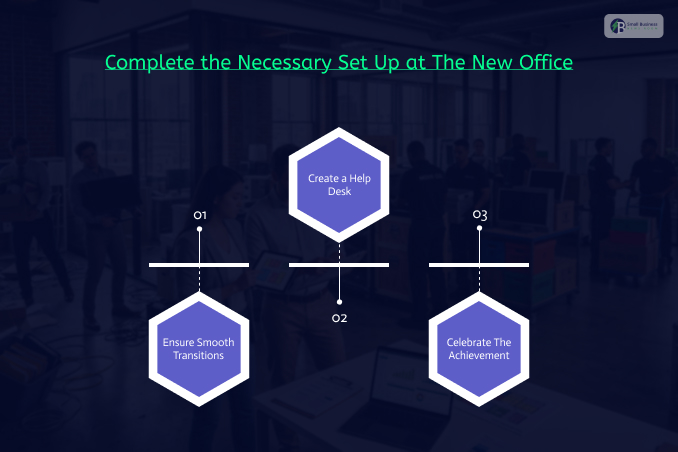
Once the office space has been transferred, make sure everything is correctly configured in the new location.
Ensure Smooth Transitions
The project manager and chief technology officer should inspect the site to ensure that lighting, heating, and air conditioning systems meet the organization’s needs.
Meanwhile, other workers can test the reliability of the internet connection and the meeting room’s display screen.
Create a Help Desk
The company can open a help desk in the new office to address technical and other concerns raised by the employees.
The desk can also collect feedback from the workers, including their recommendations for improving the new office space.
This way, the organization can respond quickly to employees’ needs and ensure the area remains safe and conducive to work.
Celebrate The Achievement
An office relocation represents a significant milestone in a firm’s development trajectory. Acknowledge their efforts and further help them to stay motivated!