Table Of Contents
- Understanding FoSCos FSSAI License India
- What Are The Types Of FoSCos FSSAI Licenses?
- Quick Comparison Table
- 1. Basic FSSAI Registration (For Small & Petty Businesses)
- 2. State FSSAI License (For Medium-Sized Businesses)
- 3. Central FSSAI License (For Large Businesses & Special Categories)
- How Can You Obtain The FSSAI License For Foscos Online?
- Step 1: Figure Out Your Category
- Step 2: Visit The Foscos FSSAI Official Portal
- Step 3: Fill Out The Right Form
- Step 4: Upload Your Documents
- How To Download FSSAI Certificate?
- What Documents Do You Need For The FSSAI Basic Registration?
- For Basic Registration
- State & Central Licenses
- More Rules For Big Companies
- What Happens When You Submit Your Application?
- Keep An Eye On Your Status Live
- Cloud Kitchens Are Also Included!
- Keeping Things Clean: The Audit Grading System
- Real Talk: Penalties And Punishments
- Don't Forget Your Expiry Date!
How To Download Your FoSCoS FSSAI Certificate: A Complete Step-By-Step Guide For Food Businesses
Have you already started your food business without FoSCos FSSAI certification? Then you must prepare yourself to pay around ₹5 lakh fine.
Food has always been the beating heart of Indian culture. Because sharing a meal is all about love and community, making sure your dishes are completely safe, clean, and healthy for everyone is your number one priority.
Well, that is where the government steps in to help. They issue a special safety certificate to prove your food is top quality.
Honestly, if you decide to skip that old paperwork saves you so much time. Instead, you can easily apply online.
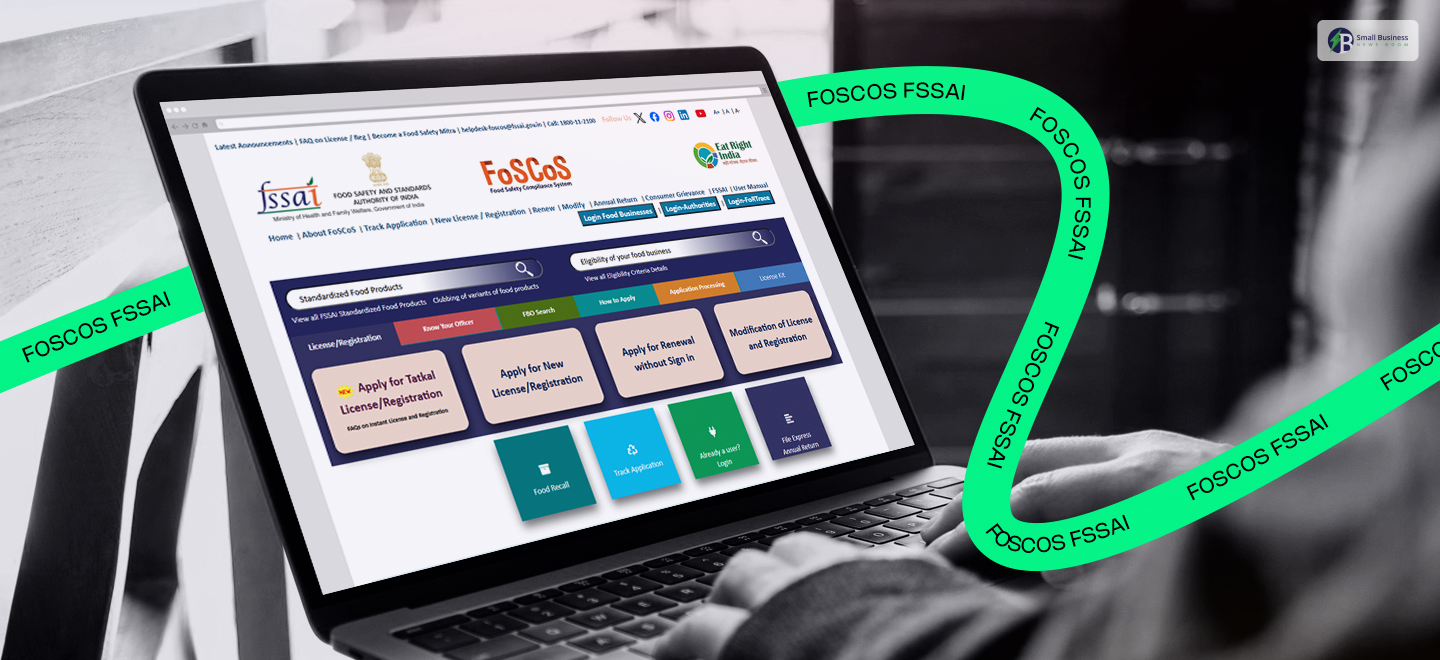
The official FoSCos FSSAI web portal handles everything smoothly from start to finish.
So, just hop on their website, click the application link, and you are good to go! It is truly the fastest way to get your business legally ready.
Understanding FoSCos FSSAI License India
So, what exactly is FoSCos? It stands for the Food Safety Compliance System.
This is like an official online hub that hands out your food license once your application gets the green light.
Indian law requires an FSSAI license. It is a strict must-have if you handle food. You will absolutely need it for:
- Manufacturing and processing food
- Packaging and labeling products
- Storing ingredients or finished goods
- Importing or exporting food items
Moreover, this license is a huge stepping stone. You actually need it before you can apply for other business permits or trade codes.
And the best part? It gives you a 14-digit Foscos registration number to print right on your packaging.
When customers see that number, they instantly trust that your food is clean, safe, and completely free from contamination.
It is the easiest way to win their hearts and build a loyal brand!
What Are The Types Of FoSCos FSSAI Licenses?
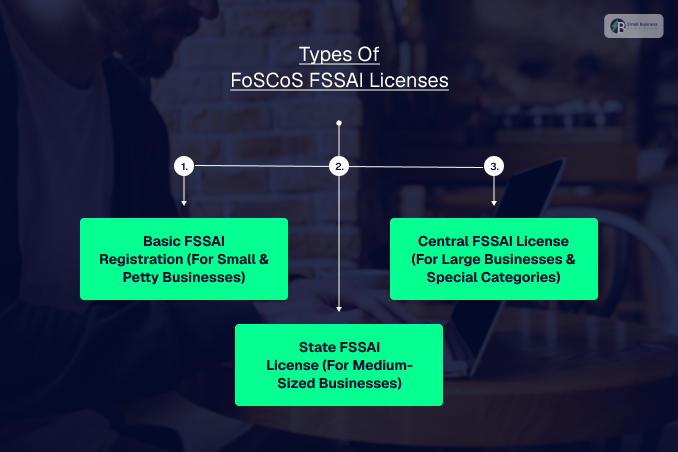
When you look at the FSSAI portal, you will notice that the government breaks these licenses down based on your business’s revenue and the scale of your operations.
This ensures that a small street food vendor does not have to pay the same fee or follow the same heavy compliance rules as a massive food factory.
Let’s take a closer look at each category so you can confidently pick the right one for your setup.
Quick Comparison Table
Here is a handy visual guide to help you find your category, along with the official annual fees you will need to pay:
| License Type | Annual Turnover Limit | Who Is It For? (Examples) | Annual Government Fee |
| Basic Registration | Under ₹12 Lakh | Petty retailers, street stalls, small dairies | ₹100 / year |
| State License | ₹12 Lakh to ₹20 Crore | 3-star hotels, local wholesalers, cold storage | ₹2,000 to ₹5,000 / year |
| Central License | Over ₹20 Crore | 5-star hotels, food importers, multi-state brands | ₹7,500 / year |
1. Basic FSSAI Registration (For Small & Petty Businesses)
This is likely where you will start if you are just dipping your toes into the food industry.
It is officially called a “Registration” rather than a license because the process is incredibly simple.
- The Rules
Your annual business turnover must be under ₹12 lakh.
- Who needs this
Small tea stalls, street food hawkers, tiny home-bakers, local dhabas, small-scale distributors, and even small medical stores selling health supplements.
- Specific limits
If you handle milk, your daily limit is 500 liters. It applies if you handle up to 2 large animals, 10 small animals, or 50 poultry birds a day and run a small butchery.
- The Cost
It costs a flat, super-affordable ₹100 per year.
2. State FSSAI License (For Medium-Sized Businesses)
As your business grows and your customer base expands, you will move into the State License tier.
This requires a bit more paperwork but keeps your growing brand fully protected under the law.
- The Rules
Your annual turnover falls between ₹12 lakh and ₹20 crore.
- Who needs this
Mid-sized restaurants, local wholesalers, cold storage facilities. The capacity can be up to 1,000 metric tons, and hotels rated 3 stars or below.
- The Cost
The government fees range from ₹2,000 to ₹5,000 per year depending on what you do:
- Regular wholesalers, retailers, and 1- to 3-star hotels pay ₹2,000 annually.
- 4-star hotels, large grain mills, and major local dairies (handling up to 50,000 liters of milk per day) pay ₹5,000 annually.
3. Central FSSAI License (For Large Businesses & Special Categories)
This tier is reserved for large corporations, high-end hospitality brands, and any food business that operates across state lines or international borders.
- The Rules
Your annual turnover is over ₹20 crore. However, some businesses must get a Central License regardless of their turnover.
- Who needs this
Any business involved in importing or exporting food products, 5-star hotels, large manufacturing plants, e-commerce food platforms, and large wholesalers with annual turnover over ₹30 crore.
- Special zones
Let’s say you want to open a food stall or catering service inside a railway station, airport, seaport, or defense establishment.
In such a case, you automatically need a Central License because these areas fall under the central government’s direct authority.
- The Cost
It costs ₹7,500 per year. The great thing is that you can apply for up to 5 years at once.
Moreover, it saves you from dealing with annual renewal paperwork.
How Can You Obtain The FSSAI License For Foscos Online?
The digital movement has made it easier for food business owners to register themselves online. And the process is easier than ever!
You do not even have to stand in long lines with stacks of paperwork.
The government used to run an old system called FLRS. However, they have completely upgraded it.
Now, everyone across India uses the modern FSSAI portal to obtain their certificates online.
You just need to follow these four simple steps to apply!
Step 1: Figure Out Your Category
You need to look at your business model before doing anything else, even if it is a small business.
Moreover, you also need to consider your annual turnover, your location, and whether you plan to import or export food.
As we discussed earlier, this helps you decide if you need a Basic Registration, a State License, or a Central License.
Step 2: Visit The Foscos FSSAI Official Portal
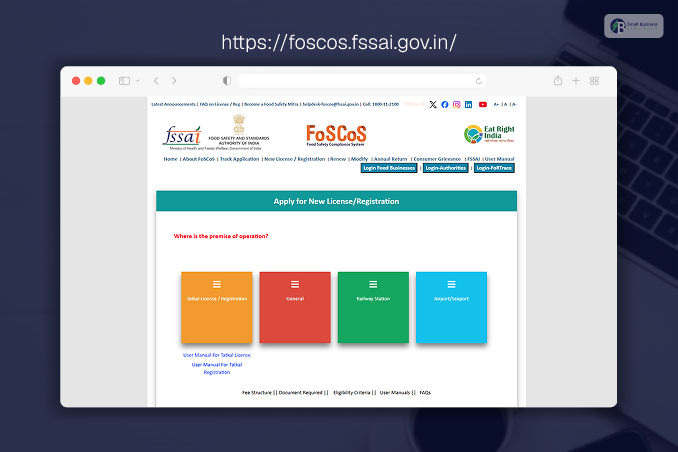
Next, you can head over to the official website at foscos.fssai.gov.in. Right on the homepage, you will easily spot a button that says “Apply for New License / Registration”.
You just need to click on that. After that, the site will ask you where your business is located. You can choose between:
- General areas (like a standard shop or market)
- Railway Stations
- Airports or Seaports
Step 3: Fill Out The Right Form
The portal will guide you to the actual application page once you select your location.
The exact form you fill out depends entirely on your business size:
- Fill out Form A if you are applying for a Basic Registration.
- Fill out Form B if you are applying for a State or Central License.
Step 4: Upload Your Documents
Finally, you will need to upload scanned copies of your documents.
Make sure to save them as clear JPG files and double-check the website’s maximum file size limits before uploading.
Quick Document Checklist
No matter which tier your business falls into, you must keep these three basic items ready before you start filling out your form:
- Your Photograph: A clear, recent passport-sized photo of the business owner.
- Government Photo ID: Your Aadhaar Card, Voter ID, PAN Card, or Passport.
- Proof of Business Address: A utility bill or rent agreement if your shop address is different from the address listed on your ID card.
How To Download FSSAI Certificate?
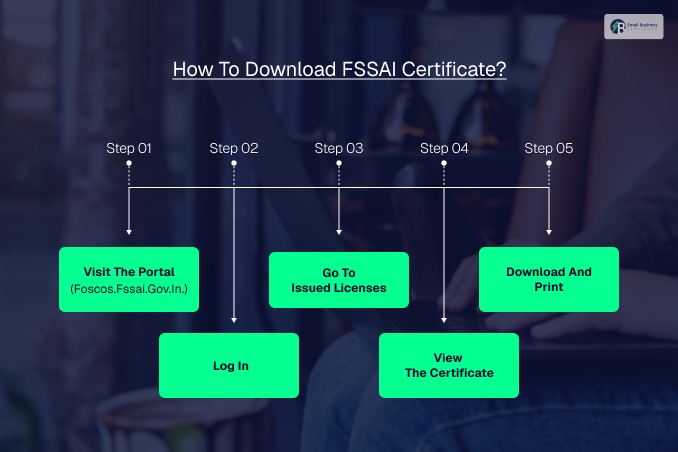
Here is the easy, step-by-step guide to download your FSSAI certificate from the official food safety portal:
- Step 1: Visit the Portal first. You need to go to the official FosCoS website at foscos.fssai.gov.in.
- Step 2: Log In. Then, click the “Login/KHAYAN” button. Enter your unique User ID, Password, and the captcha code shown on the screen.
- Step 3: Go To Issued Licenses. After that, you need to look at the dashboard menu on the left side of your screen. Click on the tab labeled “Issued”, then select “Issued License/Registration”.
- Step 4: View The Certificate. Thirdly, your business details will appear on the screen. Find your specific License Number and click it to open your document.
- Step 5: Download and Print. Lastly, click the download icon to save the official PDF to your device. Be sure to print a physical copy, as Indian law requires food businesses to display this certificate clearly on their premises.
What Documents Do You Need For The FSSAI Basic Registration?
Collect all necessary documents, then access the FOSCOS FSSAI website.
The government alters regulations based on the scale of one’s business. Therefore, the document requirement differs according to one’s license level.
Please refer to the simplified list below of what you should acquire:
For Basic Registration
Only the fundamentals are necessary, such as:
- A photo.
- A valid government-issued ID (e.g., Aadhaar or PAN).
- Proof of your business location.
If you live in a rented house, then you should give the lease documents and the landlord’s quick no-objection certificate (NOC).
Also, you shall be required to provide
- A simple safety management plan.
- A list of the items you will deal with.
- Your bank account details.
State & Central Licenses
You will have to present a duly signed Form B along with the other details such as:
1. Your kitchen layout diagrams
2. Equipment lists
3. Partner/Director information.
More Rules For Big Companies
Those planning to seek a Central License are expected to provide:
- Analysis report for the water (in case water is utilized in production)
- Sourcing details of the raw materials (such as meat or milk)
- Product recall strategy
If you are involved in international trade, the Import Export Code (IEC) will also be necessary.
What Happens When You Submit Your Application?
Submitting your application is just the start, as it is forwarded directly to the FSSAI department.
They insist on giving it a thorough consideration and don’t simply approve it without due diligence.
They will get back to you within 7 days of submission to let you know whether your initial application is accepted or if you are asked to rectify any document errors.
For large facilities, a Food Safety Officer is sent to the site to conduct a physical inspection of the kitchen. They carry out the following:
- Confirmation of clean food preparation areas,
- Avoidance of food tampering and adulteration,
- Matching your premises to the submitted plan.
If you meet these standards, they issue your official FSSAI license.
Keep An Eye On Your Status Live
Once you have submitted your application, you will be assigned a unique 17-digit Application Reference Number (ARN).
Please keep it safe! This is the number that lets you check the status of your application on the website:
- Go to foscos.fssai.gov.in/view-application.
- Enter the 17-digit ARN code you were given in the appropriate field
- Provide the captcha code, then press the submit button.
On your screen, you will see your current status. It is great if it says, “Approved”, “Registration Certificate Issued”, or “FSSAI License Issued”.
This is your confirmation that you have your license and can log in to your dashboard, download a digital version of your license, and print it.
Cloud Kitchens Are Also Included!
Those operating a “cloud kitchen” from their home are wondering if regulations apply to them.
Only two answers: yes and yes! Even if you do not have a brick-and-mortar sales point (where customers sit down and eat), you are still selling food to the public.
Moreover, you will use the same FSSAI platform; the turnover rules will be identical, and the documents to be submitted are similar to those for standard restaurants.
Keeping Things Clean: The Audit Grading System
When safety officers show up at your business for a routine check, they will grade your compliance using four simple letters.
Understanding these marks will help keep your shop running smoothly:
- C (Compliance): You are doing perfectly! Your kitchen is clean, rules are followed, and you can keep running happily.
- PC (Partial Compliance): You are doing some things right, but missing others. You will get a friendly correction notice to fix specific issues.
- NC (Non-Compliance): This is trouble. It means your setup violates major food safety laws, which can lead to severe fines or the loss of your permit entirely.
- NA (Not Applicable / Not Observed): The specific rule did not apply to your business type during their visit.
Real Talk: Penalties And Punishments
Breaking food safety guidelines is a major “Your Money or Your Life” (YMYL) issue because bad food makes people sick.
To keep consumers safe, the government enforces strict penalties:
| Type of Violation | Cash Penalty (Rupees) | Other Consequences |
| Running without a License | Up to ₹5 Lakh | Up to 6 months in jail |
| Substandard Food Quality | Up to ₹5 Lakh | Product warnings |
| Misleading Advertisements | Up to ₹3 Lakh | Forced ad removal |
| Unmatched / Wrong Labels | Up to ₹10 Lakh | Stock seizure |
| Unsafe Food (Causing Injury) | ₹1 Lakh to ₹5 Lakh | 6 months to 6 years in prison |
Don’t Forget Your Expiry Date!
Your new certificate will be valid for 1 to 5 years, depending on what you selected during the application. A good rule of thumb is to apply for your renewal at least 30 days before your current license expires to ensure your business operations are not unexpectedly paused.