
Table Of Contents
- The Relocation Strategy Blueprint
- Moving Tips For A Smooth Transition
- Research The New Location
- Secure Housing Early
- Plan Your Move Meticulously
- Communicate with Your Employer
- Adapt to Your New Work Environment
- Explore Your New Community
- Maintain Connections Back Home
- Why Relocation Opens Doors in Competitive Job Markets
- Access to Specialized Roles and Industries
- Demonstrates Commitment and Flexibility
- Expands Professional Network
- Potential for Career Growth
- Crucial Cost Of Living And Financial Considerations
- Financial Considerations And Support
- Evaluating Cost of Living Differences
- Negotiating Relocation Packages
- Personal Financial Planning
- Overcoming Challenges Associated with Relocation
- Emotional and Social Adaptation
- Logistics and Timing Issues
- Navigating New Workplace Cultures
- Crafting a Relocation Resume and Cover Letter
- Being Flexible with Interviews
- Tailoring Applications for Target Markets
- Optimizing Your Job Application For External Markets
Seizing Opportunity: How Relocation Opens Doors in Competitive Job Markets
Last Updated on: August 25th, 2026
Job hunting in 2026 might make you feel like you are running a marathon!
There are tons of talented people in the job market. And all of them are chasing the few jobs available in the competitive job market.
In this situation, you can just do one thing: to stand out among the rest! All you have to do is pick up the pace. Imagine uprooting your entire life and heading to somewhere new. It sounds really scary, doesn’t it?
And honestly, I feel like it can be a little exhausting too. But? Well, there is always a secret key that can open that can open up the door for new opportunities.
You get access to jobs you wouldn’t even see otherwise, better pay, and new people who can help you move forward.
In this blog, I am going to help you learn about how relocation can open up the doors for new opportunities in this competitive job market.
The Relocation Strategy Blueprint
Before packing a single box, a relocating candidate must navigate three distinct phases to ensure the move builds—rather than breaks—their career trajectory:
- Phase 1
Financial Validation (Days 1–30): Cost of Living Index (COLI) testing, tax tier calculations, and relocation stipend parsing.
- Phase 2
Market Penetration (Days 31–60): ATS geographic modifications, localizing networking hubs, and timezone interview alignment.
- Phase 3
Operational Settlement (Days 61+): Strategic workplace onboarding, establishing immediate municipal support structures, and regional community integration.
Moving Tips For A Smooth Transition
Moving ain’t just about shoving stuff in boxes and hopping on a plane. It’s a mini project that’ll either run smoothly or totally blow up in your face. Here’s some stuff to keep in mind so you end up with the former.
Research The New Location
Before you pack your life into suitcases, get serious about learning what’s waiting for you. What’s the rent like?
Can you get around easily, or will you be stuck paying for Uber forever? How’s the vibe—does it feel like your kind of town, or totally foreign?
That paycheck might be bigger, but that does zero good if you’re barely scraping by on rent and ramen.
And don’t forget—local culture and lifestyle matter. You want to wake up somewhere that feels like home, not just some random spot on the map.
Secure Housing Early
Once you finger the place you wanna go, start hunting for a place to live, like now. Nothing’s worse than showing up with nowhere to sleep or stuck in some dump just because you put this off.
Look for neighborhoods near your new job, check prices, and peek at nearby must-haves—grocery stores, hospitals, schools if you’ve got the crew with you.
Locking this down early cuts out a ton of stress and makes the whole move way smoother.
Plan Your Move Meticulously
If you try to wing a move, trust me, you’ll hate yourself later. Write down a timeline, like “Day 1 pack books, Day 3 call movers,” whatever floats your boat—but have a plan.
Don’t be that person digging through boxes looking for your phone charger on Day 1. Hiring reliable moving companies, especially for long distances or international moves, is your sanity’s friend.
And if you can, avoid summer—it’s the moving mad season, which means jammed-up prices and headaches galore.
Communicate with Your Employer
After you’ve made the call to relocate, tell your boss ASAP. Some companies have relocation help locked and loaded—moving costs, temporary housing, travel.
And if they don’t bring it up, just ask—they might surprise you. Plus, being upfront smooths out your onboarding and gets everyone on the same page.
Adapt to Your New Work Environment
The first weeks at a new job? They’re a rollercoaster, no lie. Take some time to actually get to know your coworkers (yes, actually talk, don’t just lurk), figure out how the company ticks, and really get comfy with your role.
Ask questions, be open to feedback, and show you want in. It makes things way easier in the long run.
Explore Your New Community
Yeah, you moved for work, but don’t just live in your cubicle and your apartment. Get out there.
Hit up local events, clubs, cultural gigs—whatever helps you connect with people and feel at home.
Other than that, you also have several other options, such as:
- Joining a sports team,
- Trying a new class
- Sampling some neighbourhood diners.
All of these can add up to you settling in and feeling like this place isn’t just a stop on your career path, but a real home.
Maintain Connections Back Home
Moving away from friends and family hits hard sometimes. Trust me! It is 100% normal. You just have to keep in touch via phone calls, texts, and even social media.
This can help you a lot to feel less alone when you have your people and your home to cheer you! It can automatically make you feel less lonely.
Why Relocation Opens Doors in Competitive Job Markets
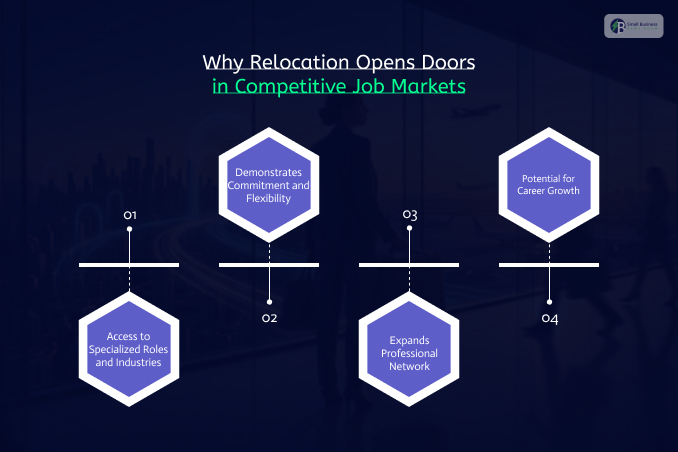
So, why does moving pack such a punch in a tough competitive job market? Here’s the skinny.
Access to Specialized Roles and Industries
Certain jobs live in certain cities—like tech in Silicon Valley or finance in New York. Want in on those? You gotta get close.
Being right where your dream industry hangs out means you see more openings and get pulled into the network.
Demonstrates Commitment and Flexibility
Moving says so much about you: you’re serious, adaptable, and ready to hustle. Employers notice that, and it separates you from the “I’m happy here” crowd. It’s basically a little flag waving, saying, “I’m all in.”
Expands Professional Network
New city = new people. New people = new connections. From casual coffee with coworkers to industry meetups, building your network is what lands you unexpected gigs, collabs, and referrals. The bigger and stronger your web, the more doors open.
Potential for Career Growth
Location matters. Being where your company’s HQ or key offices are means promotions, projects, and leadership chances come quicker.
Plus, experiencing a new competitive job market or culture sharpens your skills like nothing else, along with your career progression.
Crucial Cost Of Living And Financial Considerations
Because employment transitions directly impact your financial security, executing an analytical, data-driven budget assessment before accepting an offer is a critical safety requirement.
A higher nominal salary can easily be neutralized by an aggressive local tax structure or inflated housing costs.
| Metric / Expense Category | Key Factors to Research | Data Source / Tool to Use | Target Financial Safety Margin |
| Purchasing Power Parity | Local state income taxes, municipal sales taxes, basic commodity price indexes. | CNN Money or Bankrate Cost of Living Calculators | Ensure net disposable income increases by at least 15% after the move. |
| Housing Cost Ratio | Median monthly rent prices, commuter transit fees, average utility costs per square foot. | Zillow Research / HUD Fair Market Rents | Total housing expenses should never exceed 30% of your new gross monthly income. |
| Emergency Relocation Fund | Move-in security deposits, short-term lease premiums, immediate transit logistics. | Self-Calculated Cash Reserves | Maintain 3 to 6 months of projected local living expenses in liquid cash. |
Financial Considerations And Support

Okay, moving isn’t cheap. You gotta think about the dollars and cents before you dive in.
Evaluating Cost of Living Differences
That shiny new salary might get eaten up by sky-high rents, transport, and groceries. Breakdown your monthly budget—housing, utilities, food—don’t let sticker shock catch you after the fact.
Negotiating Relocation Packages
Many companies offer perks—from paying for movers, temp housing, travel costs, to helping unload your old place. Don’t be shy about bringing it up. Think of it as part of the job offer negotiation.
Critical Financial Risk Warnings:
The Clawback Clause: Always review the fine print for “Repayment Provisions.” Most enterprise employers mandate that you repay 100% of your relocation allocation if you voluntarily leave the firm within 12 months of your hire date.
The Tax Gross-Up Requirement: The IRS taxes relocation bonuses heavily as ordinary income.
Ensure your negotiation includes a “Tax Gross-Up” so the company covers the tax liability and preserves your actual moving liquidity.
Personal Financial Planning
No company help? Start stashing cash early. Movers, hotels, plane tickets don’t pay for themselves. Tighten your belt a bit beforehand so money stress is manageable.
Overcoming Challenges Associated with Relocation

Moving can be rough. Here’s how to dodge (or survive) the biggest headaches.
Emotional and Social Adaptation
Firstly, homesickness is real and hits hard. Keep talking to your people back home, but also throw yourself into your new town’s social scene. The quicker you find your tribe, the easier it gets.
Logistics and Timing Issues
Secondly, moving’s a juggling act—housing, movers, travel, job start dates. Get your timing tight so you’re not stuck with dead time or double headaches.
Navigating New Workplace Cultures
Thgridly, every office has its own rhythm. Spend time figuring out how yours works and where you fit. Show up, join team lunches, be that friendly face. It speeds up settling in big time.
How to Highlight Relocation Willingness in Your Job Search
If you want the move to help snag a job, make it loud and clear.
Crafting a Relocation Resume and Cover Letter
Don’t just hint that you’re open to moving. Use your cover letter and resume to shout, “I’m ready, willing, and looking to relocate!”
Being Flexible with Interviews
Sure, virtual chats are normal now, but if they want to meet in person, be game. It shows you’re serious—and ready to make it happen.
Tailoring Applications for Target Markets
Make your resume and cover letter fit the city/industry you’re going for. Highlight skills and experiences that local employers crave.
Optimizing Your Job Application For External Markets
Apply these precise formatting protocols directly to your resume header.
This can help you to prevent Applicant Tracking Systems (ATS) from instantly disqualifying your file due to an out-of-market zip code:
- Standard Format: [Your Name] | [Phone] | [Email] | “Relocating to [Target City] in [Month/Year]”
- Self-Funded Format: [Your Name] | [Phone] | [Email] | “Target Market: [Target City, State] (No Relocation Assistance Required)”
In your cover letter, explicitly state your physical arrival deadline in the first paragraph to signal absolute operational readiness to the hiring manager.
- Interview Availability: Signal total flexibility for initial remote panel assessments, ensuring your schedule perfectly aligns with the target market’s local timezone.
Offer defined windows of physical availability for final-stage on-site evaluations.
Disclaimer: This actionable framework is provided exclusively for educational and general informational purposes.
Geographic economic indicators, municipal tax treatments, and corporate labor compliance laws vary wildly across jurisdictions and macro environments.
For direct, personalized legal, tax, or career-investment planning, please consult a Certified Financial Planner (CFP) or a licensed tax professional. AI responses may contain errors.
Read More: