


Table Of Contents
Understanding The Principles Of Art: A Comprehensive Guide For Artists And Enthusiasts
Art is just like the world around us. It needs both balance and variety to look just right! So, whether you are painting a simple sunset or just doodling in class, you are using a special set of rules called the 7 principles of art.
These principles are not meant to limit your creativity. Instead, you can use it like a toolkit! Something that can help you to give your work more depth and charm.
They can help you to decide where to put colors, how to show certain movement, and how to make your art feel complete.
You might already be using these specific rules without even knowing it! As you continue to learn about each one of them, take a look at your own drawings or that favorite picture of yours.
You will start to see the invisible rules everywhere! Once you understand them, you can easily use them to make your art even better. So, are you ready to see how your creations come to life?
Read this blog, as we continue to learn about the principles of art in detail to enhance the quality and effectiveness of your artwork!
How Do The Principles Of Art And Elements Work Together?
To understand the principles of art, first you need to know how exactly they work with different elements of art.
Just think of the elements such as color, lines, and shapes. Consider these elements as your raw ingredients. These are the things that you can actually touch or see in a piece of work.
If you were building a house, the elements would be your bricks, wood, and glass.
The principles, on the other hand, are balance, rhythm, and harmony. These are the basic rules for using those ingredients.
These mostly act like the blueprint. It shows you where to lay your bricks so the house doesn’t fall.
For example, a single splash of blue paint is like an element. However, the decision of where to place that blue so it can balance a yellow circle on the other side is based on a principle!
As you continue to create art, you will start to notice an “intricate dance” between the two. You can use elements to build your work, and further, you can use the principles to organize them into something beautiful.
Every artist uses these specific tools in different ways! And this is how you can develop your unique style.
Now, let’s start your journey through the 7 principles of art!
What Are The Principles Of Art?
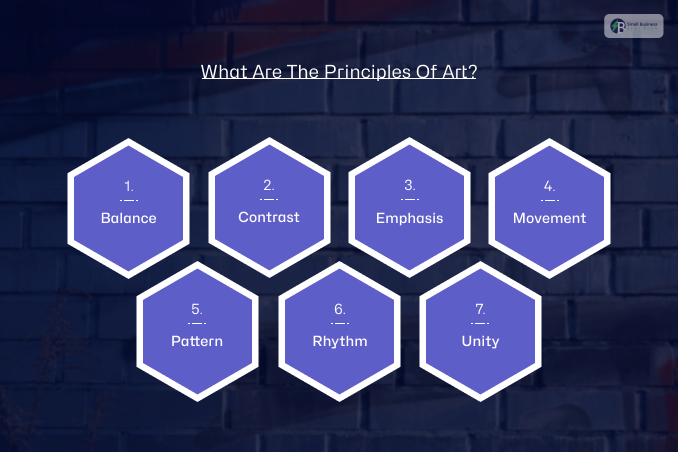
The principles of art are a guide to help you make your work look great! You can also call them the principles of design. You can think of them like a map that shows you how to organise your lines, colors, and shapes.
It doesn’t matter what kind of art you like to make. You could be a painter, a photographer, or someone who loves making sculptures!
When you understand and use these principles, your art becomes much stronger and more interesting to look at!
They can help you to turn a simple drawing into something that really grabs people’s attention. By learning these rules, you can make more creative ideas come to life in the best way possible!
Here are the top 7 principles of art!
1. Balance
In visual design, balance is the way you distribute visual elements in a composition to achieve a sense of stability or equilibrium. You arrange objects, colors, and textures so that no single one overpowers the rest.
This way, you can ensure your design feels comfortable and looks right to the viewer.
You have three main ways to create this sense of equilibrium:
- Symmetrical balance: Think of a mirror image or a classic architectural facade. You can distribute elements evenly on both sides of the central axis.
This method is the easiest to achieve and further creates a formal, orderly, and stable feeling in your work!
- Asymmetrical Balance: This approach is more dynamic and modern. You can use these elements that are not identical on both sides. However, you can still achieve harmony by balancing the visual weight.
For example, a large, heavy element on one side can be balanced by several smaller, lighter elements or ample negative space on the other.
- Radial Balance: Imagine the spokes of a wheel, the petals of a flower, or a circular stained-glass window. Here, the elements radiate outwards from a central point, drawing the eye to the center while creating a sense of movement.
2. Contrast
To use contrast, you can place different elements side-by-side to grab more attention and make your work more interesting.
You can achieve this by mixing the opposites, such as light and dark colours, rough and smooth textures, and large and small shapes.
Once you learn how to use contrast effectively, you can create the focal points that can guide the viewer’s eye to the most important parts of the design.
It can highlight the key details and prevent your artwork from looking flat or boring. By emphasizing these differences, you add depth and dimension. This can help to make your composition feel more dynamic and professional.
Whether you are choosing bold colors or varying your shapes, contrast is your best tool for making your message stand out!
3. Emphasis
To create emphasis, you have to build a focal point that instantly grabs your viewer’s attention.
You can do this by making one part of your design stand out using the bright colours, a larger size, or a unique shape. Place an important object right in the center or use high contrast to make it pop.
By using the emphasis, you guide the viewer’s eye exactly where you want it to go. This can help you to communicate your main idea clearly. Moreover, this can ensure your most important message does not get lost in the rest of your artwork.
4. Movement
Now, how to create movement? Well, you have to give your artwork the feeling of action or motion. You can do this by using curved or diagonal lines that lead the eye across the page.
Repeat shapes and patterns, or arrange your elements to create a smooth, natural flow.
By using the movement, you can add energy and excitement to your design. It keeps your audience engaged because their eyes stay active, moving from one part of your work to another.
Instead of a still image, your composition feels alive and dynamic, which makes your message much more interesting to look at!
5. Pattern
To create a pattern, you repeat specific elements such as lines, shapes, colors, and textures throughout your work! You can think of it like the heartbeat of your design.
By repeating the same motif, you can build a sense of rhythm and harmony.
When you use these patterns, your artwork feels more organized and professional. It ties different parts of your composition together. This creates a sense of unity.
Whether you are designing a very simple background or a complex piece, the patterns help your work feel cohesive and easy for the viewer to follow!
6. Rhythm
You have to repeat or alternate different elements to give your work a sense of visual flow. You can achieve this by using a sequence of similar shapes, colors, or lines.
Just like a beat in music, rhythm in your design creates a feeling of harmony and organization.
When you use rhythm, you can guide your viewer’s eye smoothly across your composition. It creates a sense of continuity while making different parts of your artwork feel connected.
The repetitive elements can be placed in a thoughtful way. This can create interest and energy in your design.
This technique can ensure your work feels alive and moving, keeping the viewer engaged as they follow the visual path you have created.
7. Unity
To achieve unity, you build a harmonious relationship between all the elements in your artwork.
It is about organizing and arranging everything so that the entire composition feels like one complete idea. You want all the parts to work together seamlessly, not compete for attention.
When you use unity effectively, you make sure your design feels whole and balanced. Every line, shape, and color supports your main message.
This ensures your intended idea is clearly and strongly communicated to the viewer. Your artwork feels finished and coherent because all elements are focused on the same goal.
Additional Resource: Why More Australians Are Turning to Regional Art Events to Grow Their Investment Portfolios


