Table Of Contents
- What Is Human Resource Management?
- A Quick Trip Down Memory Lane: How HR Evolved
- What Is Human Resource Management: The 5 Core Functions Of Modern HR
- 1. Planning
- 2. Organizing
- 3. Staffing
- 4. Directing
- 5. Controlling
- Why HR Matters: More Than Just "Hiring and Firing"
- The Role Of Ethical Leadership In HR
- Talent Management And Employee Enrichment
- · Continuous Learning
- · Job Enrichment
- Guarding The Workplace: Compliance, Rights, And Well-being
- · Fair Compensation
- · Workplace Safety
- · Equal Opportunity
- · Anti-Harassment Policies
- The Future Of HR: Data, Analytics, And AI
- Wrapping It Up
Why Your Business Will Fail Without It: What Is Human Resource Management And How It Secretly Drives Profit
Every successful company has a secret ingredient that nobody can see, hear, or touch.
It is not their amazing software programs or lovely offices that make them famous worldwide.
It is the people behind the screens, the problem solvers, the daily idea generators who put the company on the right track.
Nonetheless, managing such a powerful team is not easy, especially because every person is unique in their own way.
This is where human resource management comes in handy.
In this article, you will find an overview of what is human resource management, from its definition and history to the most important functions.
We will also analyze this discipline’s role in a company and why it has such a significant impact on people’s everyday lives.
What Is Human Resource Management?

Every company has an ultimate aim, and human resource management (HRM) practices help it reach that goal.
In other words, HRM is a set of activities that support staff in all work-related matters.
These activities begin with job postings and end with retirement benefits.
By definition, human resource management is a management category that helps the workforce perform to the level of an organization’s expectations.
If you want to better understand the term, try dissecting it into three subterms:
- Human stands for the qualified workforce, or simply, people.
- Resource implies that experts are a skillful asset that is not available in abundance.
- Management means optimizing and getting the best from available resources.
Managers know that to improve productivity, one should first deal with people since they control all other factors. This includes: money, machinery, methods, and materials.
In business management, there is a saying that every company has five Ms: Men, Money, Machines, Materials, and Methods. In human resource management, everything boils down to the first M.
A Quick Trip Down Memory Lane: How HR Evolved
It is interesting to note that the concept of people management has dramatically changed over time.
The discipline used to be called personnel management, and its main purpose was to exploit each employee to the fullest extent possible in exchange for salary.
In other words, people were once regarded as a tool, not an asset.
Today, the saying “happy workers perform better” is common, but that wasn’t the case a century ago.
One of the earliest pioneers of progressive people management was Robert Owen, who implemented the 8-hour workday, 8-hour rest, and 8-hour sleep in his factories.
As a result, his workers were more productive and healthier.
In the 1920s, Elton Mayo revealed the importance of work-life balance through experiments and became the father of modern human resource management.
In general, it helps to remember that contemporary human resource management developed from personnel management practices.
There are at least five reasons why modern companies are shifting from an old paradigm to a new one:
- Globalization and rapid technological progress are pushing businesses to re-examine their practices.
- Companies realize that people are their most valuable asset.
- Organizations are eager to change their traditional approaches to work.
- Fierce competition challenges every business to innovate.
- Companies understand that employees are the key to gaining competitive advantage.
You May Also Love To Read: How Many Hours Is Part Time Really? The Sneaky 29-Hour Capping Trick Employers Use To Dodge Your Benefits!
What Is Human Resource Management: The 5 Core Functions Of Modern HR
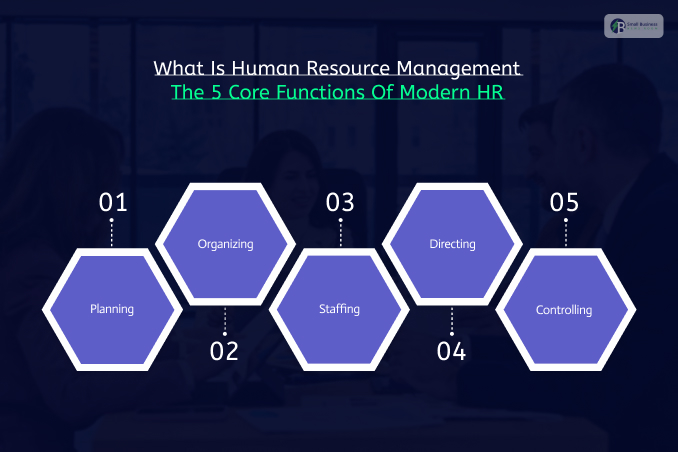
A human resource manager plays a critical role in any organization. Their main purpose is to maintain an excellent work environment and ensure everything runs smoothly.
In general, HR managers perform five main functions.
1. Planning
This function is the starting point of any human resource activity. An HR manager analyses the organization’s anticipated needs to determine how to fill vacant positions.
The manager also reviews the company’s policies to ensure no employee is treated unfairly.
In addition, the planner must identify whether some operations can be subcontracted to other organizations to make the process more cost-efficient.
Another objective of planning is to establish a strategic framework that helps HR managers understand the bigger picture.
2. Organizing
This function involves coordinating resources with minimal conflict and confusion.
To do that, an HR manager has to set up job posts, organize communication channels, delegate authority, and match positions with people’s skills.
Organizing is a vital function because it helps implement the action plan effectively.
3. Staffing
This function involves recruiting, selecting, and placing candidates in vacant positions.
Moreover, staffing includes developing job descriptions, conducting interviews and tests, and organizing training courses and orientations for new hires.
4. Directing
Directing generally relates to leading and motivating employees. This function aims to ensure communication channels between staff and managers are open.
Another objective of directing is to develop reward systems and incentives to keep workers motivated.
5. Controlling
Controlling activities help measure each employee’s performance and compare it with previously set standards.
If there is a breach, the manager must take disciplinary action to bring performance back to the required level.
In addition, controlling involves helping employees know what to do in specific cases.
Why HR Matters: More Than Just “Hiring and Firing”
Many people assume that HR only steps in when it is time to hire someone or hand out a pink slip.
However, that assumption misses the true value HR brings to the table.
In reality, strategic human resource management is a vital business function that directly impacts a company’s bottom line.
| Traditional View of HR | Modern Strategic HR |
| Focuses purely on paperwork and payroll | Partners in long-term company growth and planning |
| Acts as a rigid enforcer of rules | Focuses heavily on building a positive company culture |
| Handles tasks manually and slowly | Uses data, analytics, and software to spot trends |
| Treats employees as expenses to minimize | Treats employees as crucial capital to grow |
When HR managers have a seat at the executive planning table, they align the workforce with corporate objectives.
They use frameworks like SWOT analysis (Strengths, Weaknesses, Opportunities, Threats) to look at the business through the lens of its people.
If a company wants to launch a new product line, HR identifies missing skills and builds a plan to acquire them.
The Role Of Ethical Leadership In HR
When managing employees, ethical leadership plays a vital role because staff members look to their superiors for guidance.
That is why ethical leadership is critical to gaining employee trust and encouraging transparency and respect.
In other words, ethical leadership fosters positive, honest relationships among staff members, managers, and the company as a whole.
This management approach also ensures that all workers are treated equally and that no discrimination takes place.
Moreover, ethical leadership maintains a safe, secure workplace free from bullying, abuse, and violence.
In general, ethical leadership is essential for several reasons:
- It helps the company maintain a positive image and reduce legal risks.
- It increases employee retention and improves the company’s reputation.
- It helps prevent social issues such as bullying and discrimination.
- It ensures the well-being of every employee.
With that in mind, ethical leadership is not only about the company’s welfare but also about employees.
Talent Management And Employee Enrichment

A key aspect of human resource management is talent management, which involves attracting and retaining skilled experts.
In addition, HR managers offer enrichment opportunities, such as training courses and mentorship programs. Let us take a closer look at each concept.
· Continuous Learning
Talented workers expect their employers to invest in their continuous learning and development.
Without the necessary support, they will look for employers who are more reliable and trustworthy.
Thus, to retain skilled professionals, a company must provide additional training, webinars, and workshops that allow them to update their knowledge and gain new expertise.
As a result, the employees will become more productive and confident in their capabilities.
· Job Enrichment
Job enrichment means motivating staff members by giving them more responsibility and control over their work processes.
This concept generally refers to creating more meaningful and rewarding jobs for employees.
In practice, job enrichment is achieved by removing stressful, demotivating duties and giving workers more freedom and flexibility.
Guarding The Workplace: Compliance, Rights, And Well-being
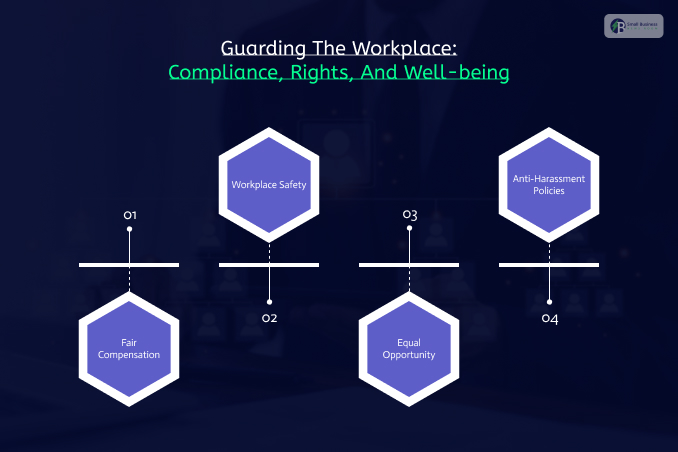
A crucial part of human resource management is ensuring compliance with all labor-related laws and regulations.
HR managers carry out this function and are responsible for workers’ safety and well-being.
In general, they handle a wide range of activities, from analyzing the organization’s compensation policies to ensuring a safe, secure workplace environment.
Below are some of the most important factors that HR managers consider.
· Fair Compensation
Employees should receive fair pay and benefits in line with local labor laws. In this case, HR managers’ role is to ensure that no worker is underpaid or exploited.
· Workplace Safety
Physical and emotional safety has to be prioritized by the company.
For example, the organization should employ safety officers and post danger signs to help the staff operate machinery and workstations safely.
· Equal Opportunity
This concept means every employee has an equal opportunity to grow within the company, regardless of religion, gender, age, race, or other factors.
To achieve this goal, the company has to develop comprehensive equal opportunity policies.
· Anti-Harassment Policies
These policies aim to ensure that all employees are treated with dignity and respect.
In addition, they create a safe environment where one can report any form of harassment, discrimination, or sexual violence.
Internal Complaints Committees generally enforce the anti-harassment policies.
By considering these factors, HR managers help ensure the company avoids legal action and that employees feel safe and comfortable.
The Future Of HR: Data, Analytics, And AI
Like every other industry, human resources is going through a massive digital transformation.
The modern workspace relies heavily on Human Resource Information Systems (HRIS) and sophisticated data analytics.
Today’s HR analysts use real data to solve burning organizational problems.
By tracking metrics like cost-per-hire, time-to-fill, and monthly absenteeism rates, they can spot negative trends before they damage the business.
For example, if data shows employee turnover peaks around the two-year mark, HR can proactively review career development and retention strategies for that group.
Meanwhile, artificial intelligence is stepping in to handle repetitive tasks like screening initial resumes or scheduling interviews.
However, as technology handles the administrative heavy lifting, the human element becomes more critical than ever.
AI lacks the judgment, empathy, and creative problem-solving skills of a real human being.
The future of HR belongs to those who can master digital tools while maintaining a deeply human touch.
Wrapping It Up
At the end of the day, a company’s greatest strength is its people. Understanding what is human resource management shows us that businesses cannot thrive on great ideas alone.
They need systems that protect, nurture, and inspire the humans behind those ideas. By blending strategic planning, compliance, continuous learning, and ethical leadership, modern HR departments ensure that both the business and its employees can grow together successfully.