
Table Of Contents
- Modernize Your Business Banking Infrastructure
- Automate Routine Financial Processes
- · Cloud Accounting Software
- · Automated Invoicing
- · Expense Management Systems
- ● Payroll Integration
- Build Financial Reserves To Fuel Strategic Growth
- Foster A Culture Of Financial Responsibility
- Mastering The Basics: Your Simple Guide To Business Financial Management
- A. All-in-One Accounting Hubs
- B. Smart Banking & Global Wallets
- C. Expense & Automation Wizards
Practical Strategies For Optimising Your Company Financial Operations
Last Updated on: August 21st, 2026
This guide is based on practical financial workflows used by small and mid-sized businesses to improve cash flow visibility, reduce operational inefficiencies, and strengthen long-term financial stability. Insights are aligned with widely accepted accounting and financial management best practices.
Running a business is a wild ride. However, you really need to stay on top of business financial management to keep the engine humming.
Your finances are the heartbeat of your company. If the pulse gets weak, everything else starts to struggle.
According to the Australian Securities and Investments Commission (ASIC), cash flow issues consistently rank as the leading cause of business insolvency—making financial visibility and liquidity management critical priorities.
It is the number one reason ventures fail. This is why having a solid plan for your money is so important.
Well, you can start by making your daily operations as smooth as possible.
When you cut out the “money friction,” you stop wasting cash and start building a safety net.
Plus, it frees up funds you can actually use to grow. Thus, you have to keep things simple and organized. You are not just surviving the week!
You are setting yourself up for long-term success. So, you must keep it steady, and your business will thrive!
Modernize Your Business Banking Infrastructure
First, make sure you’re using the right institutional tools. This is the very first step in optimizing your financial operations.
If you keep relying on outdated banking systems or a fragmented mix of personal and business accounts, it can obscure your true financial position and hinder effective business financial management.
Instead, you can upgrade to a modern, digital-first banking setup. This lets you track business expenses in real time.
For example, many growing businesses now integrate platforms like Airwallex or Wise with accounting systems to gain real-time visibility across currencies, expenses, and vendor payments.
Moreover, you can manage staff payroll seamlessly and maintain a clear view of your working capital.
Business leaders should regularly review their banking arrangements. This can ensure they are getting
- The best overall value,
- Lower transaction fees,
- Robust digital integration capabilities.
If you are looking to compare institutional digital banking solutions or dedicated business accounts tailored for growing enterprises, you can explore modern options that align with your daily operational needs.
A streamlined banking relationship acts as the central hub for all your financial activities, making cash management and forecasting significantly easier.
Before switching providers, businesses should assess regulatory compliance, transaction security, and fee structures to avoid hidden costs or operational disruptions.
Automate Routine Financial Processes
Manual data entry and paper-based tracking are not only time-consuming but also highly susceptible to costly human error.
By leveraging modern financial technology, companies can eliminate these common operational bottlenecks.
Studies show that automation can reduce finance processing time by up to 30–50%, while significantly lowering human error rates in reconciliation and reporting.
Automation in business financial management ensures that your financial data is highly accurate.
It stays up to date and readily accessible when you need it to make critical strategic decisions.
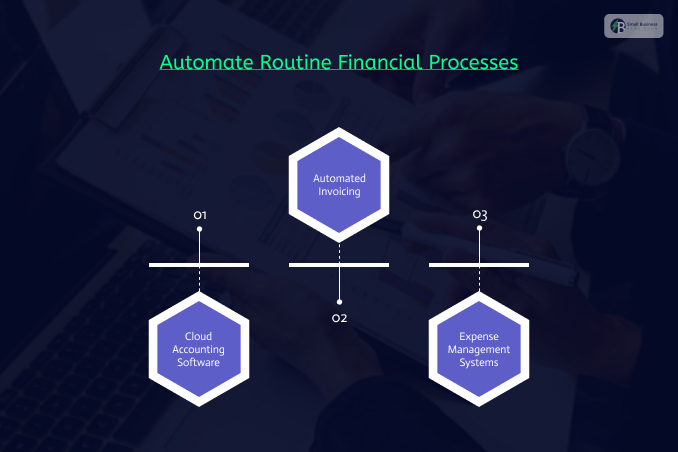
Consider implementing the following automated solutions to immediately improve your daily workflow:
· Cloud Accounting Software
Platforms like Xero, QuickBooks, and MYOB are widely used due to their compliance features and scalability.
Synchronize your bank feeds directly with modern accounting platforms to reconcile transactions daily rather than waiting for the end of the month.
· Automated Invoicing
Set up recurring digital invoices and automated multi-stage payment reminders.
This directly reduces your Days Sales Outstanding (DSO), shortens your cash conversion cycle, and protects your Operating Cash Flow (OCF).
· Expense Management Systems
Issue corporate spend cards with pre-set encumbrance limits. Require staff to upload receipts via OCR mobile scanning instantly.
This establishes a clear audit trail and eliminates end-of-month manual reconciliation drag.
● Payroll Integration
Connect your digital timesheet software directly to your payroll system to ensure your staff is paid accurately, and all compliance obligations are met effortlessly.
Build Financial Reserves To Fuel Strategic Growth
You will notice something great once you have got your cash flowing and your daily tasks on autopilot.
Here, you can finally have extra money to play with!
A commonly recommended benchmark is maintaining at least 3–6 months of operating expenses as a reserve to safeguard against unexpected disruptions.
Good business finance is not about keeping the lights on! It’s about building a solid launchpad for your next big move.
When your money moves are steady and predictable, you can stop stressing over the daily fire. This way, you can start thinking like a true leader.
Instead of losing sleep over making payroll, you can focus on the big picture.
This stability gives you confidence. In this way, you can team up with new partners or explore different cities without breaking the bank.
Plus, when other companies see that you have got your act together, they will be lining up to work with you. A solid financial foundation makes you the partner everyone wants.
So, keep it simple, stay organized, and watch your business reach heights you never thought possible!
By proving your operational efficiency, you also become a much more attractive partner to other established businesses.
This approach aligns with fundamental principles of Financial Management, where liquidity planning supports both risk mitigation and growth readiness.
Foster A Culture Of Financial Responsibility
Improving your money is all about having the latest applications or a fancy bank account.
It is about changing the way your whole team thinks. This concept is often referred to as “financial literacy across functions,” where non-finance teams understand cost structures, margins, and budgeting impacts.
Businesses that implement regular financial reviews and KPI tracking often see improved cost control and stronger decision-making consistency.
They can make much smarter choices that help the entire company grow.
Especially when every manager understands their budget.
You can also teach your leaders how to read very simple financial reports. This gives them the power to save money and spend wisely.
Plus, having quick check-in meetings keeps everyone on the same page.
In the end, you can focus on business financial management! It is one of the best things you can do as a boss.
Moreover, you can also build a super-strong foundation! You just need to use modern banking to replace the boring, repetitive tasks.
Furthermore, this keeps your business safe from surprises. It lets you jump on new opportunities the moment they pop up!
So, take a look at your processes today! Your future self will thank you!
Mastering The Basics: Your Simple Guide To Business Financial Management

Choosing the right tools for modern digital banking is like picking the best gear for a road trip.
You just want things that make the journey smoother, not harder.
Effective business financial management relies on platforms that communicate with one another and handle the boring stuff automatically.
Here are the top-recommended tools for businesses in Australia to keep their finances in top shape:
A. All-in-One Accounting Hubs
Xero: The fan favorite in Australia. It’s famous for being super easy to use, especially for things like GST and BAS reporting.
QuickBooks Online: Great if you love data and detailed reports. It’s very scalable, making it a solid pick if you plan to grow fast.
MYOB: A local legend with powerful payroll features and a long history of helping Aussie businesses stay compliant.
B. Smart Banking & Global Wallets
Airwallex: Perfect for startups that deal with different currencies. It lets you issue virtual cards and manage global spending without the usual heavy fees.
Wise Business: Best for cross-border payments with transparent exchange rates and multi-currency accounts.
Up Bank: A mobile-first favorite for its killer budgeting tools and real-time transaction tracking.
C. Expense & Automation Wizards
Expensify: Makes receipt scanning a breeze. It automatically extracts data from photos so you can ditch the shoebox of paper receipts.
Thriday: A powerful Australian automated financial management platform that seamlessly integrates transaction banking (via its partnership with Regional Australia Bank), automated bookkeeping, and real-time tax forecasting into a single dashboard.
Disclaimer: The information provided in this article is for educational and informational purposes only and does not constitute formal financial, tax, or legal advice. Business structures and regulatory requirements vary. Always consult with a licensed Chartered Accountant (CA) or financial advisor registered with the Tax Practitioners Board (TPB) before making major operational changes.