Table Of Contents
- Top 7 Best In-Home Care Services For Seniors
- 1. 2nd Family – Tech-Forward Care That Feels Like Home
- 2. Always Family – Growing a “Family-First” Model Nationwide
- 3. Home Instead – Trusted Franchise Network
- 4. Right At Home – Specialty Dementia Programs
- 5. Honor Home Care – AI-Powered Caregiver Matching
- 6. Visiting Angels – Veterans & Respite Focus
- 7. Papa Pals – Companion-Only Micro-Visits
- Revenue Architecture: Deciphering The Unit Economics
- · W-2 Employment Models
- · 1099 Registry Marketplaces
- How To Use The New Home-Health Rankings?
- The 5-Minute Family Vetting Checklist
- Caveats: When Facility Care May Be Safer
The 7 Best In-Home Care Services For Seniors In 2026 (Ranked By Real Families)
Last Updated on: September 25th, 2026
Medical Disclaimer: The information on this page is for educational purposes only. Non-medical home care agencies provide assistance with daily living and cannot perform clinical medical procedures. Always consult a physician for medical advice.
The pandemic accelerated what many families already suspected: most older adults would rather age where they feel safest and happiest, at home.
Analysts now predict that as much as $265 billion in Medicare spending could migrate from hospitals and nursing facilities to the living room over the next few years.
At the same time, a national Care Scout survey of 1,200 caregivers found that real-time communication tops every other decision factor when choosing an agency.
Whether you are looking for companionship a few hours a week or round-the-clock dementia support, the marketplace has never offered more, and sometimes confusing, options.
We are here to help you cut through the noise. Here’s a breakdown of the best in-home care services for seniors, so you can feel confident choosing the right fit for your family.
Important Legal Distinction: This focuses exclusively on non-medical home care agencies that assist with Activities of Daily Living (ADLs) like bathing and meal prep.
If your loved one requires clinical medical monitoring, wound care, or physical therapy, consult the federal CMS Care Compare Portal to find a certified home health agency.
| The Entrepreneurial Opportunity: For small business owners and startup founders, the senior care ecosystem is one of the decade’s most resilient sectors. Driven by demographic shifts, this market is no longer just about basic caregiving. It is an arena for tech integration, decentralized workforce management, and highly scalable recurring revenue models. Below, we break down the operational strategies of the top 7 industry leaders defining the modern marketplace. |
Top 7 Best In-Home Care Services For Seniors
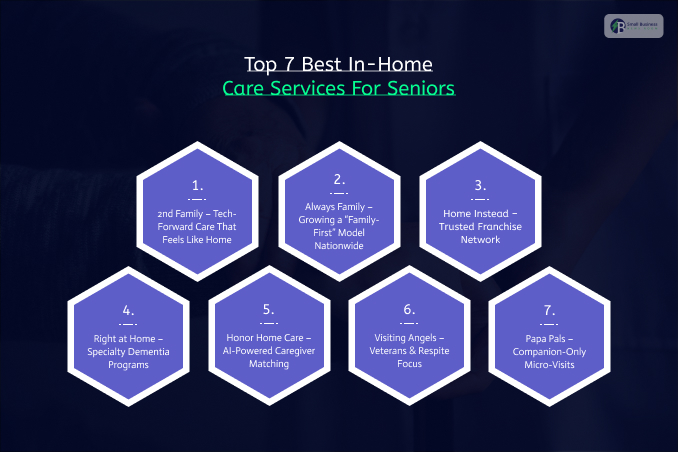
To simplify your search, we compared the best in-home care services for seniors on four public criteria that any family can verify:
- Caregiver Training: Baseline background vetting, continuing education metrics, and credentials.
- Specialized Expertise: Dedicated memory care curricula for Alzheimer’s, Parkinson’s, and advanced chronic conditions.
- Family Technology: Secure dashboards that provide long-distance relatives with GPS verification and real-time health updates.
- Pricing Transparency: Clear cost breakdowns, direct W-2 employment models, and minimal hidden surcharges.
- Independent Validation: Cross-referenced with performance metrics aligned with the federal Centers for Medicare & Medicaid Services (CMS) and consumer feedback frameworks.
Below are the seven agencies that impressed the most for 2026.
1. 2nd Family – Tech-Forward Care That Feels Like Home
2nd Family Pairs is one of the best in-home care services for seniors, offering old-fashioned bedside manner with the kind of visibility families want.
This is something that today’s long-distance children crave.
The family-owned company serves Maryland and Pennsylvania and gives every client access to its proprietary Family Room portal.
Loved ones can see schedules, care notes, and even caregiver GPS check-ins.
That digital openness maps directly to what families say they value most—constant updates.
- Alzheimer’s & dementia programs are nurse-supervised.
- Family Room dashboard for real-time visit logs and medication reminders
- Caregivers undergo company-provided training; many hold CNA or similar credentials.
- Quotes provided upon request, but the average hourly rate is around $28–$34
If your top priority is knowing what’s happening in Mom’s living room while you’re across the country, 2nd Family delivers peace of mind in a single login.
2. Always Family – Growing a “Family-First” Model Nationwide
Always Family shares the same heart-led philosophy. However, they make no mistake.
This is a separate company expanding quickly across the Midwest and South.
Its care plans begin with an in-home assessment. This blends clinical checkpoints with personal interests.
They also aim to match seniors with caregivers who feel more like friends than aides.
- Flexible packages: two-hour check-ins to 24-hour live-in shifts
- 24/7 client support line answered by a real coordinator
- Companion-plus-personal-care bundles keep pricing straightforward
- Typical cost: $26–$32 per hour
Also, families who want warmth, continuity, and the option to scale services up or down without penalty find Always Family a refreshing fit.
3. Home Instead – Trusted Franchise Network
Home Instead is another one of the best in-home care services for seniors. It has also become a household name since the 1990s.
They operate more than 1,200 franchises worldwide.
Across all locations, they follow the company’s CARES® Alzheimer’s curriculum.
They can review goals, shift notes, and upcoming appointments on the go.
- 75-hour baseline caregiver training, plus disease-specific modules
- Specialized dementia and Parkinson’s programs
- App-based care plans and visit summaries
- Average hourly rate: $25–$30
With broad geographic coverage, Home Instead is a solid choice for families who might relocate a parent and don’t want to start the vetting process from scratch.
4. Right At Home – Specialty Dementia Programs
With 700-plus territories, Right at Home is one of the largest home-care franchisors.
It maintains a clinical edge through its Cognitive Support Program, designed alongside dementia researchers.
They also feature an online Care Notes portal that lets adult children and physicians collaborate without endless email chains.
- The CARE Team model pairs a primary and a backup caregiver for consistency
- Cognitive Support curriculum endorsed by dementia specialists
- Secure family portal for daily notes and goal tracking
- Average hourly rate: $24–$30
If your loved one’s memory loss is progressing and you need structured, evidence-based support, Right at Home brings both scale and specialization.
5. Honor Home Care – AI-Powered Caregiver Matching
Honor employs its caregivers directly (with benefits) and uses a SmartMatch algorithm to align skills, personality, and schedule with each client.
This can help across the 1,300 cities it serves.
Families view schedules, pay invoices, and message the care team from one dashboard.
- The W-2 employment model often boosts caregiver retention
- SmartMatch AI improves continuity and rapport
- In-app shift updates with real-time care-note timestamps
- Typical cost: $27–$33 per hour
Moreover, Tech-savvy families who have juggled multiple agency no-shows in the past appreciate Honor’s data-driven reliability.
6. Visiting Angels – Veterans & Respite Focus
Visiting Angels has spent two decades tailoring non-medical care to local needs.
Many offices employ specialists to guide families through the VA Aid & Attendance benefit maze, a boon for military retirees.
- National Fall Prevention program with home-safety checklists
- Two-hour minimum visits ideal for meal prep or medication reminders
- After that, expertise in veterans’ benefits paperwork
- Average hourly rate: $23–$29
For short visits, caregiver respite, or veterans’ households, Visiting Angels balances affordability with targeted expertise.
7. Papa Pals – Companion-Only Micro-Visits
Papa Pals breaks the traditional home-care mould by focusing exclusively on companionship:
- Rides to the grocery store,
- Light tech help,
- Just an hour of cards and conversation.
Now, many Medicare Advantage plans cover visits. This further reflects broader industry momentum toward social-determinant services.
- On-demand app lets families book one-hour sessions
- Nationwide network of vetted college students and retirees
- Covered by select health-insurance plans
- Pay-as-you-go pricing: $17–$22 per hour
Moreover, Papa Pals is best for seniors who are largely independent but could use a friendly face between family visits.
Revenue Architecture: Deciphering The Unit Economics
When you plan to operate senior care as your business, it requires you to navigate strict labour structures.
The market is split into two primary operational frameworks:
· W-2 Employment Models
It comes with higher corporate overhead, worker insurance liabilities, and training expenses.
However, it rewards founders with strict quality control, lower staff turnover, and massive enterprise value.
· 1099 Registry Marketplaces
A leaner startup model where the platform matches independent contractors with clients.
While it limits the business’s direct liability, scaling requires robust platform compliance filters.
Private equity investments in the home care and hospice sectors surged into 2026, driven by margins that comfortably sustain technology development and automated scheduling at scale.
How To Use The New Home-Health Rankings?
The first national Home Health Rankings from U.S. News in 2025 showed that consumers want the kind of transparency they have when choosing hotels.
You can use these public scorecards to validate the agencies’ claims. Especially hospitalization rates and client satisfaction scores.
The 5-Minute Family Vetting Checklist

Before signing any long-term home care contract, interview the local branch director using these specific, high-resolution questions:
- “Is there a weekly hourly minimum?” (Many locations require a minimum of 4 to 12 hours a week to retain a primary caregiver).
- “What is the exact backup protocol if our primary caregiver calls out sick?”
- “Are your dementia care modules certified by an outside body like the Alzheimer’s Association?”
- “Do you charge time-and-a-half premium rates for federal holidays, and what is the exact cutoff time?”
- “What is the notice period required to pause care during an unexpected hospital stay without paying a penalty?”
Caveats: When Facility Care May Be Safer
Staying at home is not always the best solution. Complex IV treatments, ventilator support, or very advanced dementia calls for around-the-clock supervision.
These can be a real test for the best in-home team.
If a doctor flags potential safety issues, explore options. This can include a temporary stay at a rehab center or a memory-care unit. It is designed especially for those with dementia.
Also Check: What To Expect During Your First Meeting With A Family Lawyer