
Table Of Contents
- The Importance Of Paying Remote Workers On Time
- How To Pay Remote Employees While Keeping Remote Payments on Schedule?
- 1. Establish Clear Payroll Policies And Standard Procedures.
- 2. Use Reliable Payroll Or HR Tools.
- 3. Work With A Trusted Corporate Remittance Service Provider: How To Pay Remote Employees
- 4. Prepare The Payroll In Advance: How To Pay Remote Employees
- 5. Practice And encourage Open Communication Regarding Payroll Matters.
- Keeping Your Team's Private Data Safe
The Silent Reason Remote Employees Leave (And How To Fix It)
Last Updated on: August 21st, 2026
Several companies have now built teams that include talent from different locations.
Sometimes, talent even comes from different time zones.
Hence, many organisations have adopted remote work as part of long-term planning. Hence, remote work does not really serve as a temporary solution.
Moreover, this change isn’t just about convenience. Hence, it reflects how digital tools and communication platforms have enabled remote collaboration.
Moreover, employees can work and collaborate, even when people are not in the same office.
However, this setup presents some challenges.
One of these is managing payroll across borders and currencies, which can complicate what was once a straightforward process.
For example, if you have a business in China, you will need local specialists for payroll.
Why this matters: Paying employees in different countries is not just about sending money.
It is a big financial and legal responsibility. If you hire people in places like China or India without following local laws, your business can face huge fines or serious legal trouble.
You must follow the correct tax rules for each country to keep your business safe.
Fortunately, businesses should explore multiple options while communicating with remote team members.
Moreover, this blog explains how to Pay Remote Employees.
The options include using business money transfer services, which can help ensure your online team gets paid on time.
The Importance Of Paying Remote Workers On Time
Moreover, most employees rely solely on their paychecks to meet their daily needs.
Hence, delays in their salaries mostly affect their ability to cover essential expenses. These essentials include rent and bills.
When workers know they will get paid on time, they feel safe and less stressed. This helps them focus on doing their best work.
Plus, when a company pays on time, employees are happy and want to stay.
This saves the company money because you won’t have to spend time and money finding and training new people.
When you pay your staff on time, you show them you appreciate their hard work.
Hence, this, in turn, helps them focus on their jobs and be more productive.
Moreover, timely pay ensures employees stay loyal to your company.
Therefore, this helps reduce turnover and the time and expenses associated with hiring and training new staff.
Frequent payroll delays lead to low morale, productivity, and a poor company reputation.
Often, businesses deal with high staff turnover. As a result, they face more problems and expenses that affect day-to-day operations and revenue.
How To Pay Remote Employees While Keeping Remote Payments on Schedule?
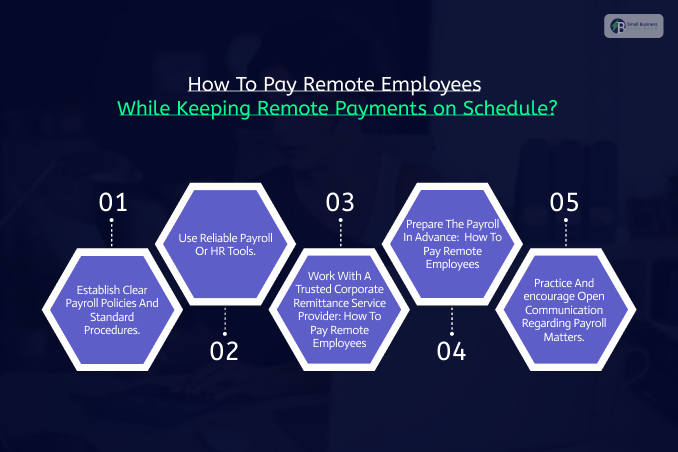
Ensure your remote employees receive their salaries on time by following these tips:
1. Establish Clear Payroll Policies And Standard Procedures.
Clear, detailed payroll policies and standard operating procedures (SOPs) ensure you stay on top of payout schedules.
When payment rules are written down and shared with the team, there is less room for confusion.
Your workers know exactly when to expect their salaries, while your managers and payroll staff have a process to follow.
This helps avoid delays that can happen when terms are vague or handled case by case.
If you’re creating a payroll policy, ensure it covers details such as pay dates, invoicing requirements, and the best payment methods.
What to include in your payment rules:
- Which currency to use: Decide if you will pay them in their local money or your country’s money. This avoids confusion when money values change.
- Deadlines: Set a clear day for when invoices and hours must be sent in (like the 20th of the month) so you have enough time to process payments before the due date.
- Bank fees: Clearly state who pays for the extra fees that banks charge for sending money abroad.
It should outline what happens if issues arise, like a bank holiday or a transfer delay. Ensure your policies also have clear rules regarding attendance, overtime, and paid and unpaid leave.
Your HR team should discuss these policies and procedures when onboarding new remote employees to ensure they understand and accept them before joining the company.
2. Use Reliable Payroll Or HR Tools.
Manual processes often lead to delays and payroll errors that can frustrate employees.
By using reliable payroll software or HR tools, you and your team can process and schedule payments in advance with few to no errors.
The right software also gives you and your team a clear record of all salary-related transactions.
You can also use this tool to organise timesheets, invoices, and any communication about each remote employee’s tasks.
A reliable tool makes it easier to keep your payroll organised and helps you avoid delays.
Keeping safe records: Using automated tools instead of tracking everything on spreadsheets helps prevent mistakes.
These tools keep a safe, digital record of everything you pay. If the government ever asks to check your taxes or payroll, you will have all the proof ready to show them.
3. Work With A Trusted Corporate Remittance Service Provider: How To Pay Remote Employees
Remittance companies offer services designed to handle bulk payments and cross-border transfers smoothly.
The right service providers allow you to send money in multiple currencies at once, which helps reduce payroll costs.
Two different ways to pay: It is important to know how you are hiring your team:
- Money Transfer Services: Use these if you are paying independent contractors who handle their own local taxes.
- Employer of Record (EOR) Services: Use these if you want to hire full-time employees in another country.
The EOR company acts as the official employer in that country, handling local contracts, benefits, and taxes so you don’t have to worry about legal mistakes.
Their solutions can also help you move funds quickly, so employees don’t have to wait too long to receive their pay.
Moreover, a trusted remittance solution allows businesses to avoid the hassle of setting up separate local accounts.
This also helps them avoid the problems of dealing with unpredictable banking systems.
Moreover, remittance services help you build a reliable foundation. This reliable foundation, moreover, ensures salaries are delivered on time and with fewer complications.
4. Prepare The Payroll In Advance: How To Pay Remote Employees
Even with the best system in place, public holidays and time zone differences can slow down transactions. Other unexpected issues may also arise and delay salaries.
To avoid this, prepare payroll and send salaries to your remote team in advance. This helps you account for possible obstacles that can cause delays.
Moreover, this small adjustment protects your remote employees from the stress of late salaries.
As a result, businesses earn employees’ trust, which helps sustain their trust in the company.
Employers should consider establishing a salary cushion when they have the budget. This ensures remote workers receive their salaries on time.
Experts suggest keeping extra money in your account equal to 1 to 1.5 months of your total payroll.
This extra money acts as a safety net. If there is a bank delay, a public holiday, or a technical issue, you can still pay your team exactly on time while you fix the problem behind the scenes.
This buffer can give you peace of mind by helping you avoid scrambling at the last minute to resolve problems.
5. Practice And encourage Open Communication Regarding Payroll Matters.
Whether you’re working with a full remote tech team or several virtual and admin assistants from different parts of the world, having a good communication channel in place allows you to keep them updated regarding their salaries.
Moreover, businesses should create a channel on Slack, Skype, or other platforms to share important payroll information.
This way, team members can voice concerns without barriers.
Businesses should create an official channel and use it to update their remote team. Moreover, the channel prevents them from being left hanging or confused about payroll-related matters.
You also show that you value open communication and transparency, which can strengthen company culture.
Timely payroll may seem like a simple detail, but it carries real weight for remote teams.
When you give salaries the same importance as any other part of the business, you show that you value your employees even if they are not in the office.
Keeping Your Team’s Private Data Safe
When you handle payroll for a remote team, you collect highly sensitive information. This includes your workers’ full names, home addresses, bank account numbers, and tax identification details. Protecting this data is a major responsibility.
To keep this information safe and follow international privacy laws, make sure to:
- Never send bank details over regular chat apps: Don’t let employees type bank account numbers in open channels on Slack or Skype.
- Use encrypted software: Use secure, password-protected HR tools or cloud storage where only authorised managers can see private financial details.
Limit access: Allow only the people running your payroll to view employee bank information. The fewer people who have access, the lower the risk of a data leak.
Read Also: