
Table Of Contents
- Why Does Data Center Compliance Determine The Security Level Of Colocation?
- Which Data Center Security Standards And Certifications Are Now Almost Essential?
- 1. ISO 27001
- 2. SOC 2 Type II
- Physical Versus Digital Security In The Context Of Data Center Compliance
- How To Verify The Actual Level Of Security Of A Provider?
- What Does Really Matter?
- What Is The Action Plan for Data Center Compliance Failures?
Data Center Compliance As The Foundation Of Secure Colocation: What To Ask Before Signing A Contract
When you invest millions in server infrastructure, the last thing you want is to discover security gaps only after deployment.
Data center compliance is not just a regulatory formality. It provides a measurable foundation of security on which your data protection is built.
In this article, we break down which data center security standards underpin secure colocation and how to identify providers that truly deliver on their promises.
Server infrastructure is built on trust! Trust that the colocation provider actually protects your data as carefully as claimed in sales presentations.
The problem is that while price and technical parameters are easy to compare, the real level of security often remains hidden behind marketing slogans.
Why Does Data Center Compliance Determine The Security Level Of Colocation?
Many organizations choose their approach to physical and digital infrastructure protection based primarily on pricing and availability, treating data center compliance as a secondary formality.
This approach is like building a house without a structural assessment. It may hold for a while. However, everything can collapse under the first real load.
ISO 27001, SOC 2 Type II, or PCI DSS are not just nicely framed documents on a reception wall.
They require regular external audits by independent experts to verify:
- Actual processes,
- Technical measures, and
- Staff readiness.
When a provider demonstrates data center compliance with these standards, it commits to adhering to hundreds of specific security controls.
It starts from data encryption and backups to the physical protection of server rooms.
Which Data Center Security Standards And Certifications Are Now Almost Essential?
Modern data centers operate as the foundation of our digital world. However, they face constant threats. This includes cyberattacks and hardware failures.
The facilities follow strict security protocols to ensure safety and build customer trust. These standards prove that a data center is reliable, secure, and ready for emergencies.
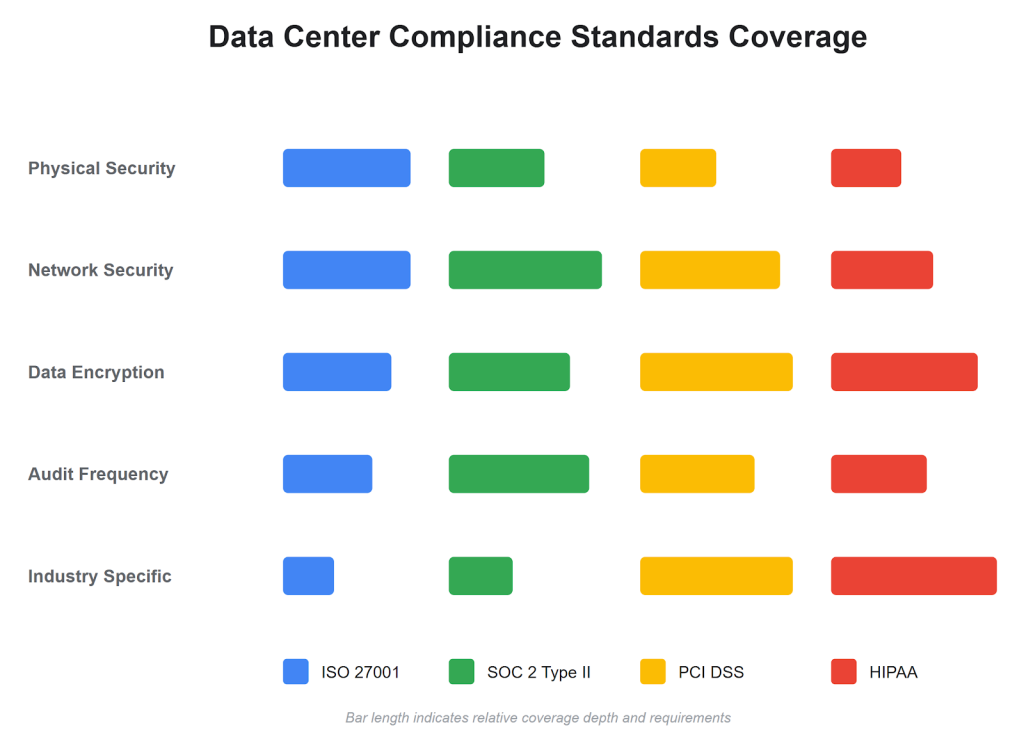
Here are the standards and certificates required for data compliance.
1. ISO 27001
This is an internationally recognized standard for information security management systems.
Providers operating an ISO 27001 data center have demonstrated that they have implemented a comprehensive framework for risk identification and continuous improvement.
2. SOC 2 Type II
This certification evaluates the effectiveness of security controls over a period of at least six months.
The audit examines five trust service criteria: security, availability, processing integrity, confidentiality, and privacy.
For secure colocation, SOC 2 Type II serves as proof that the provider does not merely promise 99.9% availability, but demonstrably delivers it.
Certain sectors require specialized standards. Companies that process payment cards must comply with PCI DSS, while healthcare organizations must comply with HIPAA.
European businesses are subject to GDPR requirements. Alongside that, the violations result in fines of up to 4% of a company’s global annual turnover.
Physical Versus Digital Security In The Context Of Data Center Compliance
Data center compliance requires integrating physical and digital protection into an inseparable whole.
No software firewall will protect servers from an intruder who enters the data hall with a flash drive.
Likewise, an attacker gains access through unpatched network vulnerabilities. Even the most sophisticated biometric scanners are useless at that time.
That is why quality providers build data center security standards in concentric layers. The physical layer typically includes:
- Biometric authentication at all entry points,
- Continuous video surveillance with archives retained for at least 90 days,
- Camera systems with motion and smoke detection,
- Redundant power supply with backup generators capable of days of autonomous operation.
Digital protection complements this system through:
- Network segmentation,
- DDoS attack prevention,
- Encryption of data both in transit
- Continuous monitoring of network traffic.
Only the combination of both dimensions meets data center compliance requirements and ensures real protection of the infrastructure.
How To Verify The Actual Level Of Security Of A Provider?
Certificates displayed on a website are a good starting point, not final proof. Request up-to-date SOC 2 or ISO 27001 audit reports. Reputable providers share them under NDA.
Thus, you must check the certification issue date and the schedule of the next audit. A two-year-old certificate with no planned renewal is a red flag.
Secondly, you can visit the data center in person. In addition to that, you can review security protocols from visitor registration through access to the server room.
You must pay attention to details. This includes
- Functional mantraps,
- Active monitoring, and
- Properly equipped fire suppression systems.
Ask about RTO and RPO parameters in the event of an outage, and request references from existing clients in your industry.
Examine how the provider manages incidents. Data center security standards require clearly defined escalation matrices and communication protocols in the event of a security breach.
A provider that hesitates to answer these questions likely has little to offer.
What Does Really Matter?
Choosing a colocation partner is a strategic decision with long-term consequences.
Data center compliance transforms the vague promise of “maximum security” into measurable parameters.
Moreover, this can protect both your investments and your company’s reputation.
You can ask questions, verify claims, and demand evidence. This is because the real protection starts before the contract is signed.
What Is The Action Plan for Data Center Compliance Failures?
If your data center provider fails to meet all compliance standards, you need to act quickly to protect your business. In such cases, you can follow these essential steps:
- First things first, you have to start assessing the impact. You have to immediately determine which data is at risk and check if any security breaches occurred.
- Secondly, you have to review the contract. In this process, you review your Service Level Agreement (SLA) for compliance clauses. You even have the right to terminate the contract or receive the financial credits.
- Thirdly, you can notify the authorities. If a breach occurs, you may be legally required to report it to regulators or affected customers.
- You can also demand remediation. In that case, you can request a formal plan from the provider to fix the issues within a strict deadline.
- Lastly, you can plan an exit. If the provider fails to improve, you can begin moving your data to a compliant partner to avoid legal fines.