Table Of Contents
What Is A Cloud Kitchen? The Secret Food Trend Saving Restaurants Millions!
Imagine running a wildly successful restaurant without ever buying a single table, chair, or dining room plate.
It sounds like a futuristic fantasy, right? However, this is exactly how thousands of culinary entrepreneurs are making their fortunes today.
Welcome to the world of cloud kitchens. This delivery-only business model completely reshapes how we think about food, real estate, and dining out.
Whether you are an aspiring chef looking to launch a brand or a curious diner wondering where your delivery food actually comes from, this comprehensive guide breaks down everything you need to know.
What Is A Cloud Kitchen?
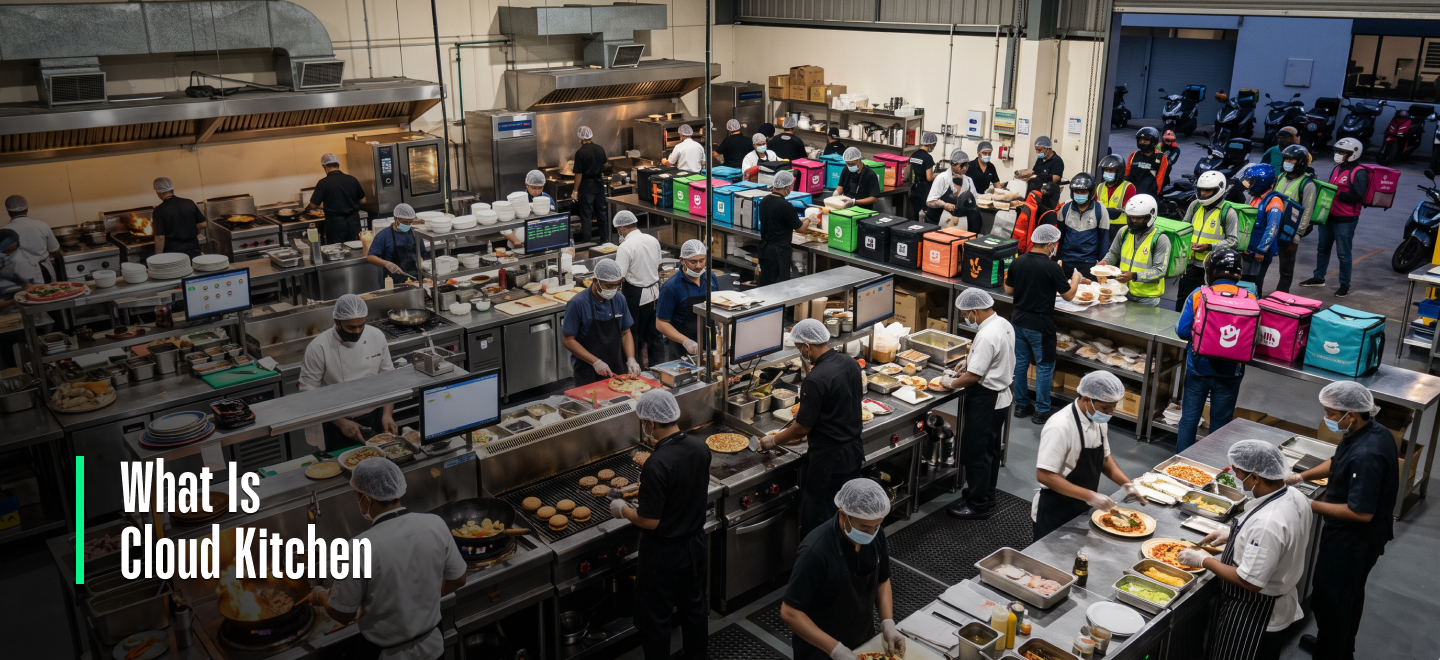
A cloud kitchen is a commercial kitchen facility built specifically to prepare food for delivery. These are also frequently called a ghost kitchen, dark kitchen, shadow kitchen, or virtual kitchen,
These setups do not have a physical storefront. They completely lack a dine-in area, a visible sign on the street, or front-of-house service staff. Instead, they exist entirely in the digital world.
Customers discover these brands through online delivery applications like Swiggy, Zomato, DoorDash, or Uber Eats.
Customers place orders online, kitchen staff cook the food in an optimised workspace, and a delivery driver picks it up and brings it straight to the customer’s doorstep.
The Market Demand Overview
The demand for delivery-only food is not just a passing phase. It is an economic powerhouse.
Globally, the cloud kitchen market is valued at over $83.5 billion. And it continues to expand rapidly.
This global surge is mirrored perfectly in India, where the cloud kitchen industry has exploded into a ₹21,000 Crore ($2.5 billion) market.
India has become one of the world’s fastest-growing food-tech hubs. This is fuelled by a blistering compound annual growth rate (CAGR) of 22.4%.
A permanent shift in consumer behaviour drives this massive surge. Modern diners value convenience, speed, and variety.
They
This massive surge is driven by a permanent shift in consumer behaviour. Modern diners prioritize convenience, speed, and variety. They want restaurant-quality meals delivered to their couch in under 30 minutes.
In India, this shift is supercharged by specific local factors:
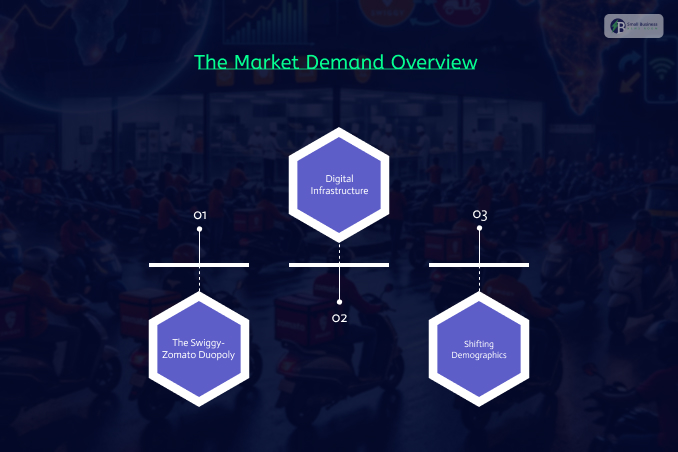
- The Swiggy-Zomato Duopoly: Hyper-efficient delivery networks have made ordering food incredibly frictionless for tier-1 and tier-2 cities.
- Digital Infrastructure: Cheap mobile data and instant UPI payments have turned food delivery into a daily habit rather than an occasional luxury.
- Shifting Demographics: A rising population of young, working professionals in urban centres values time-saving dining options.
Consequently, the traditional kitchen boundary has officially expanded into the digital cloud, whether it is a global mega-city or a bustling Indian metro.
You May Also Love To Read: Can I Start A Baby Food Trading Business In Dubai?
How Exactly Does A Cloud Kitchen Work?
A cloud kitchen’s operational workflow is built entirely around speed, precision, and digital connectivity.
Because there are no physical customers to manage, the layout is optimized for production-line efficiency.
1. The Digital Order Capture: A customer browses a virtual brand on a delivery app and places an order.
2. The Consolidated Dashboard: The order hits the cloud kitchen’s centralized Point of Sale (POS) system, which automatically updates the kitchen staff.
3. The Optimized Preparation: Line cooks prepare the meal using layout setups designed specifically to minimize movement and speed up cooking times.
4. The Strategic Packaging: The food goes into high-quality, temperature-controlled packaging engineered to withstand a 20-minute scooter or bike ride.
5. The Seamless Handover: The driver arrives, scans a barcode or states an order number at a designated pickup window, and immediately departs.
Also Check: USPS UPS Package Delivery Contract End | What Changes Are We Expecting?
What Is Cloud Kitchen: 5 Primary Cloud Kitchen Business Models
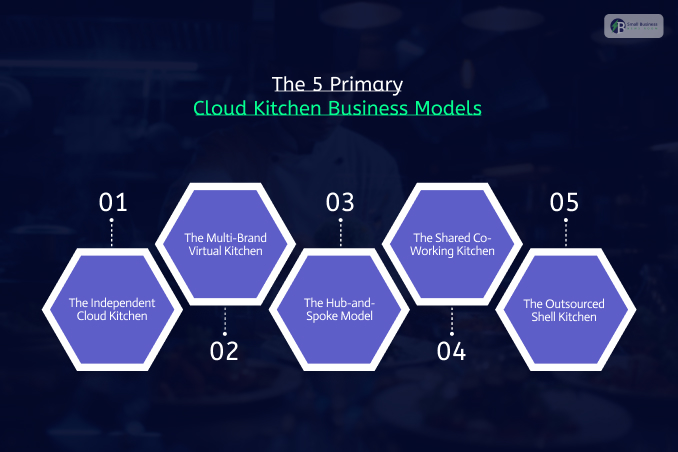
Not all cloud kitchens are run the same way. In fact, operators utilize five distinct business structures depending on their capital and scaling goals:
1. The Independent Cloud Kitchen
This is the most straightforward model. One operator owns a single kitchen space and runs a single virtual brand out of it, focusing heavily on a specific niche like gourmet burgers or healthy salads.
2. The Multi-Brand Virtual Kitchen
One operator runs multiple completely different restaurant brands out of the same physical kitchen.
For instance, the same kitchen staff might cook Italian pasta for one brand and Mexican tacos for another, sharing the same ingredients, utilities, and rent.
3. The Hub-and-Spoke Model
A large centralized “hub” kitchen handles all the heavy prep work, meat marination, and bulk cooking.
This food is then shipped to smaller, low-cost “spoke” kitchens across the city, which quickly heat, garnish, and pack the food for hyper-local delivery.
4. The Shared Co-Working Kitchen
A large real estate company builds a massive warehouse filled with 20 to 30 individual, fully equipped commercial kitchen spaces.
They rent these separate stalls to different independent restaurant owners, acting like a co-working space for chefs.
5. The Outsourced Shell Kitchen
A restaurant brand licenses its recipes, branding, and cooking processes to a specialised cloud kitchen operator.
This prepares and distributes the food on its behalf, allowing the brand to scale globally with zero footprint.
Related Article For You: DoorDash Taxes Demystified: A Complete 2026 Guide for All Dashers!
Why Have Cloud Kitchens Become A Massive Trend?
Traditional restaurants are notoriously risky businesses, mainly because of crushing overhead expenses.
Cloud kitchens have skyrocketed in popularity because they solve the hospitality industry’s biggest financial pain points.
First, they completely eliminate the need for prime real estate. A traditional restaurant requires a high-foot-traffic location on a busy main street.
This comes with astronomical monthly rent.
A cloud kitchen, meanwhile, can comfortably operate out of a low-cost industrial pocket, a quiet alleyway, or a basement, since customers never actually see the building.
Second, the upfront capital expenditure is fractionally smaller. You do not need to spend money on interior designers, expensive dining furniture, luxury lighting, or high-end tableware.
Your entire initial investment goes directly into high-quality commercial cooking equipment.
Reasons Why Cloud Kitchens Are The Future Of Food Delivery
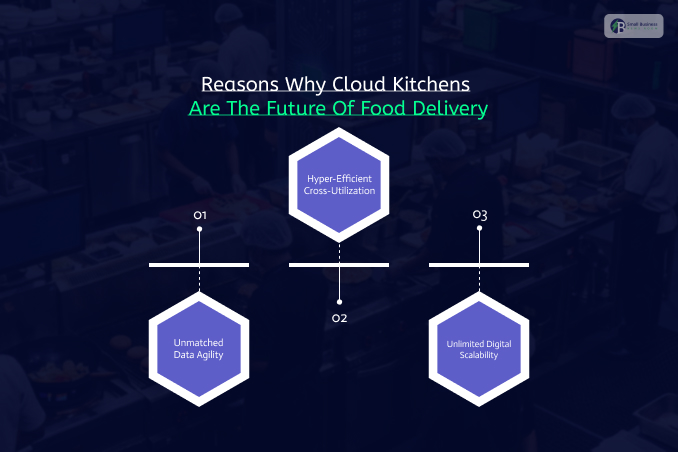
The food industry is shifting toward a delivery-first ecosystem, and cloud kitchens are uniquely structured to lead this evolution for three core reasons:
1. Unmatched Data Agility
Traditional restaurants cannot change their business concept overnight without spending thousands to reprint menus and remodel their interior.
A cloud kitchen can pivot instantly. The operator can update their digital menu or launch an entirely new virtual wing brand on the delivery apps within a few hours.
The data shows that healthy grain bowls are losing popularity while hot wings are surging.
2. Hyper-Efficient Cross-Utilization
In a multi-brand cloud kitchen setup, inventory waste drops drastically.
Chicken, vegetables, and cooking oils can be shared seamlessly across a Mexican brand, an Asian stir-fry brand, and a wrap brand operating out of the same workspace.
This maximizes profitability per square foot.
3. Unlimited Digital Scalability
Once a cloud kitchen perfects its operational playbook, scaling up is incredibly fast.
The operator can rent a small stall in a shared kitchen across town and begin delivering to a new neighbourhood within a week.
This is instead of spending millions building a new flagship brick-and-mortar restaurant.
Cloud Kitchen vs. Traditional Restaurant Showdown
When deciding how to break into the food industry, the biggest choice comes down to structure to understand what is cloud kitchen or a traditional restaurant.
Traditional brick-and-mortar restaurants focus heavily on guest experience, physical hospitality, and prime street visibility.
However, cloud kitchens eliminate the physical dining room to focus entirely on back-of-house culinary efficiency and digital scale.
| Feature | Cloud Kitchen Model | Traditional Dine-in Restaurant |
| Upfront Setup Costs | Exceptionally low (Equipment only) | Very high (Renovations, design, furniture) |
| Real Estate Requirements | Low-cost industrial or secondary zones | High-traffic main streets or commercial malls |
| Staffing Overhead | Small team (Kitchen crew only) | Large team (Host, servers, clean team, chefs) |
| Menu Flexibility | Instant digital updates and changes | Slow (Requires reprinting physical materials) |
| Scaling Velocity | Hyper-fast via virtual brand expansion | Slow and heavily capped by physical seating |
| Customer Touchpoint | Entirely digital via packaging & branding | Physical hospitality, service, and ambiance |
The Modern Cloud Kitchen Tech Stack
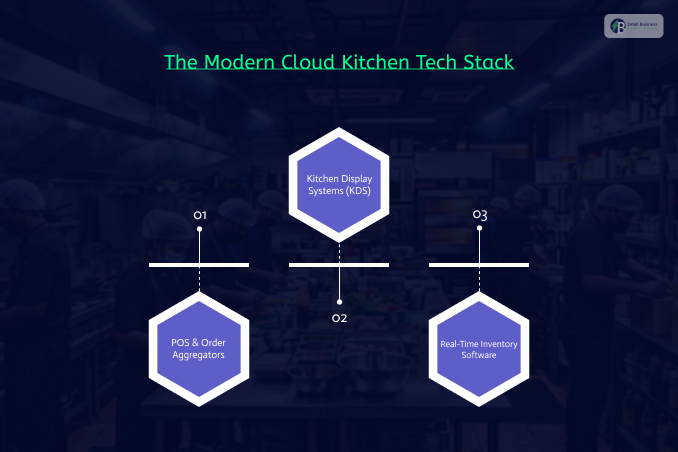
Operating a successful delivery-only brand requires a highly advanced software setup.
Without the right technology, managing multiple incoming digital order channels can quickly spiral into operational chaos.
1. POS & Order Aggregators
Software systems, such as Urban Piper or Toast, consolidate incoming orders from different delivery apps on one single screen.
This way, cooks do not have to juggle ten different tablets at the front desk.
2. Kitchen Display Systems (KDS)
Electronic screens that replace handwritten tickets and organize orders by the time needed to prepare them.
Thanks to tickets, cooks know exactly when to launch burgers and fries so that these two dishes come out of the kitchen at the same time.
3. Real-Time Inventory Software
Modern restaurants use smart software that can track every ingredient in real time.
When a line cook signs off on a chicken tenders order as complete, the system will automatically deduct specific amounts of chicken from the kitchen’s digital warehouse, alerting managers when it is time to replenish.
How Can You Optimise A Cloud Kitchen For Maximum Profit?
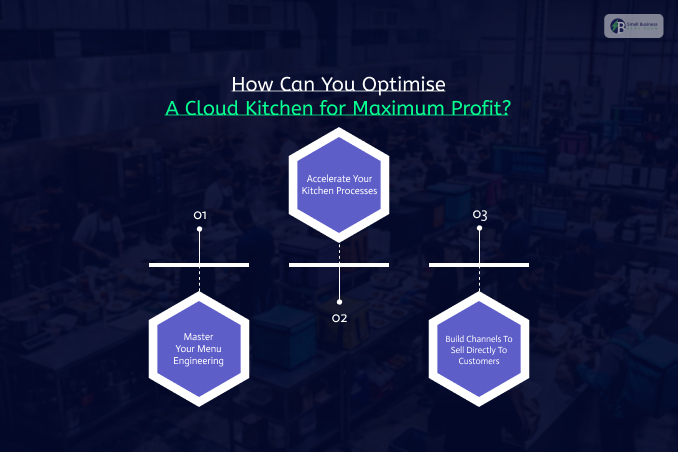
Competition in this space is intense, so optimising your cloud kitchen for maximum profit is essential.
Use the following three powerful methods to make money with a cloud kitchen.
1. Master Your Menu Engineering
Some menu items are simply incompatible with delivery due to their preparation time.
It is impossible to imagine a fresh soufflé or a cocktail that has not been shaken in a restaurant arriving at the customer in one piece after twenty minutes in a bag.
Focus on menu items compatible with delivery and having the best possible margins.
2. Accelerate Your Kitchen Processes (Quick-Commerce)
The faster the food is ready for pickup by your delivery driver, the more significant your restaurant will be in the app’s search results.
Prep everything in advance so that you spend no more than five minutes on each customer’s order.
You can cut this time by half by prepping vegetables, sauces, and proteins during slow hours instead of waiting for the busy season.
3. Build Channels To Sell Directly To Customers
While aggregators’ apps are great, they often steal hefty profits from restaurants.
Therefore, to ensure long-term profitability, you need to:
- Build relationships with your customers by creating an online store
- Optimise your website for faster loading
- Develop a mobile application
- Connect WhatsApp Business with your website
- Offer loyalty rewards.
Hidden Pitfalls & Disadvantages Of A Cloud Kitchen
Although a cloud kitchen’s financial model is tempting, running such a restaurant comes with severe disadvantages.
Namely, a significant hidden pitfall can affect every cloud kitchen owner.
Aggregator platforms usually take twenty to thirty per cent of each order as a commission.
If your cloud kitchen has mediocre margins, you might find yourself constantly losing money.
Moreover, every experienced aggregator app owner knows how to manipulate their search algorithm to keep their desired restaurant on the first page.
Therefore, if you are not confident you can keep your cloud kitchen profitable, avoid building it in the first place.
On the other hand, a cloud kitchen concept is entirely dependent on delivery. Traditional restaurants have the advantage of attracting walk-in clients. However, a cloud kitchen does not have this functionality.
Thus, if you decide to open a cloud kitchen, you will need to invest heavily in marketing and social media to attract enough customers.
The Verdict
A cloud kitchen concept has become extremely popular among food entrepreneurs for a reason.
While traditional restaurants are expensive to launch and operate, a cloud kitchen lets you enter the market at a lower cost while minimising staff.
A cloud kitchen concept is beneficial because it relies primarily on technology, making it easier to scale and achieve better margins.
However, a cloud kitchen needs thorough optimisation to operate successfully.
To make a cloud kitchen profitable, focus on mastering menu engineering, accelerating kitchen processes, and building direct relationships with clients.
Disclaimer: This guide is for educational and informational purposes only. When establishing a commercial kitchen business, always consult local zoning laws, legal professionals, and certified financial advisors to ensure full regulatory compliance.
Additional Resource: Meesho Seller Login: Secrets To 10X Your Sales Today!