After a week of communication on Slack, meetings on Zoom, and evaluations, the last thing you want to do on a Sunday is create a lengthy jewelry business plan.
Not only are you fatigued, but your cognitive capacity has also been limited.
Creating 5-year revenue projections for a brand that hasn’t sold any earrings yet is a waste of time. Your most precious asset is time!
Whilst developing my own transition out of corporate project management, I realized that conventional business plans were created for Venture Capitalists and bank loan officers.
However, if you are using $500 to $2000 of your own money to start jewelry making as a side hustle, you don’t need such a corporate document. Rather, you require a one-page ‘war map ’.
Below is my completed example of a one-page, Lean Jewelry Business Model Canvas.
It is optimized for women who want to test, develop, and automate a jewelry brand without sacrificing their 9-to-5 career too soon.
Quick Summary: How To Build A Lean Jewelry Business Plan
- Avoid the 20 Page Plan: Unlike traditional jewelry business plans, which spend weeks on unnecessary speculative data and bank revenue forecasting, use a one-page derivative of Ash Maurya’s start-up ‘Lean Canvas’.
- Test Demand: Before committing to mass jewelry casting, test your jewelry with 3D computer-aided design (CAD), samples and/or pre-orders.
- Develop a Minimum Viable Collection (MVC): Rather than offering 50 products, limit yourself to a small range (ideally between 3-5 products).
- Price for Digital Commerce: Use a 3.5x and 5x multiplier on retail price, rather than the standard 2x ‘keystone’ pricing. This will help cover marketing and fulfillment costs.
- Protect Your Working Week: Center your branding development around 5-7 hours per week, and use automation and vetted third-party fulfillment services to further protect your time.
Why Traditional Jewelry Business Plans Fail Busy Side-Hustlers
Before completing your canvas, let us analyze why conventional guidance does not suit novice jewelry entrepreneurs. Typically, online business plan templates require you to speculate about data.
People then spend 3 months analyzing sector volumes, without even speaking to consumers.
| Feature | Traditional Jewelry Business Plan | Lean Jewelry Business Model Canvas |
| Length & Format | 15 to 30 pages of dense paragraphs | 1 single page divided into 9 action boxes |
| Time to Complete | 3 to 6 weeks of research | 45 minutes with a cup of coffee |
| Inventory Approach | Buy bulk inventory upfront based on guesses | Test demand with 1 sample or 3D render first |
| Financial Focus | 5-year hypothetical revenue forecasts | Immediate unit economics and break-even math |
| Best Use Case | Applying for a $100,000 bank loan | Bootstrapping a 9-to-5 exit on weekends |
Standard business plan canvases such as Alexander Osterwalder’s original version also require you to detail ‘Key Partners’ and ‘Key Resources.’ As a novice, you don’t currently have these.
Therefore, Ash Maurya’s Lean Canvas uses more pertinent ‘survival’ data: Problems, Solutions, Unfair Advantages, and Key Metrics, in lieu of corporate red tape.
The 9 Blocks Of The Lean Jewelry Business Model Canvas
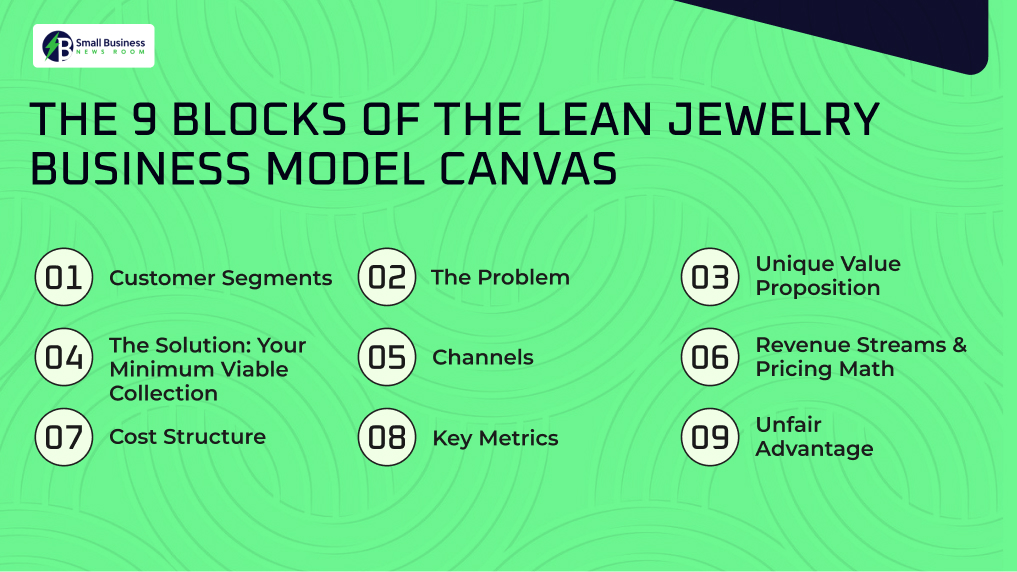
Take a blank sheet of paper and construct a 9-box matrix. Work sequentially through each box in the order shown below. Do not change order as each section affects the next.
1. Customer Segments (Who Are You Actually Serving?)
Who are you selling to? If you state that you are selling to “women aged 18 to 55,” your marketing will be too broad.
Ideally, identify one very particular consumer type, something preferably similar to yourself.
For example, corporate professionals aged 28-42 seeking hypoallergenic, waterproof gold jewelry that can effortlessly transition from 9 am boardroom meetings to 6 pm Pilates sessions without removal.
Furthermore, recognize the subset of this segment most likely to be trailblazers.
For example, women who already follow slow-fashion ‘Capsule Wardrobe’ designers on Instagram and/or TikTok.
2. The Problem (What Frustrates Your Buyer?)
Generally, people don’t buy jewelry merely for aesthetic appeal. They seek to avoid an emotion or physical issue. Identify your customer’s top 3 concerns with present jewelry offerings.
- Green finger tints and allergic reactions can result from low-quality brass jewelry.
- Gold-plated jewelry loses its sheen after just 3 showers, costing $60.
- Colorful ‘statement’ jewelry is often unsuitable for everyday corporate attire.
Current Workarounds: Consumers either buy inexpensive, throwaway fashion jewelry (such as from Zara) or pay exorbitant prices (for example, $600+) for jewelry from premium jewelers such as Mejuri and Catbird.
3. Unique Value Proposition (Your One-Sentence Hook)
Next, summarise in one succinct line what differentiates and adds value for your brand. Avoid nebulous terms such as ‘luxury’ and ‘timeless.’.
Structure: [Desired Outcome] + [Key Material/Attribute] + [Exclusion of Typical Concern]
Example: “18k PVD-coated waterproof gold essentials engineered for sensitive skin—so you never have to take your jewelry off, at under $65 a piece.”
Pro Tip: If you are finding it difficult to conceptualize a brand that embodies your Value Proposition, develop 10-15 potential jewelry brand names.
Then check that the corresponding .com web domains are available for purchase via Namecheap before becoming emotionally attached to one.
4. The Solution: Your Minimum Viable Collection (MVC)
Unfortunately, many novices quickly deplete their finances by trying to offer 30+ jewelry items (necklaces, rings, and bracelets).
However, by restricting yourself to 3-5 key SKUs, you reduce sampling costs and greatly simplify stock control during a busy week.
1 x ‘hero’ chain: This is possibly an extendable herringbone or paperclip style (between 16-18 inches in length).
2 x ‘everyday’ earrings: This comprises both huggle hoop and dainty stud styles.
1 x ‘hero’ ring: This is perhaps a stackable dome or signet ring.
Referencing jewelry sector trends (for example, multi-metal jewelry, waterproof PVD stainless steel and lab-grown birthstone pendants) can help to inspire your 4-product ‘capsule’ range.
5. Channels (How Customers Will Find You)
As a careerist, you will not be able to be active on all digital platforms. Decide on 1 sales and 1 traffic channel for your first 90 days.
- Sales Channel
You need to establish a streamlined, high-performing Shopify webshop.
This will also automatically manage taxation, mailing labels, and cart abandonment alerts, so you can continue with your 9-5 role.
- Traffic Channel
Either produce short-form video content (for example, wear-and-styling videos) for TikTok and/or Instagram Reels, or develop Pinterest-themed boards related to corporate dress so customers can discover your brand through search.
6. Revenue Streams & Pricing Math (No Guesswork)
Only once your profit margins are high enough can you afford marketing and fulfillment.
Furthermore, many novices apply a conventional double-the-cost ‘keystone’ pricing strategy which does not perform well in digital commerce.
Within your Revenue section, apply the following 3.5x – 5x Unit Economics principle:
- Landed Product Cost (COGS) = $10 (covers product, personalized velvet jewelry pouch, and delivery from supplier).
- Retail Price = $45 (producing a 4.5x multiplier).
- Transaction and digital platform charges (~3%) = -$1.60.
- Customer acquisition expenditure (either advertising or gifting jewelry to influencers) = -$12.00.
- Net Profit Per Sale = $21.40 (~47.5% net margin).
If your manufacturing costs are $15 per jewelry item but you can only sell it for $30, remove this from your canvas immediately.
7. Cost Structure (Real Startup Numbers)
Detail all static and variable expenditures needed to successfully dispatch your first 50 sales.
Be brutally honest so that your side-hustle does not compromise your personal housing and/or contingency funds.
- Sampling (5 product types x 2 samples) = $150-$250.
- Basic Photography and props = $75 (good natural light and plain linen/ stone slabs).
- Shopify Basic Account and Web Domain = ~$40 per month.
- Packaging (personalized boxes, anti-tarnish strips, and mailers) = $120 for 100 items.
- Total Lean Canvas Start-Up Expenditure = $400-$650.
If you’re manufacturing jewelry manually at home, add $80-$120 for basic jewelry-making equipment. This includes flush cutters, flat nose pliers, jump ring openers, and digital calipers.
8. Key Metrics (The Only 3 Numbers To Watch)
Do not get distracted by superficial statistics such as Instagram followers and website impressions. Monitor these 3 essential survival indicators weekly, on a Sunday evening:
Sample-to-Pre-Order Conversion Rate: The proportion of people who either pre-order or enter a waiting list having viewed your sample images.
Initial Gross Profit Margin: This helps ensure each sale has a minimum 60% gross profit margin before factoring in marketing expenditure.
60 Day Recurring Sales Rate: This includes the percentage of initial customers who subsequently make additional purchases. This is the real driver of a jewelry brand’s passive income.
9. Unfair Advantage (Your Moat)
What would an imitator on sites such as AliExpress and Etsy find difficult to replicate?
The main possibilities include:
- Unique jewelry clasp design;
- 2-year hassle-free anti-tarnish replacement service;
- Exclusive supply from a family-run workshop;
Or your genuine narrative detailing your career transition from 9-5 working life.
Real-World Examples: Two Pre-Filled Lean Jewelry Canvases
To further illustrate this approach, refer to how two distinct side-hustlers structured their business models.
These were inspired by real-life ‘Side Hustle Success Stories’, where women successfully boosted their supplemental income to more than $3,000 per month and then transitioned out of their corporate careers.
| Canvas Block | Model A: Demi-Fine Waterproof Brand (Sourced/Private Label) | Model B: Personalized Birthstone Studio (Hand-Assembled) |
| 1. Customer | Busy corporate women (28–40) who hate removing jewelry at the gym. | Gift-givers and new moms buying sentimental keepsakes. |
| 2. Problem | Gold plating fades in weeks; solid 14k gold is too expensive ($300+). | Mass-produced mall jewelry feels impersonal and rushed. |
| 3. UVP | “Sweatproof, shower-safe 18k gold essentials under $60.” | “Hand-stamped birthstone necklaces shipped in 48 hours.” |
| 4. Solution | 4-product ‘capsule’ containing a herringbone chain, heavy huggle hoops, dome, and tennis bracelet. | 3 base chain variations and 12 detachable, birthstone drop charms. |
| 5. Channels | Webshop and TikTok/Instagram Reels videos exhibiting jewelry wear and styling. | Etsy (to access inherent gift search functionality) and Pinterest gift-themed boards. |
| 6. Revenue | Average Order Value (AOV) = $78. This is achieved by offering 2-item bundles at a discounted price. | Average Order Value (AOV) = $54. This is generated by selling a base necklace and additional charms. |
| 7. Costs | $550 for sampling and micro-batch stock ordering. | $380 for mass production gold-filled chains, charms, and hand-crafting pliers. |
| 8. Key Metric | Cross-sell rate – the percentage of customers who purchase additional items. | Order hand-crafting duration – must be under 12 minutes. |
| 9. Advantage | 2-year anti-tarnish promise and elegant magnetic jewelry case. | Same-day at-source home studio bespoke etching service. |
How To Validate Your Canvas In 14 Days (Without Buying Bulk Stock)
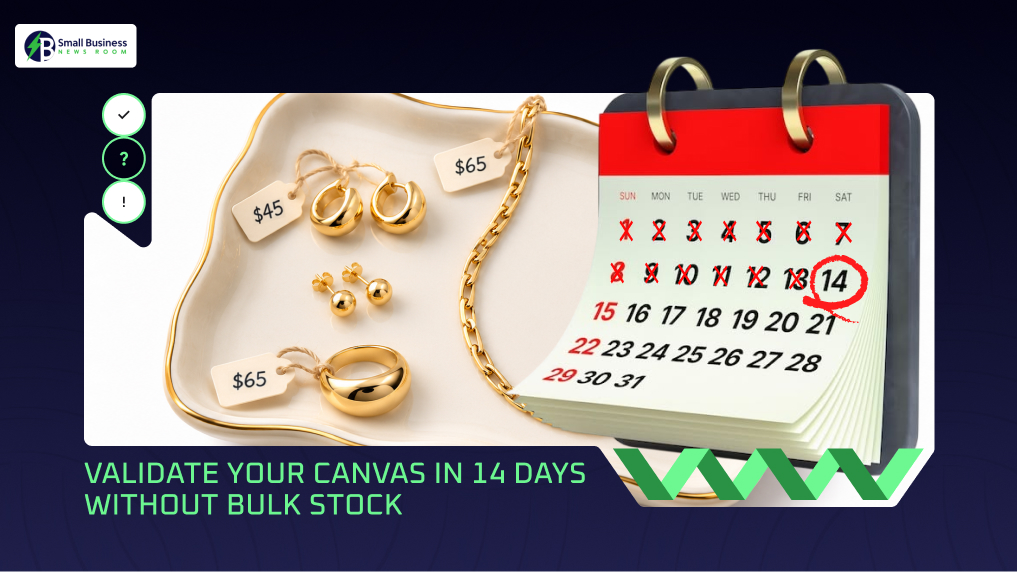
Once you’ve finished your one-page canvas, don’t transfer $2000 to a manufacturer. Execute a 2-week validation period, investing around 6 hours of your free time.
Step 1: Conduct A Jewelry Supplier Risk Assessment
Before ordering samples, mitigate risks linked to delayed delivery times, non-uniform plating, and/or concealed import charges.
You also need to scrutinize all jewelry manufacturers and/or wholesalers against stringent ‘Jewellery Supplier Evaluation’ criteria:
Also ask for details on plating thickness (for gold vermeil, aim for 1.5-2.5 microns or more; for PVD coating on 316L stainless steel).
Confirm written information about sample and re-order lead times (normally between 7-14 and 20-35 days, respectively).
Place one sample order as a regular customer so that you can assess a company’s packaging, anti-tarnish properties, and delivery speed.
Step 2: Run The “Render-First” Or Single-Sample Test
Place one tangible order for your 3-5 product MVC. Then, shoot fresh, well-lit photographs of yourself wearing these items and displaying them alongside your usual work clothing.
Subsequently, upload these images to Instagram Stories, TikTok, and/or a basic web page developed using Klaviyo or MailerLite.
Furthermore, you need to add a “Notify Me When Dropped, Get 15% Early Access” button.
Once 50+ people have joined your waiting list or messaged you requesting the link, you have confirmed there is demand for your jewelry.
And if no one engages with your content, then you have only incurred a $150 sampling expense.
Moreover, you can even alter your jewelry designs at this stage without committing real money.
Also Check: The 9-To-5er’s Guide To Assessing Jewelry Supplier Risk Safely.
Want To Skip The Blank-Page Struggle?
Avoid wasting your Sunday evenings designing. Download our stylish ready-made Notion and Printable Lean Jewelry Canvas. Included are an automatic Unit Margin & Pricing Calculator and our 15-point jewelry supplier evaluation scorecard.
Managing Your Weekly Schedule: The 6-Hour Side-Hustle Blueprint
Contrary to popular belief, you don’t need 30 hours per week to run a lean jewelry brand effectively.
With a deliberately simplified business model, you can competently manage your enterprise by dedicating 6 hours a week. This should be organized as follows:
Tuesday Evening (1 Hour): First, respond to customer Direct Messages, review supplier communications, and monitor stock.
Thursday Evening (1.5 Hours): After that, you need to film 3-4 short styling or product highlighting clips. Natural evening lighting is ideal for filming.
Saturday Morning (2.5 Hours): Also, work on packaging and printing mailing labels for the week’s orders.
Set a clear 2-3 working day processing period on your webshop so you are never rushed into packing boxes after a 10-hour workday.
Sunday Afternoon (1 Hour): Lastly, analyze your 3 Key Metrics from your Lean Canvas and program in social media and email content for the week.
Additional Resource: How Much Does It Cost To Start An Online Jewelry Store?