Imagine coming home after a tiring night-hour shift, ready to build your dream business, only to find a storage bin full of untouched gemstone beads and wire.
That impulse-bought inventory is literally cash sitting on your table. And every dollar that is trapped in those unsold boxes is money that should be funding your freedom.
When you are balancing a full-time career with a jewelry business, you cannot afford the financial drag of dead stock.
Moreover, managing your cash flow and knowing your exact cost per piece is not just basic bookkeeping. It is your ultimate strategy for efficient growth.
So, here is how to optimize your inventory, keep your cash moving, and make every investment count.
TL;DR
When running a handmade jewellery business or wholesale business alongside your 9-5, you need to shift your mindset to reduce overstocking by adopting a Just-in-Time (JIT) mindset.
The most efficient ways to protect your cash flow and secure high margin products are:
- Create a Core Component Matrix. You should create components that can be mixed and matched using common metals and gemstones.
- Adopt a Made-to-Order (MTO) process. Don’t hold any finished stock. Only make the pieces once you’ve received payment from the customer.
- Pre-Orders. Create trending products to sell online. Get capital upfront to produce batches of products safely.
By creating flexible components, corporate professionals can easily scale their side hustle without tying up emergency funds in unused stock.
Handmade Jewelry Business vs Wholesale: The Excess Inventory Trap
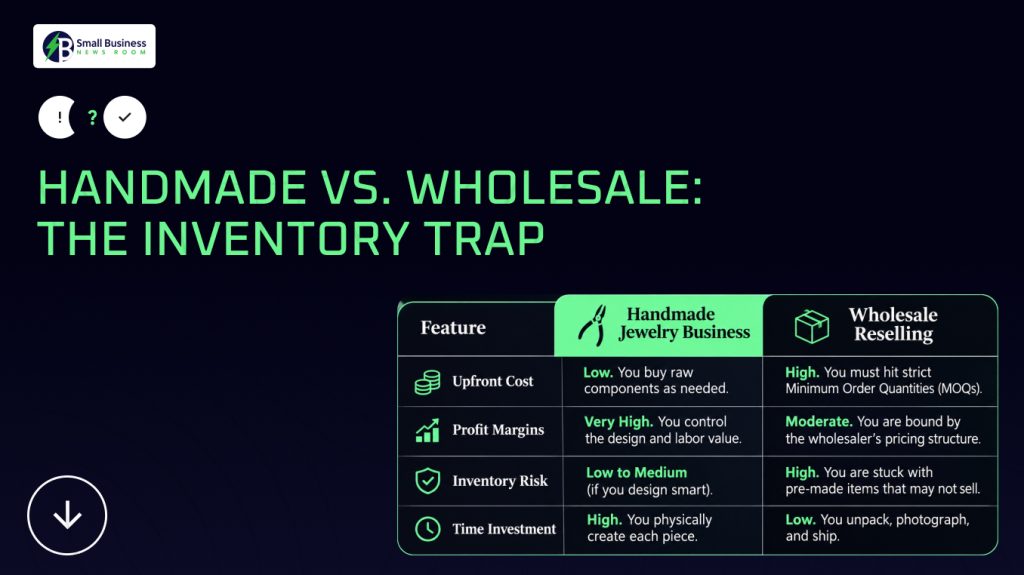
Many corporate women looking at what to sell online get confused between two business models: making the jewelry themselves or buying wholesale to resell.
Understanding the difference dictates how you manage your supply chain.
| Feature | Handmade Jewelry Business | Wholesale Reselling |
| Upfront Cost | Low. You buy raw components as needed. | High. You must hit strict Minimum Order Quantities (MOQs). |
| Profit Margins | Very High. You control the design and labor value. | Moderate. You are bound by the wholesaler’s pricing structure. |
| Inventory Risk | Low to Medium (if you design smart). | High. You are stuck with pre-made items that may not sell. |
| Time Investment | High. You physically create each piece. | Low. You unpack, photograph, and ship. |
When you are planning to launch a side hustle around a 9-to-5 job, the handmade market offers a massive financial advantage: low upfront risk.
Unlike standard retail, you must place large, fancy orders. This includes buying 50 finished necklaces all at once. Handmade production mainly allows you to start small.
You only need to invest in minimum raw materials such as a single spool of high-quality gold-filled wire and a handful of select gemstones.
This drastically limits your initial case outlay and further protects you from losing money on stock that might not sell.
Design Around A “Core Component Matrix”

The best way to kill excess inventory is to create what I call a “Core Component Matrix.”
Think of it as a mix-and-match strategy where you use a tiny pool of raw materials to create your entire collection.
Instead of buying unique parts for every single piece, you build a shared foundation that works across all your earrings, necklaces, and bracelets.
When you break your design process into these three simple steps, you completely avoid dead stock without making your brand look cheap:
Step 1: Get Picky With Your Metals (80% Of Your Stock)
Standardize your hardware. Pick just one or two metals. This inlcudes like 14k gold-filled or sterling silver.
You can use the exact same wire gauge, jump rings, and clasps across everything you make.
This lets you buy your chain and wire in bulk to save cash, without leaving you with random leftovers.
Step 2: Pick 3 To 4 Go-To Gemstones
Stop buying twenty different types of stones. Stick to a tight, versatile palette—like Freshwater Pearls, Moonstone, and Green Onyx.
Thus, you need to design your pieces so these specific stones can easily swap into any of your earring, ring, or necklace bases.
Step 3: Launch A Tight Capsule Collection (6–8 Pieces)
Start small with just a handful of finished designs. Keeping your lineup focused means you don’t have to store piles of raw materials.
Moreover, ironically, it makes your brand look more high-end, intentional, and luxurious.
Implement the Made-to-Order (MTO) Operating System
The best way to avoid excess inventory is to make pieces only after you have received payment.
A made-to-order business model works well for busy corporate ladies.
[Customer places order + pays] ➔ [Trigger production schedule] ➔ [Make using core components] ➔ [Ship to customer]
- Lead Time Can Become A Feature.
You shouldn’t feel pressured to offer next-day shipping. Customers love knowing that they have a piece made specifically for them by an artisan.
Be clear on your product pages that all pieces are made to order. Allow 5-7 working days for your piece to be made.
This gives you the flexibility to make your jewelry at the weekend or in your spare time without stress.
- Have A Safety Buffer.
Rather than having 10 completed necklaces in a box, have all the raw materials for 10 necklaces in your component tray.
If these don’t sell, you can easily turn them into bracelets/earrings. Your capital is fully flexible.
Managing Excess Inventory: Establish A Just-In-Time Supply Chain
Just-In-Time (JIT) manufacturing means that you can match your raw material purchasing to your verified sales cycle. To avoid any stock shortages, follow this process:
- Identify Domestic Micro-Wholesalers
Find reliable domestic micro-wholesalers that can supply your components quickly without requiring large minimum orders.
The added cost of ordering in small batches will be minimal (5%).
However, receiving them within 3 days is far better than importing large amounts from abroad, which will tie up your cash flow for months.
- Calculate Your Reorder Thresholds
Work out how many products you can make a week.
If you can realistically only make 10 rings a week whilst working your main job, then this is the maximum amount of materials you will use.
Set your reorder point so that you only reorder when you have 2 weeks’ worth of components left.
- Use the “Sample & Scale” Method
Sample & Scale. Before releasing your new design purchase just enough material to make 2 samples.
Moreover, take a photo of one to put on your online store and wear the other to test how durable it is.
Only order large amounts of stone/metal once you have 3 validated sales on your listing.
Monetization Loop: The Lean Inventory Planning & Costing Matrix
We have created the Lean Inventory Planning & Costing Matrix to make this an easy transition. This is an interactive spreadsheet that removes all the guesswork.
The spreadsheet will calculate the cost per component for you. It will also alert you to re-order based on your real-time sales velocity.
You will also be alerted if you are moving out of your high margin products (aiming for 70-80% margin).
By entering your raw metal weights and gemstone costs into this template on Sunday evening, you will know exactly what you need to purchase for the week ahead.
Lean Inventory Planning Matrix Template
Here’s a template example that you can use. You can also download the template for your later reference.
| SKU / Item ID | Item Name | Product Category | Annual Usage Value (A/B/C) | Demand Volatility (X/Y/Z) | Lean Matrix Quadrant | Safety Stock Days | Target Kanban Size | Reorder Trigger Point | Lean Action Required |
| SKU-001 | Example Prod A | Finished Goods | A (High Value) | X (Stable) | HVHT (High Value / High Run) | 2 Days | 50 Units | 65 Units | Automated JIT Reorder |
| SKU-002 | Example Prod B | Raw Materials | A (High Value) | Z (Erratic) | HVLT (High Value / Low Run) | 14 Days | 10 Units | 12 Units | Strict Review / VMI |
| SKU-003 | Example Prod C | Consumables | C (Low Value) | X (Stable) | LVHT (Low Value / High Run) | 5 Days | 500 Units | 600 Units | Two-Bin Kanban System |
| SKU-004 | Example Prod D | Spare Parts | C (Low Value) | Z (Erratic) | LVLT (Low Value / Low Run) | 30 Days | 5 Units | 5 Units | Min-Max System / Purge |
Run Low-Risk Pre-Order Campaigns For Major Launches
If you’re launching an upgraded gemstone or a new product range, don’t guess what the market will want.
Drive your audience to invest by putting together a structured pre-order campaign.
- Visual Prototyping:
Firstly, you need to design one perfect prototype of your new design.
Also, use luxury editorial images to create short, snappy videos of the piece moving and sparkling.
- Fixed Duration Pre-Order:
Secondly, you can allow your audience to pre-order from your website. This should be set for a short fixed duration (usually 5-7days).
Furthermore, you can highlight that production will begin immediately after the pre-order duration has finished.
- Immediate Investment:
Once the pre-order period ends, use the cash generated to invest in the exact amount of metal and gemstones needed to complete the exact number of orders.
No debt, no risk, and no excess inventory.
Final Verdict & Action Plan
With a smart system in place, you won’t have to spend a fortune or fill your warehouse to grow from your 9-5 into a successful jewelry founder!
Things To Do Tonight:
- First, tidy up your current stock. Sort them into Core Components (those that you will use in most of your pieces) and Statement Components (those that will only be used in one piece).
- Second, revamp your designs for the future. Edit your designs to make use of the different gauges and chains you have.
- Lastly, change your shipping. Edit your website settings to change the status of your pieces to Made to Order rather than Ready to Ship.
This will feel great right away and give you more flexibility in your production.