Most people find it extremely challenging to run a side hustle alongside a main career, especially when they also need to meet obligations at work, to family, and to themselves.
Starting jewelry making as a side hustle is a great option for women seeking autonomy and self-expression, and it lets them develop their own brand without the daunting transition to self-employment.
Whilst 40 hours a week isn’t essential to start building a brand, committing to 3 nights a week in 1-hour blocks is the quickest route to early self-employment.
Steady development comes from adopting sustainable routines that fit around your regular salary cycle.
Quick Answer
You can easily carve out 5 hours a week for your jewelry brand by dividing your time into three 1-hour weeknight sessions for low-energy packaging and prep.
On top of that, you can add one 2-hour weekend block for jewelry assembly and natural-light photography.
With smart task batching and a clutter-free workspace, those 5 focused hours can produce 15 to 20 finished, ready-to-ship pieces every single week.
Why 5 Hours A Week Is Enough To Build A Real Brand
Successful entrepreneurs often look like they work non-stop. However, real side-hustle success stories tell a different story.
Most founders started building their brands from a bedroom desk or kitchen table. They also only committed a limited number of hours each week to their projects.
That means 20 hours per month (or 260 hours per year) can be wholly devoted to your dream.
Again, it is not about squeezing further hours into your day but about eliminating inefficient minutes from your existing hours.
Before purchasing any jewelry components, devise a basic jewelry business plan that acknowledges your main career commitments.
An ideal novice’s plan only has to address four key issues:
- Who am I making jewelry for? (For example, office professionals, college students, or brides.)
- How many items can I practically make in 5 hours?
- At what price am I selling my jewelry? And what is my profit margin?
- Which days of the week will I NOT work on my side hustle?
By establishing these guidelines at the outset, you can make jewelry making as a side hustle in a way that feels enjoyable and expressive, not like extra labor.
Laying The Groundwork: Budget, Niche, And Tools

Many women delay starting because they think they need thousands of dollars or a dedicated studio room.
Keeping your setup small actually makes jewelry making as a side hustle much easier to manage alongside a 9-to-5 job.
How Much Does It Cost To Start A Jewelry Business?
Truthfully, you can establish a professional yet handmade jewelry brand for $150-$350 (approximately ₹12,000- ₹28,000).
You don’t need to invest in costly casting equipment or place large initial orders. Invest your initial funds in these 3 areas:
- Key jewelry components: For instance, chains, jump rings, clasps, ear wires, and/or polymer clay.
- Basic, wrist-friendly equipment.
- Brand-quality packaging solutions, including branded cards, anti-tarnish strips, and strong bubble mailers.
Essential Jewelry Making Tools For Beginners
Quality jewelry equipment is especially important since you often have only 45 minutes to work. Poor-quality tools can shape wires inconsistently and require rework. Begin with this basic equipment range:
- Round nose pliers: For smoothly shaping eye pins and wire.
- Chain nose (flat) pliers: For accurate opening and closing tiny jump rings.
- Flush cutters: For cleanly snipping wire so you don’t leave snaggy ends.
- A jewelry design board or velvet mat: To stop small beads from rolling off a work surface and onto the floor.
- A ruler and storage tray: For precise measurement and organization.
Picking Your Niche And Brand Name
Rather than offering a wide variety of jewelry, identify a particular specialism.
Further, investigate niche jewelry themes such as non-tarnishing jewelry suitable for offices, light bold earrings, hypoallergenic jewelry, and bridesmaid gift jewelry collections.
For example, greatly simplifies promotion. It also reduces the range of jewelry components you need to source.
Once you’ve identified your focus area, generate brand names that are concise, easy to spell, and enduring.
Furthermore, you must avoid including very specific terms (such as ‘beads’ or ‘clay’) as this may limit your future options should you wish to diversify the jewelry components that you utilize.
Studio Aura, Gilded Thread, Daily Charm, and Loom & Link are all great brand names because they allow for future expansion and sound sophisticated from the outset when it comes to jewelry business names.
3 Realistic 5-Hour Weekly Schedules For Working Women
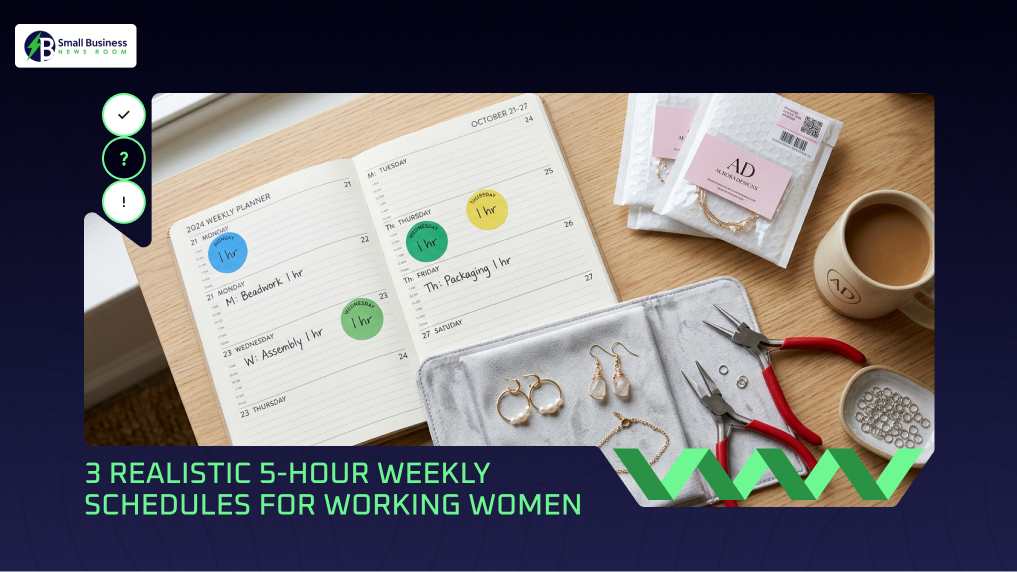
Every woman has different daily habits. Consequently, a schedule that works for a single person living alone will not suit a mother juggling children’s homework and meal prep. Choose the option that best fits your lifestyle.
| Schedule Style | Weekday Plan (3 Hours) | Weekend Plan (2 Hours) | Best For |
| The Weeknight Batcher | Monday, Wednesday, Thursday: 1 hour each evening (packaging & prep) | Saturday: 2 hours in the morning (jewelry making & photos) | Women who become mentally fatigued after work and desire simple manual activities for weeknights. |
| The Early Bird | Tuesday, Wednesday, Thursday, Friday: 45 minutes before work | Sunday: 2 hours in the afternoon | Women whose evenings are frequently taken up by family, shopping and/or extra work hours. |
| The Weekend Maker | Wednesday: 1 hour (sorting supplies & printing labels) | Saturday: 2 hours + Sunday: 2 hours | Women with high-pressure main careers who need total mental relaxation from Monday to Friday. |
How To Make These Schedules Stick
First, add your schedule to your electronic diary the same way you would a crucial meeting.
Should someone wish to meet you during your Saturday morning jewelry-making slot, suggest meeting for lunch immediately afterward.
After that, set a 50-minute timer. Concentrate intensely for this duration and then spend the final 10 minutes organizing and re-organizing your tray for the next session.
Always dedicate 2 whole days to pure leisure. Because your brain needs genuine leisure time to stay creative, never work on your side-hustle every day of the week.
The “Production Math”: What 5 Hours Actually Produces
Novices often over- or underestimate their weekly output. Fully grasping your ‘Production Math’ helps you organize your inventory and stay calm when responding to last-minute orders.
Below is a typical weekly production output for someone working within 5 hours using efficient batching:
3 Hours – Jewelry Making
Assuming good preparation, 3 hours of solid jewelry-making can produce 15-20 matched earrings or 8-10 beaded or chain bracelets. Per month, this totals 60-80 items.
1.5 Hours – Packing & Labeling
Although most novices underestimate how long this process takes, in 90 minutes you can efficiently:
- Attach 20 items to cards,
- Insert anti-tarnish strips,
- Seal items in mailer bags,
- Quickly write short thank-you messages.
You can also print postal labels.
30 Minutes – Daylight Photography
Never photograph jewelry in your bedroom at night, as yellow light makes gold look dull and alters gemstone hues.
Reserve a firm 30-minute slot on a Saturday or Sunday morning near a sunny window.
In this time frame, you can effectively shoot 5-8 new jewelry items from different angles for both your web shop and social media platforms.
Match Your Tasks To Your Energy (Not Just Your Clock)
In addition to physical exhaustion, after sitting at a desk or attending meetings for 8 hours, you will also experience decision fatigue.
Throughout the day, your brain has been continuously deciding upon various matters.
Attempting to independently design an entirely new range of necklaces at 8:00pm is likely to leave you stuck, staring at a pile of beads.
To succeed at With only 5 hours a week available, and use your 5 hours optimally, adapt activities to your energy levels.
Low Energy Activities (For Weeknights)
These mechanical activities can easily be carried out whilst simultaneously enjoying a podcast, audiobook, or relaxing program:
- Opening and closing jump rings.
- Attaching clasps and extension chains.
- Unknotting chains and separating beads into sections.
- Imprinting logos onto cotton mailers and/or folding mailboxes.
- Placing earrings onto cards.
High Energy Activities (For Weekend Mornings)
Reserve highly intellectual and imaginative work for Saturday and/or Sunday mornings when your mind is refreshed:
- Designing new jewelry and experimenting with color schemes.
- Investigating current jewelry trends, for example, 3D gold ‘hoops’, multi-metal layered chains, freshwater pearl and personalized birthstone jewelry, so that your jewelry remains contemporary and desirable.
- Analyzing the monetary costs of your jewelry components, postal charges, and retail prices to ensure that each sale provides a genuine profit.
- Producing detailed jewelry descriptions and planning social media content for the coming week.
Protect Your Time With Smart Sourcing
As mentioned above, within a 5-hour-per-week timeframe, a single problem with your jewelry suppliers (for example, acquiring discolored chains or experiencing a 3 week delay in the arrival of clasps) can effectively halt production for half a month.
Conduct A Fast Jewelry Supplier Evaluation
Before committing to any wholesaler or online jewelry supplier, perform a basic jewelry supplier evaluation.
No complex business paperwork is needed. Simply check for these 4 factors prior to placing large orders:
Honesty about jewelry materials: Does the supplier clearly state what type of metal is used (for instance, brass, stainless steel, gold-plated, or 14k gold-filled)?
Customers will lose confidence in your brand if jewelry begins to turn green after only 2 uses.
Consistency of stock availability: Is the jewelry consistently in stock throughout the year, or is it only available in limited special offers that can’t be reordered?
Delivery speed: How long does it take for goods to reach your location? Always order essential jewelry components at least 2 weeks before you anticipate running out of stock.
Alternative suppliers: Maintain at least 2 reliable alternative sources for your most commonly used jewelry components (such as jump rings, ear hooks, and chains) so delays at one supplier don’t halt your business.
‘Outsourcing’ Your Time
Without employing extra personnel, you can effectively ‘outsource’ your time by selecting more astute jewelry components:
Purchase pre-sectioned chains with clasps already attached. Instead of manually measuring and slicing a 10m length of chain into 18-inch necklace lengths.
This can take 40 minutes. You can also obtain chains that have already been sectioned, and clasps added.
Acquire ready-perforated jewelry cards. Manually perforating thick card is not only painful for fingers but is also highly time-consuming. Get personalized cards with holes already cut for earrings and necklaces.
Use jump ring openers. This inexpensive ($3) brass ring effortlessly opens jump rings, protecting your nails. It also enables you to open and close rings twice as quickly.
How To Set Up A “Zero-Cleanup” Workspace
If you don’t have an extra room, you can easily work at a dining table or your bedroom desk.
Unfortunately, within a restricted 45-60 minute window on a weekday evening, 10 minutes for unpacking and another 10 minutes for cleaning can take up a third of that time, which can eventually reduce productivity.
Thus, you can implement these 3 methods to begin working within 30 seconds:
- Stackable Trays
First, you need to place your current work in stackable jewelry or craft trays. You can then easily insert these into a dresser drawer or beneath a bed.
If you need to interrupt jewelry making (for example, when forming a bracelet), you can simply move the tray out of the way so small beads don’t scatter across the floor.
- Sunday ‘Grab Bags’
On Sunday afternoons, spend 15 minutes portioning out the correct quantity of beads, charms, jump rings and clasps for 10 items.
Insert these into small reusable zip-bags. On Tuesday nights, you can immediately retrieve a ‘Grab Bag’ and start making jewelry without rummaging through storage.
- Pocket-Size Tool Pack
After that, consolidate your 3 jewelry tools, plus a ruler and flush cutters, into a small zip-pocket.
Keep this next to your work tray so you don’t waste time searching for tools around your home.
The “2-Week Buffer” Rule For Stress-Free Months
Unforeseen events will always occur. Occasionally, your main career may present you with a huge deadline to meet.
You could fall ill and/or your weekends may be fully occupied by family commitments.
If your jewelry production is your only way to meet orders, these events will cause stress and prompt you to apologize to clients.
To avoid this, implement a ‘2-Week Stock’ policy:
- First, identify your top 3-5 enduring jewelry designs (basic yet popular items).
- Second, you need to prepare 10-15 of these items in advance, before photographing, carding, and storing them in a labeled ‘Stock For Dispatch’ box.
- During a hectic period in your main career, all you need to do is place one prepared jewelry item into a mailer, add a label, and deposit it in your letterbox. You can do all of this in under 5 minutes.
Frequently Asked Questions (FAQ)
Here are the answers that can help you to solve your queries before you make any decision:
Regard your 5 hours as non-negotiable. Separate low-intensity work (such as packing) from high-intensity work (such as design).
This can ensure you have at least 2 evenings a week totally free from both career and side-hustle activity.
Yes. If you produce 15-20 items per week, that’s 60-80 items per month.
Even with a modest net profit of $12-$15 per item (after subtracting component costs), you can increase your income by $720-$1,200 per month by selling your monthly stock as you develop your brand.
Multitasking. Trying to design, make, and photograph jewelry within the same 60-minute period wastes considerable time organizing and switching between activities. Always concentrate on one task at a time.
With only 5 hours a week available, when starting jewelry making as a side hustle, it is better to begin on an existing handmade or social commerce marketplace, since consumers are already shopping on these sites.
Building and maintaining your own bespoke website takes many hours of technical work, which would be better invested in refining your jewelry designs and securing your first 50 satisfied clients.