Table Of Contents
Double Declining Balance Method: A Comprehensive Guide For Small Businesses
Last Updated on: August 19th, 2026
Quick Summary: The Double Declining Balance Method is an accelerated accounting strategy used to calculate asset depreciation.
Businesses can accurately track the value of rapidly depreciating equipment like vehicles, computers, and specialized manufacturing machinery by front-loading depreciation expenses in the early years of an asset’s life.
Calculating the long-term maintenance expenses after purchase is essential for estimating future costs.
If the costs are high, purchasing that asset for the long run might not be a profitable choice.
Therefore, for making business decisions related to assets, understanding the Double Declining Balance Method is crucial.
This calculation is essential for assets that depreciate rapidly, especially in the early years. These assets start depreciating slowly later on.
Therefore, to calculate the depreciation of such assets, you must use this calculation. Read this post till the end to learn how to do so.
Double Declining Balance Method At A Glance
| Key Metric | Definition / Calculation Rule |
| Best Used For | Fast-depreciating assets (computers, vehicles, tech hardware) |
| The Core Formula | Beginning Book Value × (Straight-Line Rate × 2) |
| Major Constraint | Cannot depreciate an asset below its estimated Salvage Value floor |
| Tax vs. Books | Used for financial reporting; IRS requires MACRS for US taxes |
What Does The Double Declining Balance Method Mean?
The double declining balance method, also known as the reducing balance method, is used by modern businesses to calculate asset depreciation.
This technique for calculating depreciation is known as accelerated depreciation since it calculates costs much faster than other methods.
If you are an entrepreneur, you must learn how to calculate an asset’s accumulated depreciation over time.
It’s essential to do so because all your machinery and equipment have an expected production lifetime.
As it depreciates from wear and tear each year, its production capacity also decreases.
Therefore, it’s essential for you to know these values for calculating your business’s net operating income.
Various Declining Balance Methods
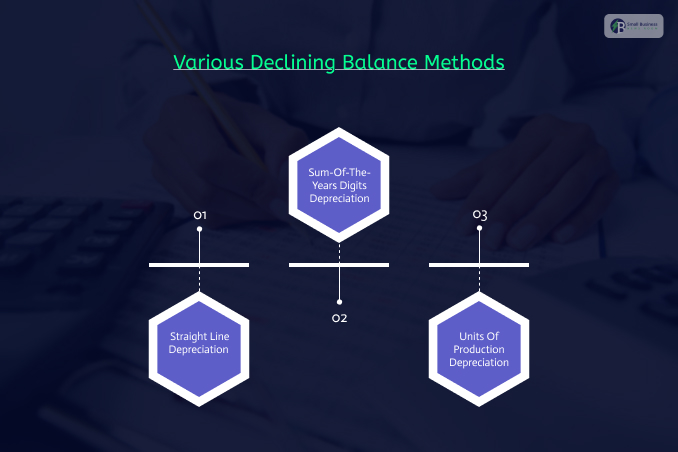
There are various depreciation methods, in addition to the double-declining-balance method, that businesses use to calculate asset depreciation.
The other methods that businesses often use are:
1. Straight Line Depreciation
This method helps calculate asset depreciation based on its initial purchase price.
This calculator is based on the salvage value of the asset – the value of the asset over its useful period.
Here’s the formula for calculating straight-line depreciation or annual depreciation:
Annual Depreciation = Total Depreciation Amount (Purchase Price – Salvage Value) / Estimated Asset Lifetime
2. Sum-Of-The-Years Digits Depreciation
Whenever you buy a new asset for your business, it’s typically estimated to be useful for five years.
Therefore, when you calculate the sum-of-the-years depreciation, you use the number of valuable years left in the asset’s useful life. You calculate this by:
Depreciation Balance = (Valuable Years Left / Annual Value) x Asset’s Remaining Depreciable Value
3. Units Of Production Depreciation
If you purchased new machinery for your business, depreciation is calculated based on its useful life and expected production.
First, calculate the expected production of a new machine by multiplying its per-unit depreciation by the total units produced.
In addition, a portion of the total depreciation is fixed for each item produced on this specific machine. This is similar to calculating marginal analysis.
The Correct Double Declining Balance Formula
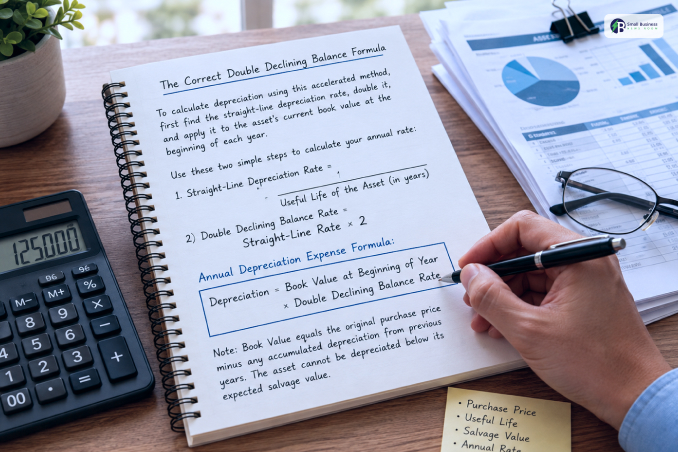
To calculate depreciation using this accelerated method, first find the straight-line depreciation rate, double it, and apply it to the asset’s current book value at the beginning of each year.
Use these two simple steps to calculate your annual rate:
- Straight-Line Depreciation Rate = (1 / Useful Life of the Asset (in years))
- Double Declining Balance Rate = Straight-Line Rate × 2
Annual Depreciation Expense Formula:
(Depreciation = Book Value at Beginning of Year X Double Declining Balance Rate)
Note: Book Value equals the original purchase price minus any accumulated depreciation from previous years. The asset cannot be depreciated below its expected salvage value.
Step-By-Step Practical Calculation Example
Let’s assume your business purchases a high-speed packaging machine with the following financial metrics:
- Initial Cost: ₹50,000
- Estimated Useful Life: 5 Years
- Salvage Value: ₹5,000
Based on a 5-year useful life, your straight-line depreciation rate is 20% (1/5). Therefore, your Double Declining Balance Rate is 40% (20% × 2).
Here is how the depreciation schedule looks over its lifecycle:
| Year | Beginning Book Value | Depreciation Rate | Depreciation Expense | Accumulated Depreciation | Ending Book Value |
| Year 1 | ₹50,000 | 40% | ₹20,000 | ₹20,000 | ₹30,000 |
| Year 2 | ₹30,000 | 40% | ₹12,000 | ₹32,000 | ₹18,000 |
| Year 3 | ₹18,000 | 40% | ₹7,200 | ₹39,200 | ₹10,800 |
| Year 4 | ₹10,800 | 40% | ₹4,320 | ₹43,520 | ₹6,480 |
| Year 5 | ₹6,480 | Special Adjustment | ₹1,480* | ₹45,000 | ₹5,000 |
Crucial Accounting Rule: In Year 5, multiplying ₹6,480 by 40% would give ₹2,592, pushing the final book value down to ₹3,888.
Because an asset cannot drop below its salvage value (₹5,000), the final year’s expense is manually adjusted to exactly ₹1,480 (Beginning Book Value of ₹6,480 minus Salvage Value of ₹5,000).
Double Declining Balance Method Calculation
Since the double declining balance method calculates depreciation at twice the rate of depreciation, it’s best used for quickly-depreciating assets.
Since it’s not easy to calculate this depreciation value, it’s best done using various accounting software for businesses.
It’s recommended to do so, as it’s easier to track the depreciation value manually.
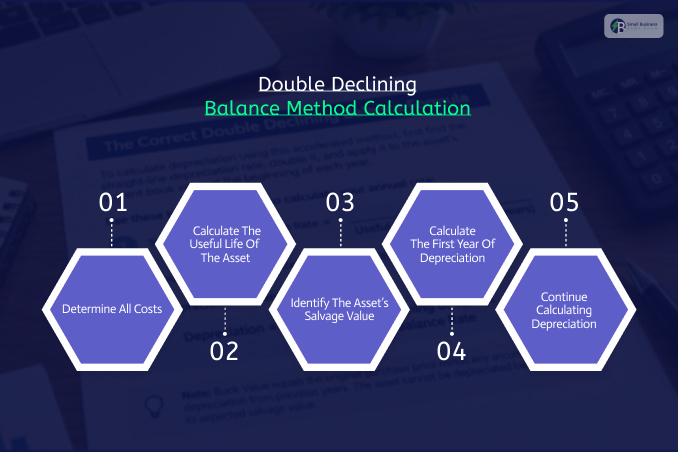
However, if you wish to calculate depreciation value using this method, here’s what you need to do:
1. Determine All Costs
Your first step here is to calculate all expenses associated with the purchase of the asset. This includes various types of costs like:
- Purchasing cost
- Legal charges
- Broker fees
- Closing costs
2. Calculate The Useful Life Of The Asset
Every asset that you buy for your business, especially machinery and other operational equipment, will have a fixed lifespan.
Therefore, it will start to wear down and depreciate over time.
While it’s difficult to calculate how long an asset will last due to production changes, there are some standard values. These set values are considered the lifetime value of an asset, which is suggested by the IRS (Internal Revenue Service).
If you wish to have a look at this list, simply click on this link.
3. Identify The Asset’s Salvage Value
Your next step in calculating the double-declining-balance method is to determine the salvage value of your assets.
This salvage value is defined as the selling value of an asset at the end of its useful life.
Therefore, if you wish to sell the asset after using it for its useful life, this is the price you will receive.
The salvage value of an asset also follows a standard rule, which is again determined by the IRS. Click this link to learn more about it.
4. Calculate The First Year Of Depreciation
Now that you have learned the values above, it’s time to use the double-declining depreciation formula. All you need to do is calculate the depreciation for the first year.
5. Continue Calculating Depreciation
Now, all you need to do is follow the double declining balance method to calculate the depreciation and final value of an asset over the years.
You will do so as long as it reaches its final valuable year and equals the salvage value.
Tax Implications And Hidden Rules To Consider
Before choosing the double declining balance method for your corporate accounting logs, keep these core rules in mind:
- IRS Tax Compliance
The IRS generally does not allow standard double-declining calculations for tax filing.
Instead, US businesses must use the Modified Accelerated Cost Recovery System IRS MACRS Guidelines, which use specific predetermined recovery percentages based on property class.
- Mid-Year Purchases
If your business acquires an asset in the middle of a fiscal year rather than on January 1st, you must prorate the first year’s depreciation expense based on the exact number of months it was in service.
Disadvantages: When Is This Method The Wrong Choice?
While accelerated depreciation offers excellent upfront tax deductions and accurately matches real-world asset wear for complex machinery, it is not ideal for every scenario:
- Inconsistent Financial Reporting
It causes your net income to appear artificially low in the early years of an asset’s life and significantly higher in later years, which can confuse potential investors or lenders.
- Predictable, Long-Term Assets
For assets that lose value evenly over time, such as structural buildings, office furniture, or basic facility improvements.
o, using this method is inaccurate and overly complicated. Stick to Straight-Line Depreciation for these specific items instead.
Conclusion: Learn How Much To Salvage After How Many Years!
Understanding the double-declining-balance method for depreciating assets is essential for determining how much an asset’s value depreciates.
Every asset, like machinery you purchase for your business, has a fixed, valuable life, or useful life, during which its productivity is at its peak.
At the end of its useful life, you can sell it off at a price. However, you can calculate its salvage price before it by calculating its depreciation each year using the double-declining-balance method. If you have any queries, you can comment below, and I will reach out to you soon!