Verify what they offer and whether they respect their workers before you choose a factory or manufacturer.
A jewelry supplier risk assessment helps you evaluate whether the manufacturer uses genuine metals, protects your designs, and meets delivery deadlines.
You just have to choose a reliable supplier. This helps you avoid brand-image disasters.
If you work 9-to-5 and want to start your own jewelry shop on the side, your budget and time are likely very limited.
A single wrong supplier can drain your savings and leave you with nothing to sell. You don’t need a business degree or a large team to vet a factory.
All you need is a well-structured checklist to uncover red flags before you send your first payment.
Why Supplier Checks Matter When Starting On A Budget
Starting a business from home means you can’t afford to make any mistakes. Usually, new entrepreneurs choose a vendor because of extremely low prices.
However, this may not be the case. You may run into hidden costs.
A poor supplier may dilute your gold, copy your design and sell to large businesses, or may ghost you close to the festival period.
Furthermore, doing a risk check with a supplier helps protect your investment when starting your business. Even though this costs a little, it could save you hundreds in potential disasters.
5 Main Risk Areas In Jewelry Manufacturing
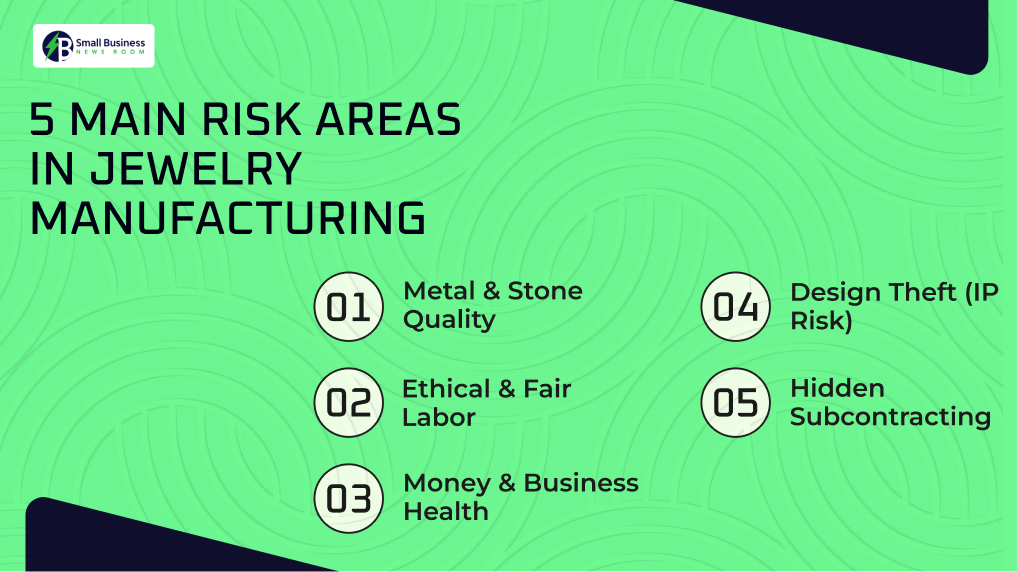
Complete a risk check on these 5 key areas of the manufacturing process. The table below outlines the risks in these areas and how to check them from your device.
| Risk Area | What Could Go Wrong | How You Can Check It |
| Metal & Stone Quality | Poor quality materials. For example: fake gold purity, cheap plating that wears quickly, and mixed lab-created gemstones and natural diamonds. | Request XRF tests and official government hallmarking. |
| Ethical & Fair Labor | Unethical working conditions, child labor, or conflict minerals that damage brand reputation. | Ensure they have valid RJC or Kimberley Process certifications. |
| Money & Business Health | The factory runs out of money during production, delaying delivery of your product. | Don’t pay 100% upfront. Instead, order a small trial batch. |
| Design Theft (IP Risk) | Factory may copy your custom design CAD files and sell them to other customers. | Request a signature on an NNN (Non-Use, Non-Disclosure, Non-Circumvention) agreement before providing CAD files. |
| Hidden Subcontracting | Vendor may subcontract setting gemstones/plating to unverified home units. | Request a real-time video tour of all departments within the unit. |
How To Do A Jewelry Supplier Risk Assessment: 5 Easy Steps
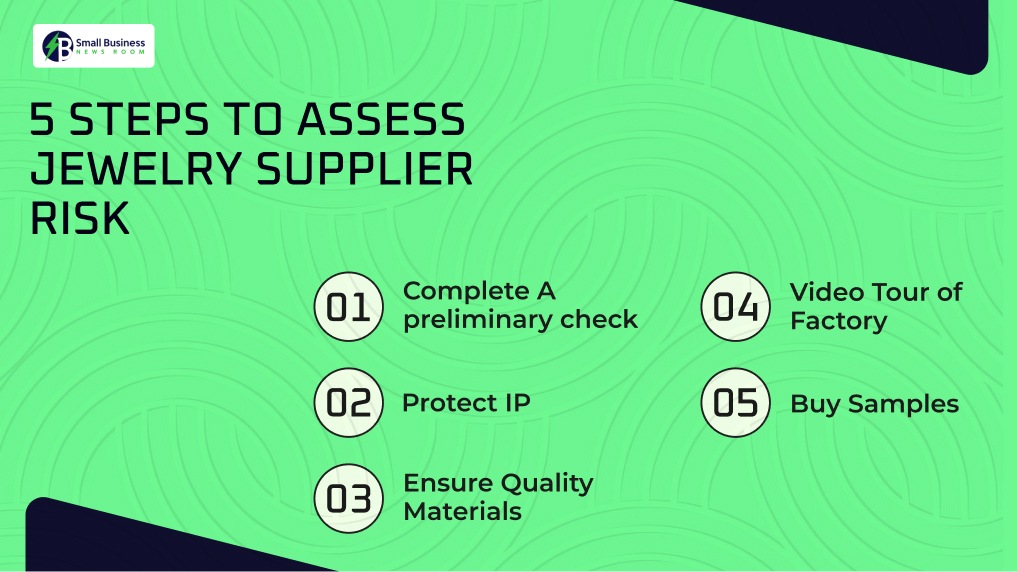
Complete the following 5 steps to complete a risk assessment on shortlisted manufacturers.
1. Complete A Preliminary Check
When you have a few spare minutes (such as at lunch or in the evening), ask for proof of official company registration, a tax identification number, and an export license.
Additionally, perform a Google search using the company name plus negative keywords (such as scam, lawsuit, delay).
If other businesses post about these issues on social media, gather more information to decide whether to work with this supplier.
2. Protect IP
Do not allow a factory to view your custom drawing / 3D CAD file until you are given a quote.
Send them a rough sketch or image as a reference to give you an idea of how much it costs.
If you decide to proceed with working with this supplier, request a very detailed NNN agreement.
In comparison to a standard NDA, this means that the factory not only cannot copy your design, but also that they can’t share it or sell it directly to your customers.
3. Ensure Quality Materials
Don’t trust a supplier if they say your item is 100% gold or 925 Sterling Silver. Ask if they have an XRF machine (a scanner that can accurately determine purity without damaging the jewelry).
If they have very small diamonds (melee diamonds), which are cheaper, ask how they verify that the diamond is natural and not man-made.
4. Video Tour Of Factory
If you can’t visit the factory in person, ask for a timed video tour (for example, 15 minutes on Zoom or WhatsApp).
In that video, ask them to tour you around the foundry, gem mounting station, polishing section, and electroplating.
Observe light levels, cleanliness, and the type of PPE workers wear.
If they refuse to provide a live video tour, or offer an excuse, we suggest reaching out to other suppliers.
5. Buy Samples
Order 2-3 samples. Once received, wear the items daily for 2 weeks. Take them to a local jeweler or assay center in your town to test metal purity and plating thickness.
This small test will cost only a few thousand rupees (or less than 100$). However, it can save you much more money in the future.
Hidden Red Flags Most New Founders Miss
Within the jewelry industry, some manufacturers may see you as an easy way to make extra profits. They may take advantage of less knowledgeable people and manipulate orders.
Moreover, be careful to avoid falling for any of the following red flags at less trustworthy factories:
Inconsistent Gold Purity
As gold prices change daily, some poorly funded factories may reduce the ring size below what was agreed to to save money if prices spike suddenly.
To avoid this, get written confirmation of the weight and gold price for each item.
“One-Stop Shop” Scam
Many trading companies may claim they can manufacture. However, they may take your order, add a 30% margin, and forward production to small local workshops.
Always double-check that the factory name on the building matches the name on the invoice.
Chemical Safety
Lead, Nickel and Cadmium are commonly found in jewelry items. However, they are toxic and therefore should be avoided completely.
If you intend to sell your jewelry to the US, UK, or European markets, it must be free of harmful chemicals, including lead, nickel, and cadmium, according to applicable standards.
Check with your supplier to ensure their alloys meet these chemical safety standards (REACH or CPSIA) to prevent your package from being seized at customs.
Simple 100-Point Supplier Scorecard
Complete this simple scorecard to compare 2 or 3 suppliers. Score each supplier out of 5 (5=Excellent, 1=Very Poor) for each category, then multiply by the weight.
| Check Area | Weight | What a Good Score (4–5) Looks Like | Red Flag / Auto-Fail (1–2) |
| Metal & Quality Proof | 30% | Supplier has in-house XRF and agrees to third-party testing. | Supplier refuses to allow third-party testing/hallmarking. |
| Honest Communication | 25% | Supplier can answer technical questions clearly and agrees to video tour. | Supplier pressures you to pay quickly without being able to answer simple questions. |
| Design Protection | 20% | Supplier is happy to sign NNN agreement before viewing CAD files. | Supplier has other people’s branded pieces in their display. |
| Payment Terms | 15% | Supplier accepts a 30-50% deposit, and the remaining payment after inspection. | Supplier wants 100% upfront payment. |
| Low Minimums (MOQ) | 10% | Supplier offers small MOQs appropriate for new brands. | The supplier is forcing you to purchase large amounts of stock that you cannot afford. |
How to read your score:
80-100: Safe to order samples.
60-79: Be cautious. Consider improving weaknesses in your contract.
Below 60: Move on and seek alternative suppliers.
No Spreadsheets Needed! Get this Scorecard ready with formulas to calculate scores in seconds. Download the Instant Supplier Scorecard Here.
5 Questions That You Need To Ask Before Sending Any Money!
If you are unsure what to ask suppliers, here is a great starting point. Before paying any money, ensure that you have written confirmation from the supplier to the following questions:
- Is everything made in-house? Or is any part subcontracted?
- Are you able to protect our design (3D CAD) and not sell it?
- Will you sign a standard NNN (Non-Disclosure, Non-Copying, Non-Sharing) Agreement before receiving our design files?
- Please describe how you measure gold and silver purity in your products. Also, can we have our order tested by a neutral 3rd party?
- What processes are in place if there are issues with a batch of goods (loose stones, incorrect plating, incorrect purity)?
- We are launching a small range. What is the minimum number of pieces that we can order from you for 1 new design?
It can be difficult to understand what kind of relationship with this supplier would look like for your business based only on their answers to these questions.
Want a script for an email and a clause in your contract? Copy our tried and tested message and clause from our templates. Download the Free Founder Outreach & Contract Templates Here.
Frequently Asked Questions (FAQs)
Ordering 2-3 custom samples will cost approximately ₹4,000 to ₹20,000 ($50-$250) depending on the material chosen (brass, silver, or gold).
However, consider this learning money, and don’t expect to make any profit from it.
Never pay 100% of your order directly into an unknown supplier’s bank account. Instead, pay 30-50% to start production.
Once you have clear pictures, videos, or a 3rd-party inspection report of your items, you can pay the remaining amount.
Yes! Many jewelry manufacturers working with startups offer very low MOQs (from 10-30 pieces per design). Instead of creating 50 designs for your first collection, focus on a few pieces.
Choose one random piece from your delivery, and send it to a BIS-approved assay center in your area.
Or ask a reliable jeweler to perform an XRF test on it for you. This test can be completed in just a few minutes and will tell you exactly how much pure gold/silver is in your product.
Final Thoughts For Side-Hustle Founders
Creating a jewelry brand alongside a 9-5 takes patience and careful planning. Whilst you may be excited to get started, don’t rush to work with the first manufacturer to reply.
Take your time to complete this supplier risk assessment, ask challenging questions, and sample items.
By finding the correct partner to work with from the start, you can dedicate more energy to creating beautiful designs and growing your brand.