Your lunch break is holy ground. During a busy 9-to-5 day, it’s impossible to find the extra hours you need to build your exit strategy.
Between meeting after meeting, overflowing inboxes, and endless spreadsheets, you simply won’t have 4 hours a night to flick through fashion magazines or lengthy 100-page corporate retail reports.
If you’re trying to build jewelry making as a side hustle, it’s easy to run out of savings quickly by guessing what your customers want.
Buying beads, chains, and wholesale stock just because you like them can leave you with items sitting in your spare bedroom.
The great news is you don’t need to spend a small fortune on market research or have a marketing degree.
By using your lunch break, you can identify profitable trends in the jewelry industry.
Here is your step-by-step guide to finding the winning styles, beating the big brands, and keeping your money safe.
Quick Summary: How To Spot Winning Jewelry Trends In 30 Minutes
- Minutes 0–10 (Verify Buyer Demand): Filter Etsy and eBay by “Sold Items” to see what shoppers are actively paying for rather than just browsing.
- Minutes 10–20 (Track Competitor Ad Spend): Search mid-tier jewelry brands in the Meta Ad Library and filter for ads running longer than 30 days, as brands only fund styles that convert.
- Minutes 20–30 (Check Search Momentum): Validate specific micro-niche keywords in Google Trends and Pinterest Predicts to confirm steady growth before buying inventory.
- Analyze 3-Star Reviews: Read 3-star product reviews on top listings to uncover common flaws like tarnishing or weak clasps that your brand can fix.
- Spot Adjacent Luxury Signals: Watch handbag hardware, nail art, and apparel silhouettes to catch upcoming jewelry industry trends three to six months early.
Why Most Corporate Side Hustlers Fail At Jewelry Market Research

Let’s cut through some misleading information. Most mainstream guides recommend looking to Instagram or Pinterest for design inspiration. Unfortunately, this can be a trap!
The Danger Of “Vanity Metrics”
Social Media is driven by engagement over purchase. For example, a video of an oversized, heavy brass cuff being worn on TikTok might get 2 million views because of the entertaining background music.
However, this does not mean any women will rush out to buy it! This means that when you chase likes and views, you’ll end up chasing trends that go viral but don’t last.
The High Cost Of Guessing Inventory
According to data from the U.S. Small Business Administration (SBA) , poor market demand is one of the leading reasons new small businesses fail within their first year.
If you are funding your brand from your company salary, then every penny will count!
By making research a quick daily task, you can be sure every item you create or source has people willing to buy it!
The 30-Minute Lunch Break Trend-Hunting Routine

Turn your phone to Do Not Disturb mode. Open up 3 browser tabs. Set your timer to 30 minutes. Do this 3-4x per week during your lunch break.
0-10 mins – Marketplace “Sold” Mining (Follow the Money)
Never look at what sellers are selling. Look at what purchasers are buying. Marketplaces give you free access to real sales data.
Etsy
Search Etsy for a general keyword (e.g., dainty gold necklace, chunky silver ring).
On the search results page, look for listings with Bestseller badges or In 20+ carts underneath the listing title. Click into 5 of these listings.
eBay
Go to eBay and search a specific jewelry type. Scroll down the left-hand side of the search results page and select the Sold Items checkbox (a core feature highlighted in the eBay Seller Center research tools).
This shows you exactly what has sold, when it was purchased, and the price it was purchased for.
Note down: Never copy other people’s art. Just look for patterns. Are people purchasing 14k gold-filled chains for $45 and not purchasing cheaper brass chains for $15? Are oval stones in an east-west cut selling faster than round stones? Note down any specifics.
10-20 mins – Competitor Ad + SKU Tracking (Follow the Ad Spend)
Small and medium online jewelry brands spend thousands of dollars to test their designs to see which will sell. You can legally spy on their findings for free!
- Meta Ad Library
Go to the Meta Ad Library and select your country. Choose All Ads in the ad category and type in 3–5 successful boutique jewelry brand names.
- Filter by 30+ Days Running
Look at the launch date of each ad card. Scroll past any ads that have launched yesterday. Only look at ads that have been running for 30 days or more.
- Spot the profitable hero products.
E-commerce has very little margin. A clever business owner will never pay Meta daily for 2 months to advertise a necklace that no one is purchasing.
If an ad has been running for 6 weeks, then that specific jewelry item is a winner! Note down what color metal they’re using, what type of clasp, packaging, and what wording they’re using.
20-30 mins – Micro Niche Search (Confirm the Wave)
Now you’ve identified a few styles to go with, spend your last 10 minutes confirming that it’s trending, hitting its peak, or declining.
- Google Trends
Go to Google Trends and select Past 12 months or Past 5 years. Don’t use generic terms like “earrings.”
Compare specific micro-niche keywords (e.g., Mixed metal bracelet vs. Rose gold bracelet) and look for a consistent upward curve.
- Pinterest Predicts + Pinterest Trends
Pinterest users plan their purchases months in advance. Go to Pinterest Trends and type in your keyword.
If the search volume is increasing consistently before the upcoming season, you’ve found a reliable wave to ride!
Save Hours of Setup Time: Struggling to keep your research organized across messy sticky notes? Grab our Lunch Break Trend Tracker & Margin Calculator Notion Template ($14)—designed specifically for busy corporate side hustlers to log winning styles, calculate real material costs, and score product ideas in under five minutes.
4 Under-Reported Jewelry Industry Trends You Should Watch Right Now
Most generic content will tell you the trendiness of lab-grown diamonds or sustainability.
However, if you’re looking for high-margin jewelry design ideas that stand out from the crowd, then take a look at these 4 changes!
1. Sub $200 Lab Grown Diamond + Human Element
Firstly, lab-grown diamonds and moissanite have gotten so cheap that everyone can easily get a basic solitaire pendant under $200.
People are looking for products that look unique, old, and handcrafted because everything can be made to look perfect for a low price.
Look out for: Natural textures, hammered, raw metal, and vintage mounting options such as bezel mount or old mine.
Use this by: Showcasing hand-finished elements in your imagery.
2. Lower Karat Gold
Secondly, with gold prices being at an all-time high globally, it’s been difficult to justify 18k or 22k solid gold pieces. People also don’t want to wear cheap brass jewelry that will turn their skin green after 2 wears.
Look out for: High-quality 14k gold-filled wire, gold vermeil (heavy gold coating over sterling silver), and delicate 9k or 10k solid gold pieces.
Use this by: Educating your customers on why they should wear gold-filled or vermeil jewelry. This means they’ll have many years of tarnish-free wear without paying the premium price of a luxury boutique.
3. Easy to Wear Clasps + Sensory Friendly
Now, more people are looking for jewelry that is comfortable to wear. With long acrylic nails, hectic mornings, and sensory issues, wearing small clasps can be frustrating.
Look out for: Front toggle clasps, large lobster clasps, magnet clasps, and sliding chain.
Use this by: Having the clasp as a bold design element on the front of your necklaces.
4. Mixing Metals
Also, women are becoming more relaxed about mixing silver and gold. They just want a one-off piece that they can easily pair with their silver smartwatch and gold wedding band as they’re busy professionals.
Look out for: Silver chains with gold charms, braided bi-color hoops and tri-color stack rings.
Use this by: Promoting your mixed-metal pieces as an ultimate capsule wardrobe for working ladies.
How To Turn Market Research Into a Profitable Product Line
Collecting trend data is only half the battle. Next, filter your findings through a strict business lens so you don’t waste money or time.
Use The “Signal vs. Noise” Decision Matrix
Before you spend a single dollar on supplies, compare your trend idea against this simple table. Only move forward if your idea falls into the High-Confidence Signal column.
| Research Channel | High-Confidence Signal (Invest & Test) | Vanity Noise (Skip Immediately) |
| Social Media | High saves-to-likes ratio and comments asking “Where can I buy this?” | Millions of views driven by a trending dance or joke with zero product questions. |
| Meta Ad Library | Multiple boutique brands running ads for similar styles for 30+ days. | A single viral post from a celebrity stylist with no paid ad backing. |
| Marketplaces | Rising search volume paired with low review counts on top listings (high demand, low competition). | Massive search volume flooded by thousands of identical $5 listings. |
| Customer Reviews | Consistent complaints about durability or fit that you can easily solve. | Complaints focused purely on slow postal delivery times. |
Mine 3-Star Reviews For Instant Product Differentiation
One of the best ways to find winning design ideas is to look at the 3-star reviews section on Amazon, Etsy, and other big retail sites.
Moreover, 5-star reviews often won’t help because they’re too biased, and 1-star reviews are usually just someone ranting about delivery problems.
So, 3-star reviews are the best! These are fair customers who really liked the style. However, they noticed some issues. Look out for comments such as:
Look for phrases like:
- “Beautiful necklace, but the chain tangles every time I layer it.” (Opportunity: Create pre-layered necklaces with 1 clasp.)
- “Love the earrings, though they feel too heavy after four hours at work.” (Opportunity: Create lightweight or hollow designs so they can be worn all day at work).
- “Tarnished after two showers.” (Opportunity: Switch to waterproof PVD-coated stainless steel or 14k gold-filled.)
Early Clues From Adjacent Luxury
Most jewelry trends don’t come from jewelry stores. They’re usually around 3-6 months behind the latest handbag, shoe, and nail art trends.
So take a look at the newest items from mid-luxury handbag brands such as Coach, Polène, or Tory Burch during your lunch break.
Take note of the hardware they are using on their straps and buckles. Is it brushed brass, chunky silver chains, or shaped knots?
Whatever hardware they are using on trending handbags this season will most likely be the biggest jewelry trend next season.
Protecting Your Time, Budget, And Supply Chain
Once you identify a winning trend, your corporate mindset becomes your biggest superpower. Furthermore, treat your side hustle like a lean startup rather than an expensive hobby.
Conduct A Quick Jewelry Supplier Risk Assessment
Before ordering bulk charms, chains, or gemstones, run a basic Jewelry Supplier Risk Assessment. Never rely on a single vendor for your best-selling components.
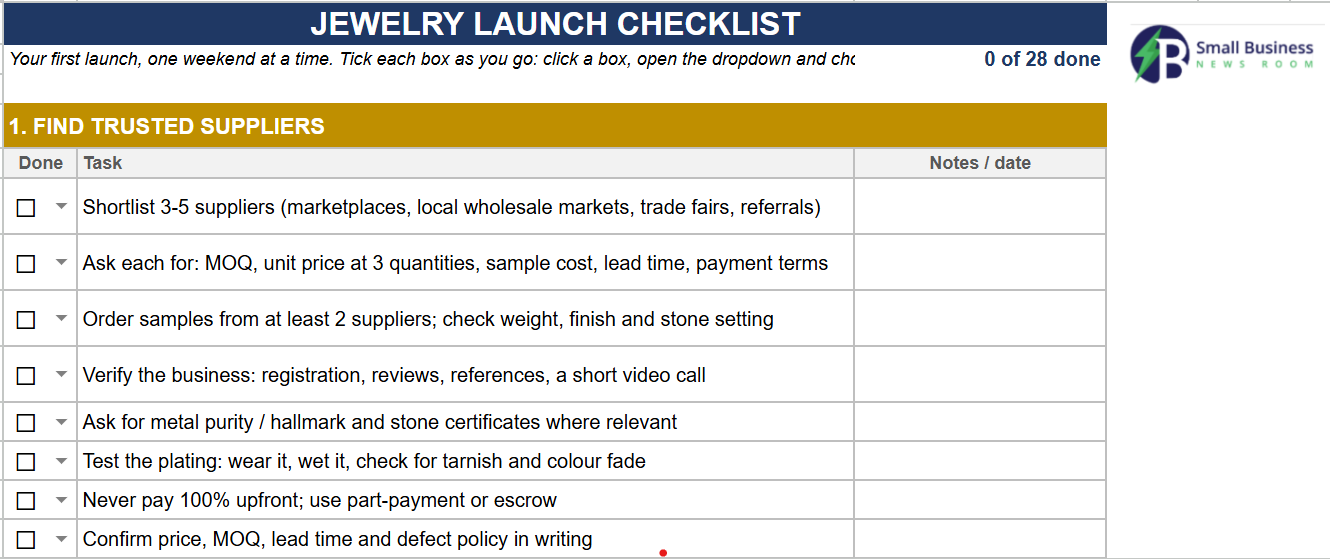
- Order sample kits first: Always test metal plating, clasp strength, and stone clarity yourself before placing a larger order. Wear the sample piece in the shower and during workouts for two weeks to verify durability.
- Verify lead times and restock speed: Secondly, ask suppliers how quickly they can ship repeat orders if a product sells out.
- Check minimum order quantities (MOQs): Lastly, stick with suppliers that have low MOQs while you test new trends so your cash stays flexible.
Build A Lean Setup Around Your 9-to-5 Schedule
Start with just the essentials. You won’t need an entire silversmith studio!
Have a few basic tools such as flush cutters, chain-nose pliers, round-nose pliers, a bead mat, and digital calipers to fit within 1 storage box that you can store beneath your bed.
First, create a basic 1-page jewelry business plan. This will help you track your research, calculations, and ideal customer.
Having numbers will help you avoid spending money on a whim when you’re tired after a long day at work.
You must always keep it simple. Brainstorm some business names. Make sure they allow you to grow your brand.
Don’t get stuck with a name like Sarah’s Beaded Anklets. Maybe after doing some research during your lunch break, you realize that your real money maker is simple gold rings!
Also, pick a timeless name that is easy to remember. It should reflect the style of your ideal customer.
Want to take your research and create your first launch without feeling overwhelmed? Our free 9-to-5 Exit jewelry launch checklist includes everything you need to know.
Realistic Time And Budget Expectations
Let us stay grounded in reality. Inspiring Side-Hustle Success Stories often skip the quiet, disciplined months that happen behind the scenes.
Building a profitable jewelry brand while holding down a full-time corporate job takes steady consistency, not overnight miracles.
Your Weekly Time Commitment (5 to 7 Hours Total)
- Monday–Thursday Lunch Breaks (2 Hours Total): Spend 30 minutes tracking sold listings, checking the Meta Ad Library, and logging notes.
- Saturday Morning (3 Hours): Batch-produce 10 to 15 pieces of your top validated design, photograph them near a sunny window, and write clear, benefit-driven product descriptions.
- Sunday Evening (1 Hour): Pack weekend orders, restock low supplies, and schedule three social media posts for the week ahead.
Realistic Startup Costs ($150 – $400)
- Basic Tools & Storage: $40 – $75
- Initial Sample Materials (for 10–15 test pieces): $80 – $150
- Packaging & Shipping Supplies: $30 – $60
- Marketplace Listing Fees / Basic Storefront: $0 – $40
You just need to test small batches of 10 to 15 pieces validated through your lunch break routine. This way, you eliminate the fear of losing thousands of dollars on dead inventory.
So, when a batch sells out, you reinvest the profits into your next proven design.
Final Verdict: Your Next Steps
No need to quit your job, pay a branding agency big bucks, or guess what people want to buy.
You can identify genuine market demand in 30 minutes and build a high-margin jewelry brand through careful planning. Here are three quick steps you can complete tonight:
1. Create A Research Spreadsheet
First, you can create a new sheet in Excel or Notion. Set up 5 columns for style name, Metal Type, Average Sold Price, competing ad length, and pain point solved.
2. Create A Bookmark Folder
After that, bookmark Etsy, Meta Ad Library, and Google Trends in a folder on your laptop or phone. This way, you only have to click once to get to all of them tomorrow at noon.
3. Schedule Admin Time
Lastly, schedule 3 private 30-minute slots in your diary for Admin Break. This will help stop you getting pulled into meetings.
Moreover, every successful exit strategy begins with small and consistent habits. Furthemore, you need to protect your lunch break, trust the data, and build your freedom through designing each piece.
Sources & References
- U.S. Small Business Administration (SBA) – Office of Advocacy: Small Business Facts & Research – Official economic bulletins and small business market demand statistics.
- Meta Ad Library: Public Advertising Transparency Database – Searchable database for tracking active competitor campaigns across Facebook and Instagram.
- Google Trends: Search Interest & Demand Validation Tool – Platform for comparing micro-niche keyword momentum over time.
- Pinterest Business: Pinterest Predicts™ Annual Trend Forecast – Seasonal consumer search data and predictive shopping insights.
- Etsy Seller Handbook: Star Seller & Marketplace Performance Standards – Official marketplace guidelines on seller performance and buyer trust signals.
- eBay Seller Center: eBay Product Research & Completed Listings – Historical pricing metrics and real-world marketplace sales data.